Should a CV Have a Photo? South African Job Seekers Need to Know This
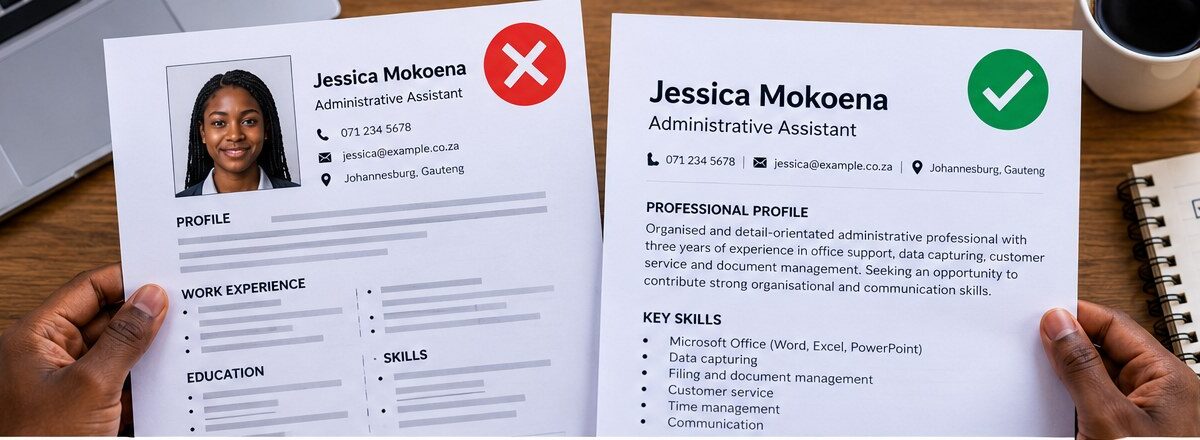
Should a CV have a photo? In most cases, no — you should not put a photo on your CV unless the employer specifically requests one or there is a clear, legitimate reason for the role to require it. For most South African job applications, your CV should focus on your qualifications, skills, work experience and achievements rather than what you look like.
This is not merely a formatting preference. Current career guidance from the University of Cape Town specifically advises applicants not to include a photograph unless the employer requests it, while Western Cape Government CV guidance says applicants do not need to include a photo unless requested. Careers Service
There is, however, some older official guidance that differs. A Department of Employment and Labour CV guide says applicants can include a photograph if they want to. That shows why South African job seekers can encounter conflicting CV advice. Labour South Africa
For a modern general-purpose CV, the safer approach is simple:
Leave the photo off unless the job advertisement specifically asks for one.
That gives you more space to show an employer what actually matters for most jobs: whether you can do the work.
This guide explains when a CV photo is unnecessary, when an employer might request one, what South African job seekers should put at the top of a CV instead, and what to do if a vacancy specifically asks for a photograph.
Table of Contents
Should a CV Have a Photo in South Africa?
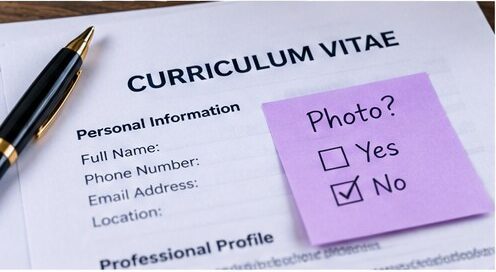
For most ordinary job applications in South Africa, your CV does not need a photo.
Your photograph is not normally necessary to demonstrate that you meet requirements such as:
- education;
- qualifications;
- work experience;
- computer skills;
- technical abilities;
- licences;
- achievements;
- relevant training;
- employment history;
- references.
South African Government guidance describes a CV as a summary of where you have worked, where you studied, and your skills and qualifications. It explains that employers use CVs when deciding whom to interview. South African Government
That is the real purpose of the document.
Your CV needs to answer:
“Why should this employer consider me for this position?”
For most jobs, your face does not help answer that question.
Quick Answer: Photo or No Photo?
| Situation | Should you include a photo? |
|---|---|
| Normal private-sector job | Usually no |
| Government vacancy | Do not add one unless the application instructions require it |
| Graduate job | Usually no |
| Internship | Usually no |
| Learnership | Usually no |
| Retail position | Usually no |
| Administrative position | Usually no |
| Warehouse position | Usually no |
| Driver position | Usually no |
| Call-centre position | Usually no |
| Professional/office position | Usually no |
| Employer specifically requests a photograph | Follow the legitimate application instructions |
| Role where appearance is genuinely part of the work and a photo is specifically requested | Follow the employer’s stated requirements |
| Job advertisement says nothing about a photograph | Usually leave it off |
The most important rule is to read the vacancy advertisement carefully.
Do not automatically add documents, photographs or personal information simply because somebody told you that “all professional CVs need them”.
They don’t.
Why You Usually Shouldn’t Put a Photo on Your CV

There are several practical reasons.
1. Your CV Should Sell Your Skills, Not Your Appearance
Imagine two candidates applying for an accounts clerk position.
Candidate A uses the top quarter of the CV for a large professional portrait.
Candidate B uses that space to show:
Accounts Clerk
- 3 years’ administrative experience
- Microsoft Excel
- Invoice processing
- Data capturing
- Customer service
- Matric
- Diploma in Financial Management
Which information tells the recruiter more about whether the applicant can perform the job?
For an accounts role, Candidate B’s information is far more useful.
The same principle applies to many positions.
If you are applying for a warehouse job, the employer may care about your relevant warehouse experience, stock handling, systems knowledge, safety awareness or licence requirements.
If you are applying for an administrative job, the employer may care about Microsoft Office, communication, filing, data capturing and previous administrative responsibilities.
If you are applying for a graduate programme, the employer may want to see your qualifications, academic background, skills and relevant activities.
Your CV space is valuable.
Use it to prove suitability.
2. A Photo Uses Space That Could Contain Better Information
Many job seekers struggle to keep their CVs concise.
UCT’s current CV guidance says CVs are typically around two pages, although applicants should always follow an employer’s instructions because requirements can differ. Careers Service
A large photograph can consume a surprising amount of that limited space.
Instead of using that space for your face, you could use it for:
- a concise professional profile;
- important qualifications;
- measurable achievements;
- relevant skills;
- licences;
- software knowledge;
- recent experience.
A recruiter already has a limited amount of information from which to decide whether to move your application forward.
Make the useful information easy to find.
3. A Photograph Can Distract From the Purpose of the CV
Your CV is not a social-media profile.
It is a professional application document.
A photograph can become one of the most visually dominant parts of a page. That means the recruiter’s eye may be drawn to your picture before your experience or qualifications.
You want the first few seconds with your CV to communicate something like:
Retail Supervisor — 4 Years’ Retail Experience — Stock Control — Team Leadership — Customer Service
not simply:
Here is what I look like.
Western Cape Government advises applicants not to include unnecessary information and specifically lists a photo as something that does not need to be included unless requested. Western Cape Government
That is a useful principle for your entire CV:
If information does not help the employer evaluate your suitability and was not requested, ask whether it needs to be there.
4. Simple CV Formatting Is Often Better
A professional CV does not need to look boring, but it does need to be easy to read.
University of Johannesburg career guidance recommends a professional, neat and logical layout and specifically advises against photos, images, page borders and cover pages. University of Johannesburg
UCT similarly recommends consistent fonts, sensible spacing, plain templates where needed and avoiding overcrowding. Careers Service
That means you don’t need:
- decorative photographs;
- multiple colours;
- complicated graphics;
- skill-rating bars;
- huge icons;
- elaborate backgrounds;
- unnecessary logos;
- several columns packed with information.
A clean CV can still look professional.
In many cases, simple is better.
What Should You Put Instead of a Photo on Your CV?
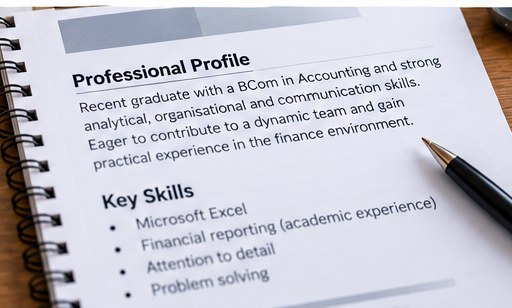
Use the top section of the CV strategically.
For example:
THABO MOKOENA
Johannesburg, Gauteng
071 XXX XXXX
thabo@example.com
Professional Profile
Retail professional with three years of experience in stock replenishment, merchandising, customer service and stock control. Comfortable working in fast-paced retail environments and assisting customers. Seeking an opportunity to contribute practical retail experience and strong attention to detail.
Immediately, the employer knows something useful about the candidate.
Compare that with a huge headshot taking up the same space.
The professional profile provides much more employment-related information.
A Good CV Header Can Include
| Information | Usually useful? |
|---|---|
| Full name | Yes |
| Phone number | Yes |
| Professional email address | Yes |
| General location | Often |
| Professional profile | Yes |
| Relevant job title | Useful |
| Photograph | Usually unnecessary |
| Huge decorative banner | No |
| Social-media selfie | No |
Exactly what personal information is appropriate can depend on the employer and application process, so always read the advertisement.
What Do Official South African Sources Say About CV Photos?
This is where the answer becomes interesting.
Different South African career resources have not always given identical advice.
Western Cape Government
Western Cape Government’s CV guidance tells job seekers not to include unnecessary information and specifically says a photo does not need to be included unless it is requested. Western Cape Government
That strongly supports the modern default:
No photo unless requested.
University of Cape Town
UCT’s current career guidance is similarly direct:
“Do not include a photograph, unless requested by the employer to include it.” Careers Service
That is particularly useful guidance for graduates and other job seekers preparing a professional CV.
University of Johannesburg
UJ’s career-services CV guidance goes even further in its general formatting recommendations:
“No photos / images / page borders / cover page.” University of Johannesburg
Again, the emphasis is on a clean, professional CV.
Department of Employment and Labour
An older Department of Employment and Labour CV guide says that applicants can include a photograph if they want to. Labour South Africa
This does not mean you should include one.
It demonstrates that including a photograph is not automatically treated as universally forbidden in South African CV guidance.
That distinction is important.
So which advice should you follow?
For a modern CV, JobMarketSA’s recommendation is:
Do not include a photograph by default. Add one only when a legitimate employer specifically requests it or the particular application genuinely requires it.
This approach aligns with the more recent UCT guidance and Western Cape Government advice. Careers Service
Should a CV Have a Photo for Government Jobs?
Generally, do not add a photo to a government-job CV unless the vacancy instructions specifically require one.
Public-service applications can have very specific requirements.
South African Government guidance explains that applicants for public-service vacancies may need to complete a Z83 form and attach a CV, while additional documents depend on the requirements of the vacancy. Applicants should therefore read the advertisement carefully. South African Government
Government application requirements can also change.
For example, the Department of Public Service and Administration previously clarified that applicants generally do not need to submit certified copies of qualifications and other relevant documents at the initial application stage; departments were encouraged to request certified copies from shortlisted candidates. South African Government
The broader lesson is important:
Don’t rely on a CV checklist you received years ago. Follow the instructions in the current vacancy advertisement.
If it says:
Submit completed Z83 and detailed CV
then submit what it asks for.
Don’t decide that your application also needs a portrait photograph because a friend told you it looks professional.
Don’t Confuse a CV Photo With a Photograph of Your CV
There is another important distinction.
A photo on your CV means a portrait/headshot incorporated into the CV document.
A photo of your CV means taking a picture or screenshot of the CV itself and sending it as an image.
These are completely different things.
Some recruitment processes specifically require a PDF document rather than a JPEG picture or snapshot.
For example, a Department of Employment and Labour vacancy notice has explicitly instructed applicants to submit a CV in PDF format and stated that JPEG picture/snapshot applications would not be accepted. Labour South Africa
So if the vacancy asks for:
CV in PDF format
send an actual PDF.
Don’t take screenshots of each page and WhatsApp or email the pictures unless the employer specifically instructs you to do so.
When Might You Put a Photo on a CV?
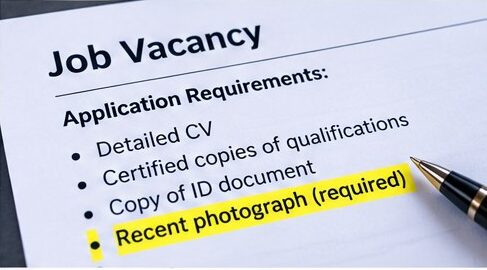
There are exceptions.
1. The Employer Specifically Requests One
If a legitimate job advertisement specifically asks applicants to include a photograph, read the instructions carefully.
Before sending it, verify:
- that the vacancy is genuine;
- that the company is genuine;
- that you are using the correct application channel;
- that the request actually appears in the employer’s instructions.
If everything is legitimate, follow the application requirements.
Do not ignore a stated requirement merely because general CV advice says photographs are usually unnecessary.
Specific legitimate application instructions take priority over generic advice.
2. The Nature of the Role Makes a Photograph Relevant
There may be specialised roles where appearance or visual representation is genuinely part of the work.
Examples could include some:
- modelling roles;
- acting roles;
- promotional roles;
- entertainment opportunities.
Even then, the employer may request a headshot or portfolio separately rather than requiring you to place a photograph inside the CV.
Follow the instructions.
If the employer says:
“Submit CV and headshot”
that doesn’t necessarily mean you should redesign your CV and put the photograph at the top.
You might need two separate files.
If an Employer Requests a Photo, What Kind Should You Use?
If a legitimate application specifically requires a photograph, use one that looks appropriate for the purpose.
For a professional headshot, generally aim for:
- good lighting;
- a clean or uncluttered background;
- clear image quality;
- appropriate clothing;
- a recent photograph;
- your face clearly visible;
- natural presentation.
Avoid using:
- nightclub photographs;
- group pictures;
- heavily filtered selfies;
- cropped photographs where another person’s arm is visible;
- screenshots from social media;
- photos taken from very far away;
- images with distracting backgrounds;
- obviously outdated photographs.
If a photo is genuinely required, treat it as part of the professional application.
Should You Smile in a CV Photo?
If a photograph has legitimately been requested, a natural, professional expression is generally more appropriate than trying to create an artificial corporate pose.
You do not need to look extremely serious.
You also don’t need to produce a fashion photoshoot.
The goal is simply to look:
- presentable;
- approachable where appropriate;
- professional;
- natural.
But remember: for most applications, you won’t need to make this decision at all because the CV does not need your photograph.
Should a Graduate CV Have a Photo?
Usually, no.
A graduate often has limited CV space and needs to use it carefully.
Your CV might need to communicate:
- qualification;
- institution;
- relevant modules;
- academic achievements;
- projects;
- internships;
- vacation work;
- volunteering;
- leadership;
- computer skills;
- professional memberships;
- relevant extracurricular activities.
UCT’s current guidance specifically says not to include a photograph unless the employer requests one. Careers Service
For a graduate, the top of the CV could therefore look something like:
NOLUTHANDO KHUMALO
BCom Accounting Graduate
Durban, KwaZulu-Natal
Phone | Email
Profile
Recent BCom Accounting graduate with strong academic knowledge of financial accounting, taxation and business management. Proficient in Microsoft Excel and interested in developing practical experience within a finance team.
That communicates much more than a portrait.
Should a CV Have a Photo for a Retail Job?
Usually, no.
If you are applying to work as a:
- cashier;
- shelf packer;
- merchandiser;
- store assistant;
- stock controller;
- supervisor;
- receiving clerk;
focus on the requirements of the vacancy.
Relevant information could include:
Experience
Store Assistant — Fictional Retailer, Pretoria
January 2024 – September 2026
- Assisted customers with product enquiries.
- Replenished stock and maintained shelf presentation.
- Checked stock rotation and expiry dates.
- Assisted with stock counts.
- Maintained clean and organised work areas.
That tells the employer what you have actually done.
Your photograph doesn’t.
Should a CV Have a Photo for a Driver Job?
Again, usually not unless requested.
For a driver position, information that may matter more includes:
- type of driver’s licence;
- relevant PrDP where required;
- driving experience;
- types of vehicles driven;
- delivery experience;
- route knowledge;
- accident-free or safety-related information where accurate and relevant;
- customer-service experience;
- availability where requested.
Never invent licences or experience.
For example:
Driver
Licence: Code 10
PrDP: Valid, if genuinely applicable
Experience: 4 years’ delivery driving
Area knowledge: Johannesburg and surrounding areas
That information helps an employer evaluate your application.
A photo usually doesn’t.
Should a CV Have a Photo for an Internship or Learnership?
Usually, no.
For an internship or learnership, focus on the selection criteria.
Depending on the opportunity, that could include:
- Matric subjects;
- qualification;
- academic record;
- computer literacy;
- relevant projects;
- volunteering;
- location;
- driver’s licence;
- required field of study;
- skills;
- availability.
Read the advert carefully.
If it asks for a CV and academic record, send those documents as instructed.
Do not add unrelated documents simply because you think more attachments will make the application stronger.
Can a Photo Make Your CV Look More Professional?
A good photo can make a CV visually polished in certain designs.
But visual polish and recruitment value are not the same thing.
A CV can look extremely professional without a photograph.
In fact, UJ’s guidance emphasises professional appearance while simultaneously advising against photos and images. University of Johannesburg
Professionalism comes from things such as:
- logical organisation;
- readable formatting;
- accurate spelling;
- consistent fonts;
- relevant information;
- strong achievements;
- concise writing;
- correct contact details;
- tailoring the CV to the vacancy.
A photograph cannot compensate for:
- spelling mistakes;
- missing contact information;
- irrelevant experience;
- an untidy layout;
- false qualifications;
- unexplained information;
- failing to meet the job requirements.
What About CV Templates That Automatically Include a Photo?
This causes confusion for many job seekers.
You search online for “professional CV template” and find a beautiful template containing a circular photograph in the top-left corner.
That doesn’t mean you need to fill it.
Templates are designs, not employment rules.
UCT’s guidance specifically warns applicants to be careful with templates because they may not serve the applicant’s purpose. Careers Service
If your chosen template has a photo section, you have three options:
- Remove the photo section.
- Choose a different template.
- Redesign the header so the space contains useful professional information.
Do not let the template decide what belongs on your CV.
The job requirements should decide.
What Should a Good South African CV Focus On?

The South African Government recommends tailoring your CV to the particular position and emphasising the skills and experience most relevant to that application. South African Government
Vuk’uzenzele similarly describes a CV as a document recruiters use to screen applicants and advises applicants to focus on qualifications, experience, achievements and accomplishments. Vuk’uzenzele
That gives us a much better checklist.
CV Content Checklist
| Section | What to focus on |
|---|---|
| Contact information | Make it accurate and professional |
| Professional profile | Briefly explain what you offer |
| Skills | Prioritise skills relevant to the vacancy |
| Work experience | Show relevant duties and achievements |
| Education | Include relevant qualifications |
| Training/certificates | Include those relevant to the position |
| Licences | Include where relevant |
| Achievements | Use genuine examples |
| References | Follow appropriate CV/application guidance |
| Photograph | Leave off unless requested or genuinely required |
Your CV should make it easy for a recruiter to identify why you match the vacancy.
Example: CV With a Photo vs CV Without a Photo
Consider Sipho, a fictional job seeker from Johannesburg applying for a warehouse assistant position.
Version A
The top third of Sipho’s CV contains:
- large portrait photograph;
- his name;
- decorative blue shapes;
- several skill-rating stars.
His warehouse experience starts halfway down the page.
Version B
The top of the CV says:
SIPHO DLAMINI
Warehouse Assistant
Johannesburg, Gauteng
Phone | Email
Professional Profile
Warehouse assistant with two years’ experience in receiving, picking, packing, stock movement and cycle counts. Comfortable working in fast-paced environments and following workplace safety procedures.
Key Skills
- Picking and packing
- Receiving stock
- Stock counts
- Warehouse housekeeping
- Basic computer literacy
- Teamwork
For this type of position, Version B gives the recruiter useful information immediately.
That is what a CV should do.
10 Things More Important Than a CV Photo
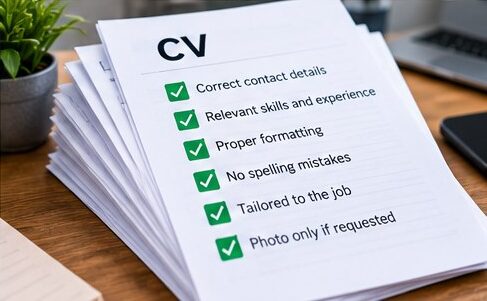
If you are spending an hour trying to choose the perfect CV photograph, redirect that effort.
Check these instead:
- Is your phone number correct?
- Is your email address professional and active?
- Does your CV match the job you’re applying for?
- Have you included your relevant skills?
- Are your employment dates accurate?
- Have you explained your relevant responsibilities clearly?
- Have you included the qualifications required by the vacancy?
- Are there spelling or grammar mistakes?
- Is the CV easy to read?
- Have you followed every instruction in the job advertisement?
Western Cape Government recommends updating your CV for each application so that your relevant skills and experience directly relate to the position. Western Cape Government
The Department of Employment and Labour has likewise advised work seekers to keep CVs detailed and updated according to the particular post they are applying for. South African Government
Those changes are likely to be much more useful than repeatedly changing your headshot.
Common CV Photo Mistakes
If an employer genuinely requests a photograph, avoid these mistakes.
Using a social-media selfie
A casual selfie may not suit a professional application.
Using an old photograph
Use a reasonably current photograph if one is required.
Making the photo enormous
Even when requested, the photograph should not dominate the CV unless the application specifically requires a particular format.
Using filters
Heavy beauty filters, artificial backgrounds and extreme editing are unnecessary.
Including a photo just because the template has one
Templates do not set recruitment requirements.
Assuming every South African employer wants one
They don’t.
Always read the advertisement.
What If You’ve Already Sent a CV With a Photo?
Don’t panic.
Including a photograph does not automatically mean that your application will be rejected.
Remember that older Department of Employment and Labour guidance even says an applicant can include a photograph if they want to. Labour South Africa
If you’ve already applied, there is usually little value in sending another CV solely because you suddenly realised it contained a photo, unless the employer’s instructions specifically prohibited it.
Instead, improve the CV for future applications.
Remove the photo and use the extra space for information relevant to the job.
Should You Remove Your Photo From Your Current CV?
For a general CV you plan to use for ordinary job applications, yes, removing the photo is a sensible default.
Then examine what replaces it.
Don’t simply leave a giant empty space.
Use a clean header containing:
Your Name
Relevant Professional Title
Phone | Email | Location
Then, where appropriate, add a concise professional profile.
For example:
Administrative assistant with three years’ experience in customer service, data capturing, document management and Microsoft Office. Strong organisational and communication skills with experience supporting busy office environments.
Now the employer’s attention goes directly to your professional value.
How to Decide in 30 Seconds
Before sending your CV, ask these questions:
Question 1: Does the advertisement specifically request a photograph?
Yes: Follow the legitimate instructions.
No: Go to Question 2.
Question 2: Is a photograph genuinely relevant to this type of work?
No: Leave it off.
Possibly: Check the employer’s instructions carefully rather than assuming.
Question 3: Am I adding the photo only because my CV template has a photo box?
Yes: Remove the box or choose another template.
That is all most job seekers need.
CV Safety: Be Careful With Personal Information
Your CV contains personal information.
That means you should be careful about where you send it.
Do not post your complete CV publicly in random Facebook groups if it exposes information you would not want distributed widely.
Before submitting an application:
- verify the employer;
- verify the vacancy;
- use the official application channel where possible;
- check the email address carefully;
- be suspicious of requests for payment;
- don’t provide passwords or PINs;
- read exactly which documents are required.
A professional-looking job advertisement can still be fraudulent.
And remember: legitimate job applications should be evaluated according to the employer’s real requirements, not arbitrary demands invented by scammers.
Frequently Asked Questions About Photos on CVs
1. Should a CV have a photo?
Usually, no. For most South African job applications, leave the photograph off unless a legitimate employer specifically requests one or it is genuinely relevant to the application.
2. Should a CV have a photo in South Africa?
There is no universal CV format followed by every South African employer. However, current UCT and Western Cape Government career guidance recommends not including a photograph unless the employer requests it. Careers Service
3. Is it unprofessional to put a photo on a CV?
Not automatically. Some contexts may request one. However, for most ordinary applications it is unnecessary, and the space can usually be used for more relevant professional information.
4. Should I put a photo on my CV for a government job?
Do not add one unless the specific vacancy instructions require it. Government applications can have precise requirements, so follow the current advertisement and required application process. South African Government
5. Should I put my photo on a retail CV?
Usually not. Focus on relevant retail experience, customer service, merchandising, stock handling, cashier experience, supervision or other skills required by the position.
6. Should a graduate CV have a photo?
Usually not. UCT’s current CV guidance advises against including a photograph unless requested by the employer. Careers Service
7. What if the CV template has a photo section?
You can remove it or choose another template. A template does not determine what an employer requires.
8. What photo should I use if an employer requests one?
Use a clear, recent and professional-looking photograph appropriate to the application. Avoid heavily filtered selfies, group photographs and distracting backgrounds.
9. Does adding a professional photo improve my chances of getting an interview?
There is no basis for promising that adding a photo will improve your chances. Your CV should primarily demonstrate that you meet the employer’s requirements through relevant qualifications, skills and experience.
10. What should I put where the photo used to be?
Use the space for a clear header, relevant professional title, contact details and, where appropriate, a short professional profile summarising what you offer.
Final Answer: Should a CV Have a Photo?
So, should a CV have a photo?
For most South African job seekers, no.
Unless a legitimate employer specifically asks for a photograph or the nature of the application genuinely requires one, leave it off.
Instead, use your CV to show:
- what you can do;
- what experience you have;
- what you have achieved;
- what qualifications you hold;
- which relevant skills you bring;
- why you match the vacancy.
Current UCT and Western Cape Government career guidance both support leaving a photograph off unless requested. Careers Service
Most importantly, read every job advertisement carefully.
A good CV is not the one with the fanciest template or best headshot.
It is the one that makes it easy for the employer to see why you are a relevant candidate.