What Is the Best CV Format to Use in South Africa?
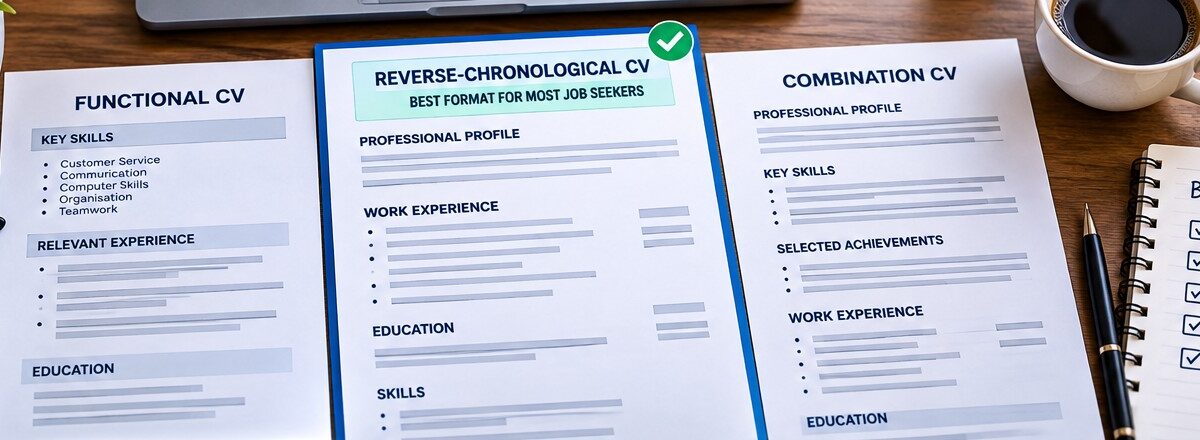
What is the best CV format to use? For most South African job seekers, the best choice is a simple reverse-chronological CV that lists your most recent work experience first, followed by earlier positions. Keep the design clean, use clear headings and bullet points, tailor the content to the vacancy, and avoid complicated graphics that make important information difficult to find.
This format works particularly well if you have a reasonably clear employment history because recruiters can quickly see:
- what you are doing now or did most recently;
- where you worked;
- how long you worked there;
- what responsibilities you had;
- which skills you developed;
- how your experience relates to the vacancy.
This approach is also consistent with South African career guidance. Western Cape Government recommends listing work experience beginning with the most recent job and working backwards, while University of Cape Town career guidance recommends reverse chronological order within CV sections. Western Cape Government
But there isn’t one compulsory CV design that every South African employer uses.
The best format depends partly on your career history and the employer’s instructions. A recent graduate with little experience may need to give education and relevant projects greater prominence, while an experienced employee may want work history near the top.
The most important principle is this:
Make it easy for the employer to find evidence that you meet the requirements of the job.
A beautiful CV that hides your experience is less useful than a simple CV that communicates your suitability immediately.
Table of Contents
What Does “CV Format” Actually Mean?
People sometimes use “CV format” to mean several different things.
It can refer to:
The structure — the order in which your experience, education and skills appear.
The design — fonts, colours, columns, icons and other visual elements.
The file format — for example, PDF or Microsoft Word.
These are separate decisions.
For example, you could have a reverse-chronological CV with a poor visual design, or a beautifully designed CV with a weak structure.
When this article recommends a reverse-chronological CV, it primarily means the organisation of your information.
Your newest experience appears before your older experience.
What Are the Main Types of CV Formats?
There are three formats job seekers commonly encounter:
- Reverse-chronological CV
- Functional or skills-based CV
- Combination or hybrid CV
Let’s look at the differences.
| CV format | Main focus | Best suited to | JobMarketSA recommendation |
|---|---|---|---|
| Reverse chronological | Work history | Most job seekers | Best default choice |
| Functional/skills-based | Skills | Certain unusual career situations | Use carefully |
| Combination/hybrid | Skills + work history | Experienced candidates with strong specialist skills | Useful in some cases |
1. Reverse-Chronological CV: The Best Format for Most Job Seekers

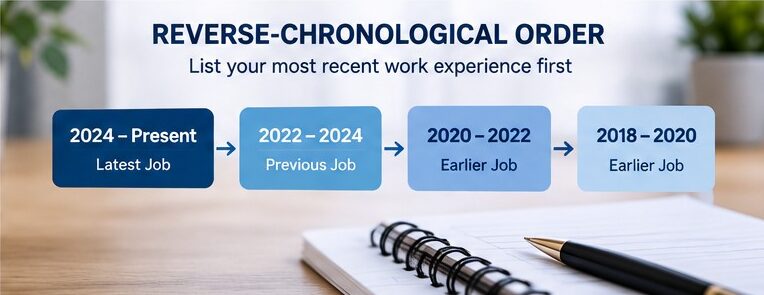
A reverse-chronological CV lists your most recent position first and then works backwards.
For example:
Work Experience
Administrative Assistant
ABC Company, Johannesburg
January 2024 – Present
- Captured customer and supplier information.
- Prepared basic Excel reports.
- Managed filing and document retrieval.
- Responded to telephone and email enquiries.
- Scheduled appointments and meetings.
Receptionist
XYZ Services, Johannesburg
March 2022 – December 2023
- Welcomed visitors and directed enquiries.
- Answered incoming telephone calls.
- Scheduled appointments.
- Maintained electronic and paper records.
The recruiter immediately understands the candidate’s recent career history.
That is one reason the format is so practical.
Western Cape Government’s CV guidance tells applicants to list working experience beginning with the most recent job and working back to the first. Its final CV checklist again refers to work experience being listed in reverse chronological order. Western Cape Government
UCT’s career guidance similarly recommends putting activities within each section in reverse chronological order, starting with the most recent information. Careers Service
University of Johannesburg career guidance also recommends listing activities in reverse chronological order. University of Johannesburg
So if you simply want to know which format to choose and don’t have a special reason to use something different:
Start with reverse chronological.
Why Does Reverse Chronological Work So Well?
Recruiters usually need to understand your employment history quickly.
They may want to know:
- What was your latest job?
- How recent is your experience?
- Have you performed similar work before?
- How long did you stay in previous roles?
- What responsibilities did you have?
- Does your experience appear relevant to this vacancy?
Reverse chronology answers these questions naturally.
Imagine someone applying for a warehouse supervisor vacancy.
Their relevant history is:
2024–2026: Warehouse Team Leader
2022–2024: Warehouse Assistant
2021–2022: Picker and Packer
That progression is easy to understand when presented newest first.
If those positions were scattered across several sections based only on skills, the recruiter might have to work harder to reconstruct the candidate’s career history.
A CV shouldn’t make the recruiter solve a puzzle.
What Should a Reverse-Chronological CV Look Like?
There is flexibility, but a practical structure is:
1. Name and contact details
2. Professional profile
3. Key relevant skills
4. Work experience
5. Education
6. Relevant training, certificates or licences
7. Additional relevant information
8. References, where appropriate
You can change the order when there is a good reason.
For example, a recent graduate with little employment experience might place Education before Work Experience.
A candidate applying for a driving position might make their relevant driver’s licence highly visible.
A technically qualified candidate may need a dedicated certifications section.
The format should serve the application.
What Is a Functional CV?
A functional CV is sometimes called a skills-based CV.
Instead of making employment history the main feature, it organises information around skills.
For example:
Customer Service
- Assisted customers with product enquiries.
- Resolved routine complaints.
- Processed returns.
- Handled telephone enquiries.
Administration
- Captured customer information.
- Filed documentation.
- Prepared reports.
- Scheduled appointments.
Computer Skills
- Microsoft Word
- Microsoft Excel
- Data capturing
Employment history may then appear later.
This can seem attractive if you have employment gaps, limited formal experience or are changing careers.
But there is a disadvantage.
The employer may still want to know where and when you gained those skills.
If you hide your employment dates or separate skills completely from the jobs where you developed them, the recruiter may have less context.
That is why a purely functional CV is not my first recommendation for most JobMarketSA readers.
Should You Use a Functional CV to Hide Employment Gaps?
Be careful.
If you were unemployed for a period, you might think:
“I’ll use a skills-based CV so they won’t see the gap.”
That isn’t necessarily the best strategy.
A recruiter may still ask for your employment dates.
A better approach is often to use a normal reverse-chronological structure and present your history truthfully.
If you did something meaningful during the gap, such as:
- studying;
- volunteering;
- freelancing;
- caregiving;
- running a small business;
- completing training;
- doing temporary work;
you may be able to include it where relevant and accurate.
Do not invent employment to fill gaps.
A CV should help present your history effectively, not create a false history.
What Is a Combination CV?
A combination CV combines elements of the skills-based and reverse-chronological formats.
For example:
Professional Profile
Experienced sales professional with six years’ experience across retail and business-to-business sales.
Key Skills
- Client acquisition
- Account management
- Sales presentations
- CRM systems
- Customer retention
Selected Achievements
- Genuine achievement
- Genuine achievement
- Genuine achievement
Employment History
Sales Executive
Company A
2024–Present
Sales Consultant
Company B
2021–2024
This can work well for experienced candidates because it gives the employer an immediate summary of expertise while still providing a clear employment timeline.
However, it can become repetitive.
If your key-skills section says everything again before the recruiter reaches your employment history, you’re wasting space.
Use a hybrid structure only when the additional skills summary adds genuine value.
Which CV Format Is Best for Someone With No Experience?
If you have no formal work experience, you can still use a reverse-chronological structure, but you may need to change the order of the sections.
For example:
THANDO MTHEMBU
Pretoria, Gauteng
Phone | Email
Professional Profile
Recent matriculant seeking an entry-level administrative opportunity. Computer literate with experience using Microsoft Word and Excel through school assignments and personal projects. Reliable, willing to learn and comfortable working with people.
Education
National Senior Certificate
Fictional Secondary School
2025
Relevant subjects:
- English
- Mathematics
- Business Studies
- Computer Applications Technology
Skills
- Microsoft Word
- Basic Microsoft Excel
- Written communication
- Teamwork
- Organisation
Relevant Experience
School Fundraising Committee — Volunteer
2025
- Assisted with registration.
- Recorded participant information.
- Helped organise materials.
- Assisted visitors during the event.
This fictional candidate hasn’t invented a job.
They have simply highlighted relevant information they genuinely possess.
What Is the Best CV Format for a Recent Graduate?
Recent graduates should usually give greater prominence to:
- degree/diploma;
- institution;
- relevant coursework where useful;
- projects;
- internships;
- vacation work;
- practical training;
- volunteering;
- leadership;
- achievements;
- technical skills.
UCT notes that CVs should be tailored and that activities in sections should generally appear in reverse chronological order. Its guidance also cautions applicants to be careful with templates and recommends plain, simple ones where needed. Careers Service
A graduate CV might therefore follow this structure:
- Contact information
- Professional profile
- Education
- Relevant skills
- Projects/internships/practical experience
- Work experience
- Leadership/volunteering
- Additional relevant information
Once the graduate gains substantial work experience, employment history may move above education.
What Is the Best CV Format for Someone With Work Experience?
For someone with established experience, I recommend:
- Name and contact information
- Professional profile
- Key skills
- Employment history — newest first
- Education
- Certifications/training/licences
- Additional relevant information
- References where appropriate
The strongest section will usually be work experience.
Don’t bury five years of relevant experience on page three because you wanted to place a huge “About Me” section, hobbies and decorative skills chart first.
Your strongest evidence should be easy to find.
What Is the Best CV Format for a Career Change?
A combination format can be useful.
Suppose Nomvula, a fictional candidate in Durban, spent four years in retail but now wants an entry-level administrative job.
Her retail experience might include transferable skills such as:
- customer communication;
- stock documentation;
- data capturing;
- cash handling;
- responding to enquiries;
- record keeping;
- Microsoft Office.
She should not pretend she has four years of administrative employment.
Instead, she could use:
Professional Profile
Retail professional transitioning into administration, with four years’ experience involving customer service, stock documentation, record keeping and daily operational support. Comfortable using Microsoft Word and Excel and seeking an entry-level administrative position.
Relevant Skills
- Data capturing
- Customer communication
- Microsoft Word
- Microsoft Excel
- Record keeping
- Stock documentation
Employment History
Then list the actual retail positions and responsibilities.
This brings transferable skills forward without hiding the candidate’s real history.
What Is the Best CV Format for Government Jobs?
For South African public-service vacancies, the most important rule is:
Follow the vacancy instructions.
Government applications may have requirements that differ from ordinary private-sector applications.
South African Government guidance says applicants for public-service vacancies generally need to complete the Z83 application form and attach a CV, while departments may request additional documentation depending on the advertisement. Government of South Africa
Current government vacancy notices can also specify exactly what the CV must contain.
For example, Gauteng Provincial Government vacancy notices have required detailed CVs alongside the new Z83 and specified information such as employers, positions and employment periods. GPG Professional Job Centre
That means you should never assume:
“I already have a professional CV, so I can ignore the government’s instructions.”
The vacancy advertisement comes first.
If it requests specific dates, provide them.
If it requires a Z83, submit it correctly.
If it asks for a detailed CV, don’t submit an extremely short one-page résumé simply because someone online said all CVs should be one page.
How Long Should a CV Be?
There is no single page count that applies to every candidate and every employer.
UCT’s career guidance says CVs are typically two pages, while also stressing that employers may request otherwise. Careers Service
Western Cape Government recommends a Word-created CV of around one to two pages, again noting that applicants should check the required page count in the advertisement. Western Cape Government
UJ’s published career guidance suggests keeping a CV between two and four pages. University of Johannesburg
These different recommendations illustrate something important:
There is no magical page number.
Your CV should be long enough to communicate relevant information but short enough to remain focused.
A matriculant with no work experience usually doesn’t need a four-page CV.
Someone with 15 years of specialist experience may struggle to communicate everything relevant in one page.
Don’t add unnecessary content merely to make the document longer.
And don’t delete important relevant information merely to force the document onto one page.
Is a One-Page CV Better?
Not automatically.
One page can work well for:
- students;
- matriculants;
- graduates;
- candidates with limited experience;
- candidates whose relevant experience is easy to summarise.
But if you have enough relevant experience to justify two pages, two pages may be more useful.
The employer needs enough information to make an informed decision about whether to progress your application.
Shorter is not automatically better. Relevant is better.
Should Your CV Have Two Columns?
This is where design starts becoming important.
A two-column CV can look attractive.
For example:
Left column
- Contact details
- Skills
- Languages
Right column
- Profile
- Experience
- Education
There is nothing automatically wrong with this.
However, complicated multi-column designs can make a CV harder to read, especially if:
- sections are squeezed into narrow spaces;
- text becomes tiny;
- icons replace clear labels;
- important information is split across the page;
- the document is converted poorly.
For most applicants, I recommend a simple one-column layout.
You can still make it professional using:
- clear headings;
- consistent spacing;
- bold job titles;
- bullet points;
- restrained typography;
- sensible white space.
You do not need a complicated graphic design.
What Is the Best CV Format for ATS?
You may hear people say:
“Your CV must be ATS-friendly.”
ATS means Applicant Tracking System.
Different employers use different recruitment systems, so there is no universal design guaranteed to work perfectly with every system.
However, simplicity is sensible.
Use clear section names such as:
- Professional Profile
- Work Experience
- Education
- Skills
- Certifications
Avoid making critical information dependent on unusual graphics.
For example, don’t display your Excel ability only as:
Excel ●●●●○
What does four dots mean?
Instead write:
Microsoft Excel — spreadsheets, basic formulas and data capturing
provided those skills are accurate.
Likewise, avoid relying solely on icons for:
- phone;
- email;
- location;
- qualifications.
Text is clearer.
Should You Use Graphics on Your CV?
Usually, keep them minimal.
UJ’s career guidance recommends a logical and professional layout and advises against photos, images, page borders and cover pages. University of Johannesburg
UCT recommends consistent fonts and warns applicants that templates may not always serve their purpose. Careers Service
Western Cape Government recommends a CV that is neat, easy to read and uses readable fonts and sensible white space. Western Cape Government
This does not mean your CV has to look ugly.
It means design should support the information.
A recruiter should notice your experience before your graphic design unless graphic design itself is what you are applying to do.
Should a CV Have a Photo?
For most ordinary applications, leave the photo off unless the employer requests one.
UCT explicitly advises applicants not to include a photograph unless requested, while Western Cape Government also says a photo is unnecessary unless requested. Careers Service
This is particularly relevant when choosing online templates.
Many templates automatically include a circular portrait at the top.
That does not mean you need one.
A template is not an employment rule.
Use the space for something more useful, such as:
- your professional title;
- professional profile;
- relevant skills;
- contact information.
Which Font Should You Use on a CV?
Your font should be easy to read.
UCT recommends consistent fonts and suggests body text between 10 and 12 points, mentioning Arial or Calibri. Careers Service
Western Cape Government similarly recommends readable fonts and gives examples including Helvetica, Century Gothic and Calibri. Western Cape Government
You don’t need an unusual font to stand out.
Safe choices include:
- Arial;
- Calibri;
- Helvetica;
- other clean professional fonts.
More important than the exact font is consistency.
Don’t use five fonts because you want the CV to look creative.
Should You Send a CV as PDF or Word?
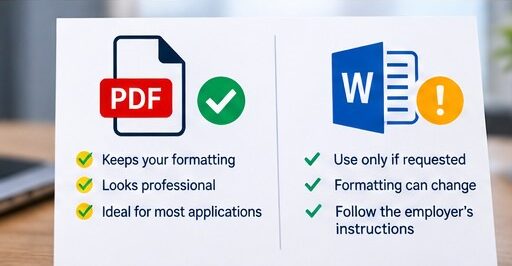
Unless the employer says otherwise, PDF is often a practical final format because it helps preserve your layout.
Western Cape Government recommends saving a Word-created CV as a PDF. Western Cape Government
However, there is an important rule:
If the employer specifies a file format, follow the employer’s instruction.
If the advertisement says:
Upload PDF only
use PDF.
If it specifically requests:
Microsoft Word document
send Word.
If an online application form asks you to enter your employment history directly into fields, complete those fields correctly.
Don’t ignore the system because you prefer your own CV format.
What Information Should Be at the Top of a CV?
A practical modern header might look like:
LINDIWE KHUMALO
Administrative Assistant
Johannesburg, Gauteng
071 XXX XXXX
lindiwe@example.com
Then:
Professional Profile
Administrative assistant with three years’ experience in data capturing, customer service, document management and Microsoft Office. Experienced in supporting busy office environments and handling telephone and email enquiries.
Within seconds, the recruiter knows:
- the candidate’s name;
- target profession;
- general location;
- contact details;
- experience level;
- relevant skills.
That is valuable CV space.
Do You Need a Professional Profile?
A concise profile can be useful.
But avoid turning it into a paragraph full of adjectives.
Weak:
“I am a passionate, hardworking, motivated, dedicated, honest, reliable, dynamic and enthusiastic individual seeking an opportunity to grow.”
Almost anybody could write that.
Stronger:
“Warehouse assistant with three years’ experience in receiving, picking, packing, stock counts and dispatch. Experienced in fast-paced warehouse environments and comfortable using handheld stock-scanning equipment.”
The second profile gives the recruiter evidence.
Your profile should answer:
Who are you professionally, and what relevant value do you offer?
How Should Work Experience Be Formatted?
Use a consistent pattern.
Warehouse Assistant
Fictional Distribution Centre — Johannesburg
March 2023 – September 2026
- Received and checked incoming stock.
- Picked and packed customer orders.
- Assisted with weekly cycle counts.
- Reported damaged or missing stock.
- Maintained clean and organised work areas.
Then move to the previous position.
Avoid writing one enormous paragraph.
Bullet points make individual responsibilities easier to scan.
UJ’s career guidance specifically recommends consistent use of bullet points and a logical, professional layout. University of Johannesburg
How Should Education Be Formatted?
Use the same principle: newest relevant education first.
For example:
Diploma in Human Resource Management
Fictional TVET College
2024
National Senior Certificate
Fictional Secondary School
2021
You may add relevant subjects, achievements or specialisations when useful.
But don’t overwhelm the section with information that doesn’t help the application.
Someone with a degree and several years of professional experience generally doesn’t need to provide an extensive description of every high-school activity.
Should You Include Every Job You’ve Ever Had?
Not necessarily.
South African Government guidance recommends changing your CV to meet the needs of the particular job and emphasising relevant skills and experiences. Government of South Africa
This does not mean falsifying your employment history.
It means deciding how much detail each role deserves.
If you are applying for an accounting role and have:
- four years’ accounting experience;
- two years’ bookkeeping experience;
- a two-week holiday job from 12 years ago;
the accounting experience deserves much more space.
Tailoring is about relevance, not rewriting history.
Don’t Send Exactly the Same CV to Every Employer
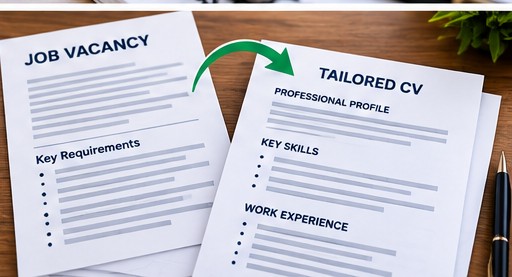
This is one of the most important improvements you can make.
Western Cape Government explicitly advises applicants not to submit the same CV for different jobs and recommends updating it to highlight relevant skills and experience for each application. Western Cape Government
South African Government guidance likewise recommends changing your CV for the specific position and emphasising the most relevant skills and experience. Government of South Africa
Suppose you have experience in:
- customer service;
- cash handling;
- stock control;
- merchandising;
- supervising employees.
For a customer-service vacancy, customer interaction may deserve more prominence.
For a stock-controller vacancy, stock counts, receiving, inventory systems and stock-loss responsibilities may deserve more prominence.
Same career history.
Different emphasis.
That’s good tailoring.
Example of a Good CV Structure
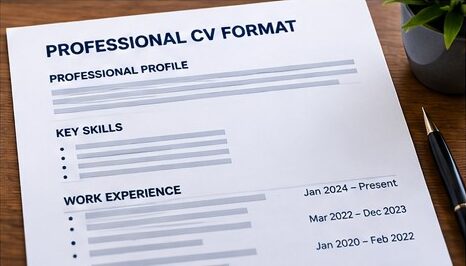
Here is a simple structure that will work for many applicants:
PAGE 1
FULL NAME
Target job title
Phone | Email | Location
PROFESSIONAL PROFILE
Three to five concise lines summarising relevant experience and skills.
KEY SKILLS
- Relevant skill
- Relevant skill
- Relevant skill
- Relevant skill
- Relevant skill
WORK EXPERIENCE
Most Recent Job Title
Company | Location
Dates
- Relevant responsibility
- Relevant responsibility
- Achievement where genuine
- Relevant responsibility
Previous Job Title
Company | Location
Dates
- Relevant responsibility
- Relevant responsibility
- Relevant responsibility
PAGE 2
Continue employment history if necessary.
EDUCATION
Most recent qualification first.
TRAINING / CERTIFICATIONS
Only relevant and genuine certifications.
ADDITIONAL INFORMATION
Relevant licences, languages, software or other useful information.
REFERENCES
Follow the application requirements and appropriate CV guidance.
Simple.
Readable.
Professional.
No complicated design is required.
What CV Format Should a Retail Worker Use?
A retail employee could use:
- Contact details
- Professional profile
- Retail skills
- Work experience
- Education
- Relevant training
- References where appropriate
Example profile:
Retail professional with four years’ experience in merchandising, stock rotation, customer service, stock counts and maintaining sales-floor standards.
Then list jobs newest first.
This immediately shows relevant retail experience.
What CV Format Should an Administrative Assistant Use?
Use a clean reverse-chronological CV.
Highlight:
- Microsoft Office;
- data capturing;
- email;
- telephone communication;
- filing;
- document management;
- diary management;
- customer service;
- reporting.
Again, only include skills you genuinely have.
What CV Format Should a Driver Use?
A driver’s CV should make relevant licence information easy to find.
For example:
PROFESSIONAL PROFILE
Delivery driver with four years’ experience completing local deliveries and interacting with customers.
LICENCES
Driver’s Licence: Code 10
PrDP: Include only if genuinely held and relevant
EXPERIENCE
Most recent driving job first.
Do not hide critical licence information at the bottom of page three.
What CV Format Should Someone With Many Years of Experience Use?
Reverse chronological still works well.
The difference is that you may need to be more selective.
A candidate with 20 years’ experience does not necessarily need eight bullet points describing a junior position held 18 years ago.
Give more detail to:
- recent roles;
- relevant roles;
- major achievements;
- specialist experience.
Older, less relevant roles can often receive less detail while remaining accurately represented.
Common CV Formatting Mistakes
1. Too Many Colours
A CV doesn’t need five bright colours.
2. Tiny Text
Don’t shrink the font so much that you can force four pages onto two.
3. Huge Name and Photo
Your name does not need to occupy a quarter of the page.
4. Skill Bars
Avoid:
Communication █████████ 90%
How did you calculate 90%?
Use evidence instead.
5. Unnecessary Icons
Icons can look attractive, but they should not replace clear information.
6. Long Paragraphs
Recruiters need to scan information quickly.
7. Inconsistent Dates
Don’t write:
Jan 2024 – Mar 2025
for one job and:
03/06/2021 until the end of 2023
for another.
Choose a consistent format.
8. Spelling Errors
Government and university career guidance consistently stresses proofreading and professional presentation. Western Cape Government
9. Irrelevant Information
Every section should earn its space.
10. Ignoring the Advertisement
The employer’s application instructions outrank generic CV advice.
How to Choose Your CV Format in 60 Seconds
Use this simple decision process.
Do you have normal employment experience relevant to the job?
Yes → Use reverse chronological.
Are you a graduate or matriculant with little work experience?
Use a modified reverse-chronological CV, but move education, projects and relevant skills higher.
Are you changing careers?
Consider a combination CV that highlights transferable skills but still clearly shows employment history.
Are you applying for a government position?
Follow the advertisement and Z83/application requirements exactly.
Does the employer provide its own CV/application format?
Use what the employer requests.
For most other situations:
Choose a clean reverse-chronological CV.
Frequently Asked Questions
What is the best CV format to use?
For most job seekers, a simple reverse-chronological CV is the best default. Put your newest work experience first and work backwards, while tailoring the information to the vacancy.
What is the best CV format to use in South Africa?
A clean reverse-chronological format is suitable for many South African applications. Western Cape Government, UCT and UJ career guidance all support presenting activities or employment history with the most recent information first. Western Cape Government
Should a CV be one or two pages?
There is no universal rule. UCT says CVs are typically around two pages, while employers may request something different. Western Cape Government suggests around one to two pages for a Word-created CV but also says applicants should check the vacancy’s requirements. Careers Service
Is a one-column CV better?
For many applicants, a simple one-column layout is a strong choice because it keeps information easy to follow. More complicated designs are not automatically better.
Is a functional CV better than a chronological CV?
Usually not for a candidate with a straightforward employment history. A functional CV can emphasise skills but may make it harder to understand where and when those skills were developed.
What CV format should I use with no experience?
Prioritise education, relevant skills, projects, volunteering and other genuine experience, while keeping dates and sections logically organised.
Should I send my CV as PDF?
PDF is often useful for preserving formatting, and Western Cape Government recommends saving a Word-created CV as a PDF. However, always use the file format specifically requested by the employer. Western Cape Government
Should my CV have a photo?
Usually not unless requested. Both UCT and Western Cape Government guidance say a photograph is unnecessary unless the employer asks for one. Careers Service
Is a colourful CV better?
Not necessarily. Readability, relevance, consistency and professional presentation matter more than decorative design.
Should I use the same CV for every job?
No. Tailor the CV to highlight genuine skills and experience relevant to each vacancy. Both South African Government and Western Cape Government guidance recommend adapting your CV to the position. Government of South Africa