Will Employers Know If I Use ChatGPT for My CV?
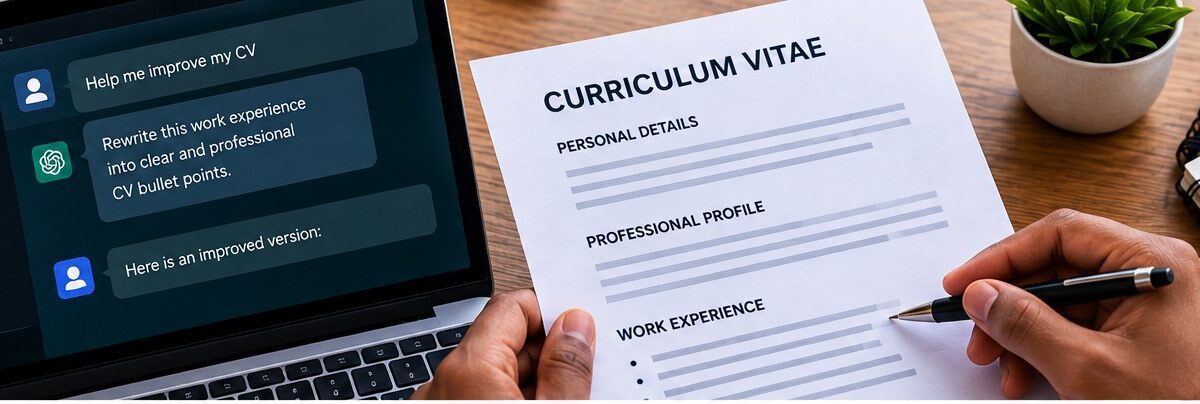
Will employers know if I use ChatGPT for my CV? Not necessarily. An employer usually cannot look at a CV and prove that ChatGPT wrote it simply from the text, but experienced recruiters may suspect AI assistance when a CV sounds generic, overly polished, repetitive, exaggerated or unlike the candidate during an interview. The safest approach is to use ChatGPT as a writing assistant, not as a tool that invents your experience, qualifications or achievements.
Using AI to improve the wording of information that is genuinely yours is very different from asking AI to manufacture an impressive career history.
For example, this is a sensible use of ChatGPT:
Your real information: “I worked in a supermarket. I checked expiry dates, packed stock, helped customers and counted stock.”
You could ask ChatGPT to make that clearer and more professional without adding anything that did not happen.
A much riskier approach would be allowing AI to turn that experience into claims such as:
“Led national inventory optimisation initiatives that reduced stock losses by 35%.”
If you never did that, the problem is no longer that you used AI. The problem is that your CV contains false information.
AI-assisted job applications are also becoming increasingly common. A 2026 CV-Library survey of 424 recruiters/employers and 1,067 candidates found widespread AI use in recruitment itself, while recruiters reported seeing increasing numbers of AI-generated applications. CV Library
So the important question for a South African job seeker is not simply:
“Can they catch me using ChatGPT?”
A better question is:
“Does my CV still accurately represent me?”
The answer to that can determine what happens when the recruiter starts asking questions.
Table of Contents
Can Employers Actually Detect a ChatGPT-Written CV?
There are two different things people often confuse:
- Software detecting that ChatGPT generated your CV
- A recruiter suspecting that AI helped write your CV
They are not the same.
AI-generated text cannot always be reliably identified just by analysing the words.
OpenAI itself withdrew an earlier AI-text classifier because of its low accuracy. In OpenAI’s published evaluation, that classifier correctly identified only 26% of AI-written English text in its challenge set as likely AI-written and incorrectly labelled human-written text as AI-written 9% of the time. OpenAI also warned that shorter texts were particularly difficult to classify reliably. OpenAI
That is particularly relevant to CVs because many CV sections consist of short bullet points and standard professional language.
However, this does not mean that employers will never suspect AI.
Recruiters can notice patterns.
A 2026 CV-Library survey found that 79% of recruiters surveyed had noticed an increase in AI-generated applications, while 81% said CVs were becoming less distinctive or personal. CV Library
So there is an important distinction:
A recruiter noticing that your CV sounds AI-generated is not the same as software proving that ChatGPT wrote it.

Can an ATS Tell That You Used ChatGPT?
This is one of the biggest fears job seekers have.
You upload your CV to a company’s careers website and imagine the applicant tracking system displaying something like:
⚠️ CHATGPT DETECTED — REJECT CANDIDATE
That is an oversimplification of how applicant tracking systems normally work.
An ATS — Applicant Tracking System — is software employers can use to collect, organise and process job applications.
Modern recruitment systems can include increasingly sophisticated AI functions, but AI in recruitment is commonly used for tasks such as candidate matching, screening, administration and other recruitment processes rather than simply providing a reliable universal test of whether ChatGPT helped write a CV.
Recent CV-Library research illustrates how widespread the perception of automated screening has become. In its 2026 survey, 75% of candidates believed AI was being used for CV screening, while only 21% of recruiters surveyed said they used AI for that purpose. CV Library
That gap matters.
Job seekers sometimes become so worried about “beating the AI” that they damage their CV trying to satisfy systems they do not actually understand.
Your priority should still be:
- matching the genuine requirements of the vacancy;
- using clear job-relevant language;
- accurately describing your experience;
- including relevant qualifications;
- using readable formatting;
- providing evidence of your skills where possible.
Do not turn your CV into a collection of keywords copied from the advertisement.
The Bigger Risk Is Not AI Detection
The bigger risk is producing a CV that doesn’t sound like you and doesn’t accurately describe you.
Imagine that a recruiter reads this statement:
“Strategically spearheaded cross-functional operational optimisation initiatives while leveraging innovative methodologies to deliver exceptional stakeholder outcomes.”
It sounds impressive.
But what does it actually mean?
Now imagine the recruiter asks:
“Tell me about one of the cross-functional optimisation initiatives you spearheaded.”
If the candidate cannot explain it, the impressive sentence becomes a problem.
Compare it with:
“Supervised a team of eight staff members, allocated daily tasks and checked that stock was correctly displayed before opening.”
That is specific.
If it is true, the candidate can explain it.
They can tell the interviewer:
- what the team did;
- what their responsibility was;
- what problems occurred;
- how they solved them;
- what systems they used;
- what a typical day looked like.
Specific, truthful information is more useful than impressive-sounding AI language.
7 Signs That Can Make a CV Look AI-Generated
There is no single phrase that proves ChatGPT wrote a CV.
However, several patterns can make recruiters suspicious.
1. The CV Is Extremely Generic
Consider this professional profile:
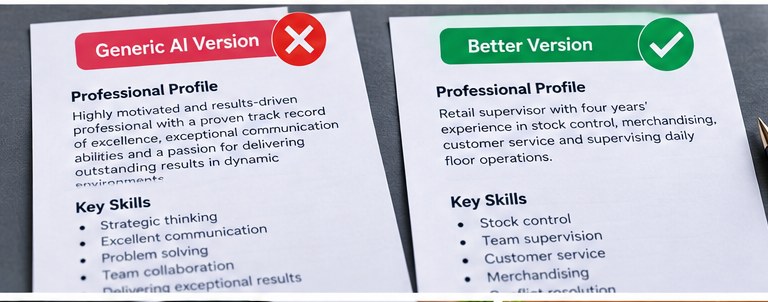
“Highly motivated and results-driven professional with a proven track record of excellence, exceptional communication abilities and a passion for delivering outstanding results in dynamic environments.”
What job does this person do?
Retail?
Accounting?
Driving?
IT?
Administration?
Warehousing?
Sales?
You cannot tell.
That is the problem.
A better profile might say:
“Retail supervisor with four years’ experience in stock control, merchandising, customer service and supervising daily floor operations.”
That tells the recruiter something.
2. Your CV Is Full of Buzzwords
AI tools can produce polished corporate language when the prompt encourages them to “make this sound professional”.
The result can become excessive.
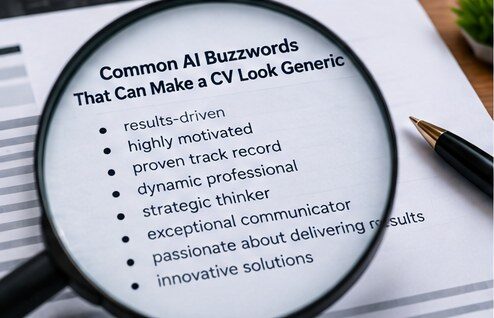
Watch phrases such as:
- results-driven professional;
- dynamic individual;
- highly motivated self-starter;
- exceptional communicator;
- strategic thinker;
- proven track record;
- innovative solutions;
- fast-paced environment;
- synergised;
- spearheaded;
- leveraged.
None of these words is automatically wrong.
The problem comes when the CV consists mostly of impressive adjectives rather than evidence.
Instead of:
“Results-driven customer-service professional committed to delivering exceptional customer experiences.”
Consider:
“Assisted customers with product enquiries, returns and locating stock on the sales floor.”
The second statement shows what you actually did.
3. Every Bullet Point Sounds Exactly the Same
A CV can start looking artificial when every bullet follows an identical pattern:
Spearheaded…
Leveraged…
Optimised…
Orchestrated…
Facilitated…
Revolutionised…
Human work histories are usually messier and more specific.
You may have:
- received deliveries;
- processed invoices;
- assisted customers;
- captured information;
- supervised employees;
- prepared reports;
- operated equipment;
- checked temperatures;
- packed orders.
There is no reason to transform every ordinary responsibility into corporate jargon.
4. The Language Doesn’t Match Your Experience
Suppose a candidate worked as a shelf packer.
Their CV says:
“Directed enterprise-level inventory optimisation and developed strategic merchandising frameworks to maximise organisational profitability.”
A recruiter may reasonably wonder what that means.
If your actual duties were:
- packing shelves;
- rotating stock;
- checking expiry dates;
- helping customers;
- maintaining displays;
say that professionally.
You don’t have to make your job sound like something it wasn’t.
There is dignity and value in describing real work accurately.
5. Your CV Contains Achievements You Cannot Explain
This is one of the most dangerous AI mistakes.
You tell ChatGPT:
“Make my CV impressive.”
It returns:
“Reduced operational costs by 30%.”
Where did 30% come from?
If you didn’t provide that figure, do not use it.
AI does not know what happened in your workplace unless you tell it.
It can generate plausible-sounding information that is completely false.
Never allow an AI tool to invent:
- sales figures;
- revenue increases;
- team sizes;
- awards;
- qualifications;
- certificates;
- job titles;
- software experience;
- years of experience;
- performance percentages;
- licences;
- employers;
- responsibilities.
Your CV is supposed to describe your history, not generate one.
6. Your Cover Letter and CV Sound Like Different People
Imagine your CV says:
“A commercially astute professional adept at facilitating cross-functional stakeholder engagement.”
Then your application email says:
“Hi. Please see CV attached. I want this job thanks.”
The difference can be noticeable.
That doesn’t prove AI was used.
But it can make an application feel inconsistent.
You don’t need to deliberately make your CV badly written.
Instead, ask ChatGPT to preserve your natural communication style while correcting grammar and improving clarity.
7. You Cannot Discuss Your Own CV During the Interview
This is perhaps the most important test.
Anything on your CV can potentially become an interview question.
If your CV says:
“Managed inventory discrepancies.”
You should know what that means.
If it says:
“Improved customer satisfaction.”
You should be able to explain how.
If it says:
“Advanced Microsoft Excel skills.”
You should be prepared to discuss what you can actually do in Excel.
If it says:
“Led a team of 12.”
You should have genuinely led that team.
A simple rule is:
Never put something on your CV that you would be uncomfortable explaining to an interviewer.
Is It Wrong to Use ChatGPT to Write a CV?
Using ChatGPT to help write a CV is not inherently dishonest.
It depends on what you ask it to do and what you submit.
There is a major difference between assistance and fabrication.
| Use of ChatGPT | Good idea? | Why |
|---|---|---|
| Fix spelling and grammar | Yes | Improves clarity without changing your history |
| Improve sentence structure | Yes | Can make genuine experience easier to understand |
| Help organise CV sections | Yes | Useful formatting assistance |
| Turn your real duties into concise bullet points | Yes | Useful if you verify every statement |
| Tailor genuine experience to a vacancy | Yes | Helps highlight relevant information |
| Suggest questions about missing CV information | Yes | Can help you remember relevant details |
| Invent achievements | No | Creates false information |
| Invent qualifications | No | Misrepresents your background |
| Invent work experience | No | Misrepresents your employment history |
| Add fake percentages | No | Creates unsupported claims |
| Claim software skills you don’t have | No | May be exposed during screening or assessment |
| Copy the entire job advert into your CV | No | Creates a generic, unnatural application |
The dividing line is straightforward:
ChatGPT can help communicate your experience. It should not create your experience.
How to Use ChatGPT for Your CV Without Making It Sound AI-Generated
The best process starts with your information, not ChatGPT’s imagination.
Step 1: Write Down Your Real Information
Before opening ChatGPT, collect:
- employer names;
- job titles;
- employment dates;
- actual duties;
- qualifications;
- certificates;
- licences;
- software you genuinely know;
- skills;
- achievements you can verify;
- relevant training.
Do not worry about perfect wording yet.
Facts come first.
Step 2: Give ChatGPT the Job Advertisement
If possible, provide the vacancy description.
Then ask ChatGPT to identify:
- required experience;
- essential skills;
- qualifications;
- responsibilities;
- keywords relevant to the position.
This helps you understand what the employer is looking for.
But don’t ask:
“Add all these requirements to my CV.”
Instead ask:
“Compare these requirements with my real experience and tell me which requirements my experience genuinely supports. Do not invent anything.”
That instruction makes a huge difference.
Step 3: Give ChatGPT Your Real Experience
For example:
I worked as a cashier for two years. I processed cash and card payments, helped customers, handled returns, balanced my till and kept my checkout area clean.
Then ask:
Rewrite this into concise professional CV bullet points. Do not add duties, achievements, numbers or skills I haven’t provided.
You might receive something like:
Cashier
- Processed cash and card transactions accurately.
- Assisted customers with enquiries and returns.
- Balanced the till at the end of assigned shifts.
- Maintained a clean and organised checkout area.
That is AI-assisted writing.
But the underlying experience remains yours.
Step 4: Check Every Sentence
Do not copy and paste blindly.
Read each bullet and ask:
Did I actually do this?
If the answer is no, delete it.
Then ask:
Could I explain this in an interview?
If not, rewrite it.
Then:
Does this sound like the work I actually performed?
If not, simplify it.
You are responsible for the final CV, even if AI helped draft it.
Step 5: Add Details Only You Know
This is one of the best ways to improve an AI-assisted CV.
Generic:
“Responsible for stock management.”
Specific:
“Received stock, checked deliveries against documentation and assisted with weekly stock counts.”
Generic:
“Provided excellent customer service.”
Specific:
“Helped customers locate products and responded to product and pricing enquiries.”
Generic:
“Managed administrative responsibilities.”
Specific:
“Captured customer information, filed documents and responded to telephone and email enquiries.”
Specificity makes your experience easier to understand.
It also makes the CV genuinely yours.
A Better ChatGPT Prompt for Writing Your CV
Instead of typing:
“Write me a professional CV.”
Use a controlled prompt.
For example:
Help me improve my CV for the job advertisement below. Use only the experience, qualifications, skills and achievements I provide. Do not invent employers, dates, qualifications, responsibilities, numbers, percentages, software knowledge or achievements. Rewrite my genuine experience clearly and professionally. Keep the language natural and specific rather than using generic corporate buzzwords. If important information is missing, ask me instead of guessing.
Then paste:
- the vacancy;
- your current CV;
- any additional genuine information.
This produces a much safer starting point.
Should You Ask ChatGPT to “Humanise” Your CV?
You can, but be careful about what you mean.
You should not be trying to “beat an AI detector”.
The goal should be to make the CV accurately sound like you.
Instead of:
“Humanise this so AI detectors can’t detect it.”
ask:
“Rewrite this in clear, natural professional English. Remove unnecessary corporate buzzwords and generic claims. Keep all facts unchanged.”
That focuses on quality rather than trying to game detection software.
OpenAI’s own experience with AI-text classification demonstrated why detector scores should not be treated as definitive proof of authorship. OpenAI
Should You Put Your CV Through an AI Detector?
You can experiment with one, but don’t panic over the result.
A detector may say:
83% AI-generated
That does not establish that 83% of your CV was written by ChatGPT.
AI-text detection has known limitations, including false positives.
CVs present an especially difficult case because professional CV writing naturally contains:
- short sentences;
- bullet points;
- repeated grammatical structures;
- predictable terminology;
- standard job titles;
- common skill descriptions.
For example:
“Assisted customers with enquiries.”
There are only so many natural ways to express that responsibility.
A detector cannot know your writing history merely because the sentence is predictable.
Focus on accuracy, specificity and readability rather than chasing a particular detector score.
What If You Copy ChatGPT’s Answer Directly Into Your CV?
This is where problems become more likely.
Suppose 100 people ask ChatGPT:
“Write a professional profile for an administrative assistant.”
Many outputs may contain similar concepts:
- highly organised;
- detail-oriented;
- excellent communication;
- fast-paced environment;
- administrative support;
- proven ability;
- results-driven.
If you copy the first output without editing it, your profile can sound similar to hundreds of other applications.
Recruiters are already reporting this problem. CV-Library’s 2026 research found that 81% of recruiters surveyed believed CVs were losing personality or distinction as AI-generated applications increased. CV Library
The solution isn’t to stop using AI completely.
The solution is to give it better information.
Example: Bad AI CV vs Better AI-Assisted CV
Consider Lerato, a fictional job seeker in Pretoria.
She has two years of administrative experience.
Bad AI Version
“Dynamic and results-oriented administrative professional with a proven track record of leveraging innovative solutions to streamline operational workflows and deliver exceptional stakeholder experiences in fast-paced corporate environments.”
It sounds impressive.
But it tells us almost nothing about Lerato.
Better Version
“Administrative assistant with two years’ experience in data capturing, filing, appointment scheduling, answering customer enquiries and preparing basic Excel reports.”
Now the employer knows what she can do.
If those are her real responsibilities, Lerato can also discuss them confidently in an interview.
Can Employers Ask Whether You Used ChatGPT?
An employer may ask how you prepared your application, particularly if AI use matters to their recruitment process or if their instructions restrict it.
If an application explicitly says that candidates must not use AI for a particular assessment, follow that instruction.
There is also a difference between:
Using ChatGPT to improve the wording of your CV
and
Using ChatGPT to complete a skills assessment that an employer expects you personally to complete.
Those situations should not be treated as identical.
Always follow the employer’s instructions.
What If the Job Is in Writing, Marketing or Communications?
You should be particularly thoughtful.
If the employer is assessing your personal writing ability, submitting text largely generated by AI may give them an inaccurate picture of your ability.
The same principle applies to assessments.
If an employer says:
“This exercise must be completed without AI assistance.”
then using ChatGPT would violate the assessment instructions.
A CV is different because its primary purpose is to communicate your professional history.
But even there, your final document should still be accurate and something you understand.
Can Employers Tell During the Interview?

This is where poor AI use can become obvious.
Imagine your CV says:
“Demonstrated exceptional conflict-resolution capabilities in high-pressure customer environments.”
The interviewer asks:
“Tell me about a time you resolved a difficult customer complaint.”
You respond:
“I’ve never really dealt with complaints.”
Now there is a credibility problem.
The employer doesn’t need AI-detection software.
The interview exposed the mismatch.
A well-written CV should make interviews easier, because it accurately reflects experiences you can discuss.
If ChatGPT has made your CV so sophisticated that you no longer understand your own wording, simplify it.
Should You Tell an Employer You Used ChatGPT?
You generally do not need to add a statement to your CV saying:
“This CV was edited using ChatGPT.”
But if an employer directly asks about AI use, answer truthfully and follow any application rules they have established.
The key distinction remains how AI was used.
There is a meaningful difference between saying:
“I used AI to help improve grammar and organise my genuine experience.”
and admitting:
“I asked AI to create achievements because my CV looked empty.”
The first describes writing assistance.
The second describes fabrication.
What Employers Actually Need From Your CV
AI is changing recruitment, but the fundamental purpose of your CV remains straightforward.
An employer wants to understand whether you might be suitable for the vacancy.
That requires information such as:
- relevant experience;
- qualifications;
- skills;
- responsibilities;
- achievements;
- licences where required;
- training;
- employment history.
The South African Government’s CV guidance similarly describes a CV as a summary of where you have worked and studied and the skills and qualifications you possess, and recommends tailoring it to the position. South African Government — Compiling a Curriculum Vitae
ChatGPT can help you communicate those things.
It cannot make false information true.
Don’t Let ChatGPT Create Fake Qualifications
This deserves special attention.
Never allow an AI-generated CV to claim that you have:
- Matric when you don’t;
- a degree you didn’t complete;
- a driver’s licence you don’t hold;
- a professional registration you don’t have;
- a certificate you never received;
- software skills you haven’t developed.
You may eventually be asked for supporting documentation.
Even where documentation isn’t requested immediately, you may face technical questions or practical assessments later.
The short-term benefit of making your CV appear stronger is not worth creating a credibility problem.
Don’t Let ChatGPT Invent Numbers Either
AI-written CV advice often encourages measurable achievements.
That can be useful when you genuinely know the numbers.
For example, if you really supervised eight employees, saying:
“Supervised a team of eight employees.”
is useful.
If you know you processed approximately 100 customer transactions per shift because that information is based on your actual work, you may be able to state it appropriately.
But don’t tell ChatGPT:
“Add some impressive metrics.”
You could end up with:
“Improved operational efficiency by 40%.”
Where did 40% come from?
If there is no answer, it doesn’t belong on the CV.
AI Is Also Being Used by Recruiters
Job seekers sometimes feel guilty about using AI while imagining employers are conducting recruitment entirely manually.
That increasingly isn’t the case.
CV-Library’s March 2026 research found that 83% of the recruiters surveyed said they used AI to speed up or improve hiring efficiency. The same research found uses ranging from writing job descriptions to administration, scheduling and some CV screening. CV Library
Another 2026 study reported that recruitment leaders increasingly believe AI-generated CVs are commonplace, while employers are questioning how reliably a CV alone reflects a candidate’s abilities. PR Newswire
This does not mean “employers use AI, so candidates can do anything with AI”.
It means AI assistance itself is becoming less unusual.
Accuracy and authenticity are what matter.
A Practical ChatGPT CV Workflow
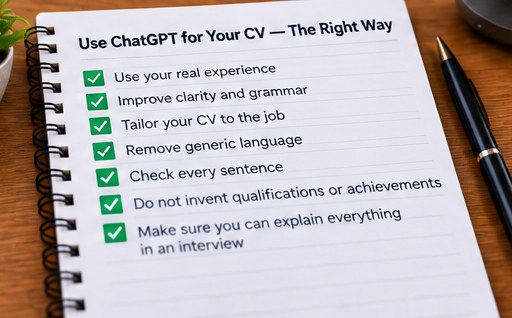
Here is a safer way to use ChatGPT from beginning to end.
Step 1 — Find the vacancy
Save the complete job advertisement.
Step 2 — Read it yourself
Identify the essential requirements before asking AI anything.
Step 3 — Give ChatGPT the vacancy
Ask it to explain what the employer appears to prioritise.
Step 4 — Provide your real CV
Tell ChatGPT not to invent missing information.
Step 5 — Compare your experience with the requirements
Identify genuine matches.
Step 6 — Rewrite relevant sections
Improve clarity without changing facts.
Step 7 — Remove generic language
Replace vague claims with specific duties, skills and achievements.
Step 8 — Verify every sentence
Check employers, dates, qualifications, numbers and responsibilities.
Step 9 — Read it aloud
Ask yourself whether you understand and could naturally explain every statement.
Step 10 — Prepare for the interview from the final CV
Anything you claim may become an interview question.
That final step is particularly useful.
You can even give ChatGPT your final, truthful CV and ask:
“Act as an interviewer. Ask me questions based only on the claims in this CV, one question at a time.”
Now AI is helping you prepare rather than pretending to be you.
AI CV Mistakes to Avoid
| Mistake | Why it can hurt |
|---|---|
| Copying ChatGPT’s first draft | Often produces generic language |
| Asking AI to “make me sound highly experienced” | Can exaggerate your background |
| Inventing metrics | Creates unverifiable claims |
| Copying job-advertisement requirements | Makes the CV inaccurate if you don’t possess them |
| Stuffing keywords | Can make the CV difficult to read |
| Using skills you don’t understand | May be exposed in an interview |
| Using complex words you wouldn’t normally use | Can create a noticeable mismatch |
| Sending the same AI CV everywhere | Fails to address individual vacancies |
| Not proofreading | AI can still make errors |
| Trusting AI with facts you haven’t verified | Plausible output can still be wrong |
Frequently Asked Questions
Will employers know if I use ChatGPT for my CV?
Not necessarily. There is no foolproof way to determine authorship simply by reading a CV, and AI-text detectors have important limitations. However, recruiters may suspect AI when applications contain generic, repetitive, exaggerated or impersonal language. OpenAI
Can ATS detect that my CV was written by ChatGPT?
Do not assume an ATS automatically performs a reliable “ChatGPT detection” test. Recruitment systems are primarily designed to manage and evaluate applications, and employers use AI in different ways. Focus on accurate, relevant, readable content rather than trying to beat an imagined detector.
Is using ChatGPT for a CV cheating?
Using AI to improve grammar, structure or wording of your genuine experience is different from using it to fabricate experience or qualifications. Always follow any specific rules set by the employer.
Can ChatGPT write my whole CV?
It can help draft and organise a CV, but you should provide the underlying facts and personally verify every statement before submitting it.
Should I copy ChatGPT’s CV directly?
No. Review it carefully, remove generic wording, correct mistakes and make sure every claim accurately reflects your real background.
Can employers tell that AI wrote my cover letter?
They may suspect AI assistance if the letter is generic, formulaic or does not match your experience and communication style. Suspicion is not the same as reliable technical proof.
Can AI detectors detect ChatGPT?
AI-text detectors can produce both missed detections and false positives. OpenAI withdrew its earlier public classifier because of its low accuracy. OpenAI
Should I humanise my AI-written CV?
Edit it to make it accurate, specific and natural — not merely to evade an AI detector. Replace generic claims with details from your genuine work history.
Can I use ChatGPT to tailor my CV to every job?
Yes, provided the tailoring highlights genuine aspects of your experience rather than adding requirements you do not actually meet.
What is the safest way to use ChatGPT for a CV?
Give it your real experience and the job advertisement, explicitly tell it not to invent information, use it to improve clarity and relevance, and then personally verify every sentence.
Final Answer: Will Employers Know If I Use ChatGPT for My CV?
Employers will not necessarily know that you used ChatGPT for your CV, and there is no reason to assume that every employer has a reliable tool that can prove your CV was AI-written. AI-text detection itself has significant limitations. OpenAI
But that doesn’t mean you should submit whatever ChatGPT generates.
Recruiters are increasingly encountering AI-assisted applications, and generic AI writing can make candidates harder to distinguish from one another. CV Library
The best way to use ChatGPT is therefore not to ask it to be you.
Ask it to help you present the real you more clearly.
Give it your genuine:
- work history;
- qualifications;
- skills;
- responsibilities;
- achievements;
- training.
Then use AI to improve the organisation, clarity and relevance of that information.
Before submitting the CV, ask yourself one final question:
“Could I confidently explain every sentence on this CV if an interviewer asked me about it tomorrow?”
If the answer is yes, you’re using AI much more responsibly than someone who simply presses Generate, copies the result and hopes nobody notices.