
What Are Three Things You Should Not Say in a Job Interview?
What are three things you should not say in a job interview? The three biggest things to avoid are speaking badly about a previous employer, lying or exaggerating about your skills and experience, and making the interview mainly about your personal or financial problems. Instead, keep your answers professional, truthful and focused on what you can contribute to the position.
For example, avoid saying:
“My previous manager was terrible, and I hated working there.”
“Yes, I know Excel very well,” when you have barely used it.
“I desperately need this job because I have bills to pay.”
These statements can create unnecessary concerns for an interviewer. You can often communicate the same underlying situation in a much stronger way without lying.
South African government interview guidance emphasises preparation, honesty, understanding the employer and being able to explain why your strengths make you suitable for the position. South African Government
This article explains not only what you should avoid saying, but what you can say instead, including realistic examples for South African job seekers.
Table of Contents
The three things you should not say in a job interview

Here is the short answer:
| Don’t say | Why it can hurt your interview | Better approach |
|---|---|---|
| “My previous boss/company was terrible.” | It can make the conversation negative and raise questions about professionalism | Explain what you are looking for in your next opportunity |
| Lie or exaggerate about skills and experience | You may be questioned further or expected to demonstrate a skill you do not have | Be truthful and explain what you know and are willing to learn |
| “I desperately need this job because I need money.” | It focuses on your needs instead of what you can offer the employer | Explain why you want the role and how your skills fit it |
These rules do not mean you must pretend everything in your career has been perfect. You can discuss a bad workplace, unemployment, lack of experience or financial motivation.
The difference is how you communicate it.
1. Do not speak badly about your previous employer or manager
One of the easiest ways to turn an otherwise good interview negative is to spend time attacking your former employer.
Imagine an interviewer in Sandton asks:
“Why did you leave your previous job?”
You answer:
“My manager didn’t know what he was doing. The company was a mess, people were lazy and I couldn’t stand working there anymore.”
Even if parts of that statement reflect your genuine experience, an interview is rarely the best place to unload every frustration from your previous job.
The interviewer has only your side of the story.
They may start wondering how you handle conflict, whether you might speak about their organisation in the same way later, or whether unresolved workplace disagreements could follow you into the new role.
South Africa’s Department of Basic Education interview material advises candidates to remain positive during interviews rather than being drawn into negative topics or speaking badly about people. Department of Basic Education
What should you say instead?
Move the answer towards what you learned and what you want next.
Instead of:
“My manager was horrible.”
Try:
“I learned a lot in my previous position, particularly about customer service and working under pressure. I’m now looking for an environment where I can continue developing and take on greater responsibility.”
Instead of:
“The company treated us badly.”
You might say:
“I decided it was time to look for a new opportunity that was better aligned with the direction I want to take my career.”
That does not require you to pretend the previous workplace was wonderful.
It simply keeps the interview professional.
What if you genuinely left because of a bad workplace?
Sometimes there is a serious reason for leaving.
You may have experienced workplace conflict, poor management, unsafe conditions or another legitimate problem.
You can still answer truthfully.
For example:
“There were some workplace challenges that made me decide it was time to move on. I tried to handle the situation professionally, but eventually I felt finding another opportunity was the right decision. I’m now focused on finding a position where I can use my experience in stock control and customer service.”
Notice that this does not fabricate a positive story.
It gives enough information to answer the question without turning the interview into an attack on another person.
What if the interviewer specifically asks about the conflict?
Then provide relevant facts.
A useful structure is:
Situation → What you did → What happened → What you learned
For example:
“My supervisor and I initially disagreed about how a particular task should be prioritised. I asked to discuss it privately so that I could understand what was expected. We agreed on the priorities, and after that I made sure I confirmed urgent tasks at the beginning of the shift. It taught me to clarify expectations early rather than allowing a misunderstanding to grow.”
That answer demonstrates conflict management rather than conflict avoidance.
2. Do not lie or exaggerate about your experience, qualifications or skills
The second major thing you should not say in a job interview is something you know is untrue.
Government employment guidance explicitly advises honesty in interviews, while public employment material tells candidates to be ready to explain their qualifications, skills and experience. South African Government
An exaggeration can sound harmless when you desperately want an opportunity.
Suppose a vacancy in Midrand requires advanced Microsoft Excel skills.
The interviewer asks:
“How would you rate your Excel skills?”
You have only used Excel to enter information into basic spreadsheets.
You reply:
“I’m advanced. I can do everything on Excel.”
Now imagine the next question is:
“Great. Tell us about a complex spreadsheet you’ve built and which functions you used.”
You have created a problem that did not exist before.
You do not have to know everything
A much stronger response would be:
“I have basic to intermediate Excel experience. I’m comfortable capturing and organising information and using basic spreadsheet functions, but I haven’t yet worked extensively with advanced features such as PivotTables. I’m currently developing that area.”
That answer is honest while still showing initiative.
Don’t claim responsibilities you never had
Imagine a retail employee applying for a supervisor position.
They may think this sounds impressive:
“I managed a team of 15 employees.”
But suppose their actual role was assisting the supervisor and sometimes helping colleagues with tasks.
A truthful version could be:
“I wasn’t formally the supervisor, but I regularly assisted with coordinating tasks within the department and helping newer team members understand procedures. That experience is one reason I’m interested in progressing into supervision.”
The second answer is more credible and gives the employer an accurate understanding of the candidate’s potential.
Don’t invent qualifications
If you started a qualification but did not complete it, do not describe yourself as having completed it.
You can say:
“I completed the first year of the programme but did not complete the full qualification.”
If the interviewer wants more information, explain further.
Don’t exaggerate your previous salary
Candidates sometimes believe increasing their previous salary will strengthen their negotiating position.
It can create unnecessary risk if information you provide later conflicts with what you said in the interview.
Salary discussions are better handled by researching the position and deciding what compensation you would reasonably accept rather than building negotiations around false information.
What if you do not meet every requirement?
Do not immediately disqualify yourself.
Suppose a vacancy asks for three years of administrative experience and you have two.
If you were invited to interview, the employer has already seen enough potential in your application to speak with you.
Focus on what you do have:
“I have two years of direct administrative experience, particularly in data capturing, customer queries and document management. Although I haven’t yet reached three years, those two years have given me strong practical exposure to the main responsibilities listed in this position.”
You have addressed the gap without hiding it.
3. Do not make your personal or financial problems your reason for getting the job
Almost everyone works partly because they need income.
Rent, transport, groceries, electricity, family responsibilities and other expenses are real.
But telling an interviewer:
“Please give me this job. I’m desperate and I haven’t paid my rent.”
usually does not answer the employer’s main question:
Why should we employ you?
South African public employment guidance specifically lists talking about personal or money problems among things candidates should avoid during interviews. Vuk’uzenzele
That does not mean financial difficulties are shameful. It means the interview is primarily an assessment of your suitability for the position.
Turn the conversation towards your value
Instead of:
“I need this job because I’m unemployed.”
Say:
“I’m currently available and looking for a position where I can use my customer-service and retail experience. This role interested me because many of the responsibilities match the work I’ve done previously.”
Instead of:
“I have children to support, so I really need you to hire me.”
Say:
“I’m looking for a stable opportunity where I can contribute long term and continue developing professionally.”
The second statement gives the interviewer something relevant to evaluate.
Why these three statements can cause problems
All three mistakes have something in common.
They move attention away from the strongest question you want the interviewer thinking about:
“What could this candidate contribute here?”
Compare these two interview directions:
| Weak direction | Stronger direction |
|---|---|
| My former employer was terrible | Here is what I learned in my previous role |
| I can do everything | Here are the skills I genuinely have |
| I desperately need money | Here is why I’m interested in this role |
| My manager didn’t like me | Here is how I handle workplace disagreements |
| I’ll take absolutely anything | Here is why this position fits my experience |
| I don’t have that skill | I haven’t used it yet, but here is related experience I have |
Professional interviewing is not about pretending to be perfect.
It is about presenting truthful information in a way that helps the employer understand your suitability.
Other things you should be careful about saying in an interview
The target question asks for three things, but there are several related mistakes worth understanding.
“I don’t know anything about your company.”

You should normally research the organisation before arriving.
The South African Government advises interview candidates to research the organisation’s profile, core business and objectives beforehand. South African Government
The Department of Employment and Labour similarly recommends examining the job description and researching the organisation’s culture, profile, values, mission and relevant stakeholders. Labour South Africa
If an interviewer asks:
“What do you know about us?”
and you answer:
“Nothing really. I just saw the vacancy and applied.”
you may give the impression that you applied without much interest in the particular organisation.
Before the interview, visit the employer’s official website and understand:
- What the organisation does
- Which products or services it provides
- Where the position fits
- The main responsibilities of the vacancy
- Why you are interested
You do not need to memorise the entire company website.
You should understand enough to explain why you applied.
“I don’t have any weaknesses.”
You do not need to present yourself as flawless.
If asked about a weakness, choose a genuine area for development and explain what you are doing about it.
For example:
“Earlier in my career I sometimes struggled to ask for clarification because I wanted to solve everything independently. I’ve learned that asking the right question early can prevent mistakes, so I now clarify expectations when instructions aren’t clear.”
Avoid turning every weakness into an obvious fake strength such as:
“My weakness is that I work too hard.”
Interviewers have heard variations of that answer many times.
“I’ll do anything.”
This may sound enthusiastic, but it can also sound unfocused.
If you are interviewing for an administrative position, say why administration interests you.
If you are applying for a warehouse role, connect your experience to warehousing.
An employer wants to know why you fit this job, not simply that you want any available job.
“It’s already on my CV.”
An interviewer may ask about something clearly written on your CV.
That does not make the question pointless.
They may want you to expand on it, check your communication skills or understand the context behind the information.
Instead of:
“It’s on my CV.”
say:
“Yes. In that position I was responsible for…”
Then explain the relevant details.
“I have no questions.”
Near the end of an interview, you may hear:
“Do you have any questions for us?”
Having a thoughtful question can demonstrate that you have considered the position carefully.
The Department of Employment and Labour recommends preparing appropriate questions for the interviewer, particularly questions seeking clarity about the position. Labour South Africa
You could ask:
“What would be the main priorities for the person in this position during the first few months?”
or:
“What does a typical day in this role look like?”
or:
“How would you describe the team I would be working with?”
Do not ask a question simply for the sake of speaking. If everything genuinely has been covered, you can acknowledge that:
“You have covered most of the questions I had, thank you. I would just like to know what the next stage of the recruitment process will be.”
Should you ask about salary in a job interview?
This requires more nuance than saying “never mention salary.”
Salary is an important part of accepting employment. You are entitled to understand what a job pays before accepting it.
However, timing matters.
Western Cape Government interview guidance recommends avoiding questions about bonuses, benefits or salary during the interview and dealing with salary negotiations later or when the interviewer raises the subject. Western Cape Government
The Department of Employment and Labour’s interview-preparation material similarly advises candidates not to use their end-of-interview questions to ask about remuneration, suggesting that this can be discussed with HR outside that part of the interview process. Labour South Africa
If the interviewer asks you about your salary expectations, however, answer the question.
Do not reply:
“We’re not supposed to talk about salary in interviews.”
The employer has raised it, so it is appropriate to discuss it.
What should you say when asked why you left your previous job?
This is where many candidates accidentally fall into the first mistake.
You can use this structure:
Reason → positive transition → future
For example:
“I’d reached a point where there was limited room for progression in my previous position. I gained valuable experience there, particularly in customer service and stock control, and I’m now looking for an opportunity where I can develop further.”
If you were retrenched:
“My position was affected by retrenchment. I had worked there for four years and gained strong administrative experience. I’m now looking for another role where I can use those skills.”
If your contract ended:
“It was a fixed-term contract and it came to an end. I enjoyed the work and I’m now looking for a permanent opportunity where I can continue developing.”
If you were dismissed, do not invent a resignation.
Give a brief, truthful explanation and focus on what you learned and what has changed.
What if you were fired from your previous job?
This can be uncomfortable, but lying may create a larger problem.
Keep your answer concise.
For example:
“My previous employment ended after I failed to meet the required attendance standard. I take responsibility for that. Since then I’ve taken steps to address the issue, and I understand how important reliability is to an employer.”
The exact wording should reflect what actually happened.
Do not blame everyone else if you were responsible, but do not confess to things that are untrue either.
Accountability can be more persuasive than a complicated excuse.
What if you have been unemployed for a long time?
Avoid:
“Nobody wants to hire me.”
or:
“I’ve applied everywhere and everyone rejects me.”
Even if job searching has been frustrating, those statements do not help demonstrate your suitability.
Instead, explain the situation factually:
“I’ve been looking for the right opportunity while continuing to apply for positions that match my experience. During that period I’ve also been working on improving my computer skills and preparing for roles like this one.”
Only mention courses or skills development you have genuinely completed.
If you have been caring for a family member, studying, doing temporary work or handling another responsibility, you can explain that honestly if you are comfortable doing so.
What if you have no work experience?
Do not say:
“I don’t have experience, so there’s not much I can tell you.”
You have just ended your own answer.
A better response is:
“I haven’t had formal employment yet, but during school I developed experience working in teams, completing projects to deadlines and using Microsoft Office. I’m looking for my first opportunity to turn those skills into workplace experience.”
For a learnership:
“I don’t yet have formal industry experience, which is one reason this learnership interests me. I’ve completed matric, I’m comfortable learning new systems and I’m ready to develop practical experience.”
Being inexperienced and being incapable are not the same thing.
How to answer difficult questions without saying something you regret
When an interviewer asks an unexpected question, you do not have to answer instantly.
A brief pause is fine.
The Department of Employment and Labour advises interviewees to listen attentively and pause before answering so that they understand the question, while keeping responses clear, concise and relevant. Labour South Africa
Use this simple process:
1. Listen to the whole question.
Do not begin answering halfway through.
2. Pause briefly.
Think about what the interviewer is actually asking.
3. Identify the relevant information.
You do not need to reveal every detail surrounding the situation.
4. Answer truthfully.
Do not create facts because you think they sound better.
5. Bring the answer back to the job where appropriate.
Explain what you learned, what you can do or how the experience prepared you.
A realistic South African interview example
Imagine Ayanda, a fictional job seeker from Soweto, is interviewing for a retail supervisor position at a shopping centre in Johannesburg.
The interviewer asks:
“Why are you leaving your current employer?”
Poor answer
“Management is useless. They don’t appreciate anything I do and my supervisor has favourites. I’m tired of that place.”
Better answer
“I’ve gained valuable retail experience in my current position, particularly in customer service, stock management and working with a team. I’m now looking for an opportunity where I can take on greater responsibility and develop towards supervision, which is what attracted me to this role.”
Later, the interviewer asks:
“Have you formally managed employees before?”
Poor answer
“Yes, I’ve managed teams.”
Ayanda has not formally managed anyone.
Better answer
“I haven’t held a formal management title yet, but I’ve regularly helped coordinate tasks in the department and supported newer employees. I’m now looking for an opportunity to develop that experience into formal supervisory responsibility.”
Finally:
“Why do you want this job?”
Poor answer
“The salary is better and I really need money.”
Better answer
“The position interests me because it would allow me to build on the retail experience I already have while taking on more responsibility for the team and daily operations.”
The facts have not been manipulated.
The stronger answers simply focus on relevant information.
Prepare before the interview so you do not say the wrong thing

Most interview mistakes are easier to prevent before you enter the room.
South African Government guidance recommends researching the organisation, preparing for common and challenging questions, and preparing a short pitch about what makes you suitable for the position. South African Government
Before your interview, prepare answers for questions such as:
- Tell me about yourself.
- Why do you want this job?
- Why should we hire you?
- What are your strengths?
- What is one weakness you are working on?
- Why did you leave your previous position?
- Tell us about a workplace challenge.
- What do you know about our organisation?
- Where do you see yourself developing professionally?
- Do you have any questions for us?
Do not memorise entire paragraphs.
Prepare the facts and examples you want to communicate.
That makes it easier to sound natural.
A quick “say this, not that” interview guide
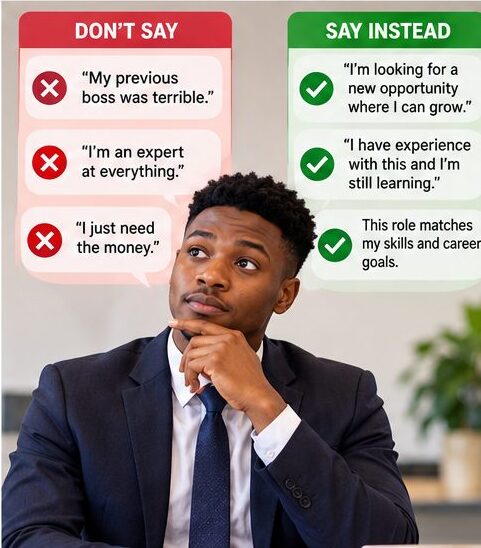
| Situation | Avoid saying | Better approach |
|---|---|---|
| Previous employer | “My boss was an idiot.” | “I’m looking for an environment where I can develop further.” |
| Missing skill | “Yes, I’m an expert.” | “I have basic experience and I’m currently developing that skill.” |
| Unemployment | “Nobody will hire me.” | “I’m actively looking for a role that matches my experience.” |
| Motivation | “I just need money.” | “The responsibilities match my experience and career direction.” |
| Weakness | “I don’t have weaknesses.” | Explain a genuine development area and what you’re doing about it |
| Company research | “I know nothing about you.” | Research the organisation beforehand |
| No experience | “I can’t do much.” | Discuss education, projects and transferable skills |
| Previous conflict | “Everyone there was toxic.” | Explain the situation professionally and focus on what you learned |
| Questions | “No, nothing.” | Ask a thoughtful role-related question if something remains unclear |
| CV | “It’s written on my CV.” | Expand on the relevant experience |
Your interview is not a test of perfection
Avoiding certain phrases does not mean you need to act like a different person.
Interviewers know that candidates:
- have made mistakes;
- may have left difficult workplaces;
- may be unemployed;
- may lack some skills;
- may be nervous;
- care about salary; and
- may not have a perfect employment history.
Your goal is to communicate these realities professionally and truthfully.
The Department of Employment and Labour advises job seekers to understand their own personality, interests, talents, skills, qualifications, work experience and accomplishments before interviewing. Doing so makes it easier to explain clearly what you can offer. Labour South Africa
Preparation gives you something useful to talk about when nerves arrive.
Frequently Asked Questions
What are three things you should not say in a job interview?
Three important things you should not say are negative comments attacking previous employers, lies or exaggerations about your qualifications and skills, and statements making personal or financial desperation your main reason for wanting the job. Keep your answers truthful, professional and relevant to the vacancy.
Is it bad to say “I don’t know” in an interview?
Not necessarily. If you genuinely do not know something, admitting that can be better than inventing an answer. Where appropriate, explain how you would find the answer or relate the question to something you do know.
Should I tell an interviewer that I really need the job?
You can show that you genuinely want the opportunity, but focus on why you want this particular role and what you can contribute rather than asking to be hired because of financial pressure.
Can I say my previous boss was difficult?
You can explain a genuine workplace difficulty if it is relevant, but avoid personal attacks. Describe the situation factually, explain how you handled it and focus on what you learned.
What should I say if I was fired?
Be truthful and concise. Explain the circumstances without unnecessarily attacking your previous employer. If you made a mistake, explain what you learned and what you have done differently since.
What if the interviewer asks something I do not understand?
Ask for clarification. It is better to understand the question before answering than to guess what the interviewer meant.
Should I ask about salary during the first interview?
If the employer raises salary, answer appropriately. If they have not, guidance from the Western Cape Government and Department of Employment and Labour suggests keeping your own end-of-interview questions focused primarily on the role and dealing with remuneration at an appropriate stage or with HR. Western Cape Government
What should I say when the interviewer asks if I have questions?
Ask something you genuinely want to understand about the position, such as the role’s main priorities, the team, what success looks like or the next stage of the recruitment process.
Is it okay to admit I do not have experience?
Yes. Do not invent experience. Explain the relevant education, projects, volunteering, transferable skills or training you do have, and show that you understand what the position requires.
Should I memorise my interview answers?
Prepare your main points and practise speaking them, but avoid memorising every sentence. Western Cape Government guidance similarly recommends preparing possible answers without necessarily memorising them. Western Cape Government
Conclusion
If you remember only three things you should not say in a job interview, remember these: do not attack your previous employer, do not lie about your abilities, and do not make personal or financial desperation your main reason for wanting the job.
You do not need a perfect employment history or perfect answers.
You need to be prepared, truthful and able to explain what you can contribute.
When discussing something difficult, move the conversation towards what you learned, what you can genuinely do and why the opportunity makes sense for you.
That gives the interviewer something useful on which to judge your application.