
How Do I Introduce Myself During an Interview?
How do I introduce myself during an interview? Start by briefly stating who you are professionally, mention your most relevant qualification or work experience, highlight two or three skills that match the job, and finish by explaining why you are interested in the position. Your introduction should normally be concise, job-focused and natural rather than a long story about your personal life.
Table of Contents
For example:
“My name is Thando Mkhize. I have three years of retail experience, mainly in customer service, stock control and merchandising. In my previous position, I worked in a busy store where I assisted customers, monitored stock and worked closely with the rest of the team to keep the department organised. I’m reliable, comfortable working with customers and able to work under pressure. I applied for this position because it matches my experience and I’d like to continue developing my retail career.”
That answer gives the interviewer useful information immediately.
You do not need an impressive job title, university degree or years of experience to introduce yourself well. A matriculant, graduate, unemployed job seeker, career changer and experienced professional will simply structure the answer differently.
The key is to answer the question the interviewer is really asking:
“Who are you as a candidate, and why should I continue considering you for this job?”
What Does “Introduce Yourself” Mean in a Job Interview?
When an interviewer says:
“Tell me about yourself.”
“Please introduce yourself.”
or:
“Can you tell us a little about yourself?”
they are usually not asking for your entire life story.
They want a useful overview of you as a candidate.
The South African Department of Employment and Labour includes “Tell us about yourself” among common questions job seekers should prepare for. Its interview guidance also advises candidates to know their personality, interests, talents, skills, educational qualifications, work experience and accomplishments before attending an interview.
Your introduction gives the interviewer an early picture of how your background relates to the vacancy.
A good answer should therefore help them understand:
- who you are professionally;
- your relevant experience or education;
- your strongest relevant skills;
- what you can potentially contribute;
- why the position makes sense for you; and
- where appropriate, what you hope to develop.
It should not simply repeat every line of your CV.
Think of your introduction as a short guided tour of the parts of your background that matter most for this particular vacancy.
A Simple Formula for Introducing Yourself
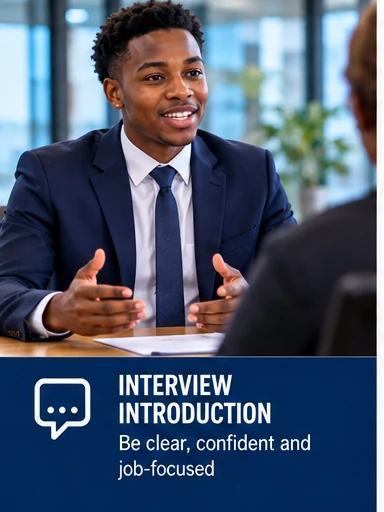
If you struggle to know what to say, use this four-part structure:
Present → Background → Relevant strengths → Why this job
| Part | What to talk about | Example |
|---|---|---|
| Present | Who you are professionally now | “I’m a recent logistics graduate…” |
| Background | Relevant education or experience | “…and I completed practical workplace training during my studies.” |
| Relevant strengths | Skills connected to the vacancy | “I developed strong Excel, organisation and inventory-management skills.” |
| Why this job | Why you applied | “I’m now looking for an entry-level role where I can apply those skills and develop further.” |
This structure is flexible.
Someone with ten years of experience should emphasise experience and achievements.
Someone who has never worked before can emphasise education, projects, volunteering, practical training and transferable skills.
Someone changing careers can explain how skills from their previous occupation transfer to the new one.
How to Introduce Yourself During an Interview Step by Step
Step 1: Read the job advertisement again
Do this before preparing your introduction.
Look specifically for:
- required experience;
- qualifications;
- responsibilities;
- technical skills;
- software;
- licences;
- communication requirements;
- customer-service responsibilities; and
- personal qualities.
The Department of Employment and Labour recommends examining the job description carefully and comparing your goals and qualifications with the position.
Why does this matter?
Because your introduction for a cashier vacancy should not be identical to your introduction for a warehouse position.
Imagine you previously worked in retail and performed both customer-service and stock-control duties.
For a cashier vacancy, you might emphasise:
- assisting customers;
- communication;
- accuracy;
- working under pressure; and
- reliability.
For a warehouse vacancy, the same person might emphasise:
- receiving stock;
- stock counting;
- inventory control;
- checking deliveries;
- organisation; and
- following procedures.
Your background has not changed.
The information you choose to emphasise has.
Step 2: Decide how you describe yourself professionally
Your first sentence should establish who you are in relation to the vacancy.
For example:
“I’m a qualified electrician with four years of maintenance experience.”
“I’m a recent BCom graduate interested in financial administration.”
“I’m an experienced retail employee with a background in customer service and stock control.”
“I recently completed matric and I’m looking for my first formal employment opportunity.”
“I’m an administrative professional with experience in customer support, data capturing and office coordination.”
You do not need to force yourself to use an impressive title.
Be accurate.
If you have never worked as an accountant, do not call yourself an accountant simply because you studied accounting.
Step 3: Give relevant background
Now explain the most useful part of your background.
This could include:
- previous jobs;
- qualifications;
- learnerships;
- internships;
- volunteer experience;
- university projects;
- TVET training;
- school responsibilities; or
- relevant practical experience.
Do not describe everything.
If you have worked for 12 years, the interviewer probably does not need a detailed explanation of every position you held.
Choose the experience that helps them understand why you could perform this job.
Step 4: Mention two or three relevant strengths
Your strengths should connect to the job advertisement.
Instead of:
“I am hardworking, passionate, motivated, dedicated, loyal and a fast learner.”
give the interviewer something more useful.
For example:
“My strongest areas are customer service, stock control and working accurately under pressure.”
That answer is easier to understand and remember.
Better still, connect a strength to evidence:
“I’m comfortable working in busy environments because my previous retail position required me to assist customers while also keeping track of stock and maintaining the department.”
Now the interviewer has a reason to believe your claim.
Step 5: Explain why you are interested in the opportunity
Finish by connecting your background to the position.
For example:
“I’m now looking for an opportunity where I can use my customer-service experience while taking on more responsibility.”
Or:
“I applied because this position would allow me to use the administrative skills I developed during my internship while continuing to grow professionally.”
This creates a natural ending.
The interviewer can then move to the next question.
How Long Should Your Introduction Be?
There is no universal rule requiring your introduction to be exactly 30, 60 or 90 seconds.
The better principle is:
Long enough to establish your relevance, but short enough that you do not dominate the interview.
For many ordinary interviews, roughly 45–90 seconds can be a useful practice range.
Do not panic if your natural answer is slightly shorter or longer.
Quality matters more than hitting a stopwatch.
A 40-second answer containing relevant information is better than a two-minute speech full of unrelated details.
Example: How to Introduce Yourself With No Work Experience
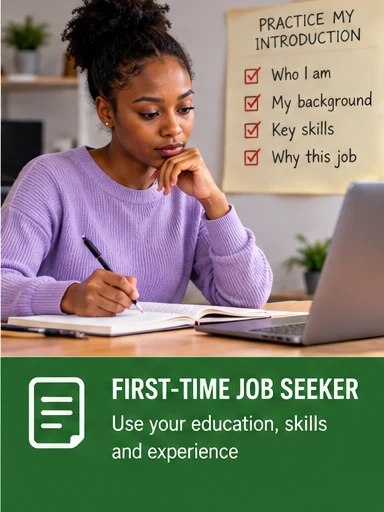
Having no formal work experience does not mean you should say:
“My name is Sipho. I don’t have experience because nobody has given me a chance.”
That immediately focuses the conversation on what you lack.
Instead, build your introduction from what you do have.
For example:
“My name is Sipho Dlamini. I recently completed matric, where I developed a strong interest in working with people and solving problems. Although I haven’t had formal employment yet, I have helped with community activities and school projects that required teamwork, responsibility and meeting deadlines. I’m comfortable learning new tasks and working with others. I’m looking for my first formal opportunity where I can gain practical experience, contribute to the team and develop my skills.”
Notice that the candidate does not pretend to have experience.
He is honest.
But he does not allow the absence of formal experience to become his entire identity.
What can you mention if you have never worked?
Consider:
- school projects;
- leadership roles;
- sports teams;
- church or community activities;
- volunteering;
- helping in a family business;
- computer skills;
- driver’s licence;
- language skills;
- certificates;
- practical courses;
- academic projects; and
- genuine responsibilities you have handled.
Only mention things that are true.
Example for a Retail Job Interview

Suppose you are interviewing for a sales assistant, shelf packer or general retail position.
You could say:
“My name is Lerato. I have about two years of retail experience, where my responsibilities included helping customers, merchandising stock, checking product availability and keeping the department organised. Working in retail taught me how important reliability, teamwork and good customer service are, especially during busy periods. I’m comfortable working with different customers and handling several responsibilities at once. I’m interested in this position because it matches the experience I’ve built and gives me an opportunity to continue developing in retail.”
This introduction works because it speaks directly to retail work.
Example for a Cashier Interview
“I’m Nomvula, and I have experience working directly with customers in a retail environment. I’m comfortable communicating with different people, working accurately and staying calm when the store is busy. My previous experience also taught me the importance of following procedures and treating customers respectfully. I’m interested in this cashier position because I enjoy customer-facing work and believe my retail experience would allow me to contribute quickly.”
If you have actual cash-handling or point-of-sale experience, mention it.
If you do not, do not claim it.
Example for a Warehouse Job
“My name is Kabelo. My background is mainly in retail stock handling and inventory-related work. I have experience receiving and organising stock, checking quantities, maintaining stock areas and following procedures. I’ve learned to work accurately and efficiently, particularly when there are deadlines or large deliveries. I’m interested in moving into warehouse work because I want to build on my stock-handling experience in a more logistics-focused environment.”
This is a good example of transferring experience from one industry to another.
Example for an Administrative Job
“I’m Ayanda, an administrative assistant with experience in data capturing, filing, customer communication and Microsoft Office. In my previous role, I regularly worked with documents, responded to enquiries and helped keep records organised. I’m particularly strong at keeping track of details and completing tasks accurately. I’m interested in this position because it combines administration and communication, which are both areas I enjoy.”
Example for a Graduate Interview
Graduates sometimes make the mistake of describing their entire degree.
You do not need to list every module.
Try:
“My name is Neo, and I recently completed a Bachelor of Commerce degree. During my studies, I became particularly interested in financial analysis and business operations, and I developed practical Excel, research and problem-solving skills through assignments and group projects. I’m now looking for a graduate opportunity where I can apply what I’ve learned in a professional environment and continue developing under experienced colleagues.”
If you completed an internship, vacation programme or substantial project, include the most relevant one.
South African university career services also encourage interview preparation and practice. The University of Cape Town describes interviews as structured conversations used to understand a candidate’s skills, experience and personal attributes, while emphasising that candidates can and should prepare.
Example for an Internship or Learnership Interview
“I’m Zanele, and I recently completed matric with subjects including Mathematics and Business Studies. I’m interested in developing a career in business administration. I haven’t had a permanent job yet, but through school projects and volunteering I developed teamwork, communication and basic computer skills. I applied for this learnership because I want structured workplace experience and an opportunity to develop practical skills while contributing to the organisation.”
Avoid saying:
“I applied because I need money.”
Income is naturally important, but the interviewer is evaluating your suitability and motivation for the opportunity.
Example for an Experienced Candidate
If you already have substantial experience, your introduction should be more focused.
For example:
“I’m an operations supervisor with seven years of experience across warehousing and distribution. For the past three years I’ve supervised teams responsible for receiving, picking and dispatch while monitoring stock accuracy and daily productivity. One of my strongest areas is identifying operational problems and working with teams to improve processes. I’m now looking for a position where I can take on broader operational responsibility, which is what attracted me to this role.”
You do not need to explain your first job unless it remains relevant.
Example When Changing Careers
Career changers need to answer an unspoken question:
Why does your old experience matter here?
For example:
“My background is in hospitality, where I spent four years working directly with customers and handling bookings, enquiries and complaints. Through that experience I developed strong communication, administration and problem-solving skills. I’m now moving towards office administration because I want to use those transferable skills in a more administrative environment. This position stood out because it requires both customer communication and accurate record keeping.”
The candidate does not pretend hospitality and office administration are identical.
Instead, the answer explains the bridge between them.
What Should I Say About Myself?
Use this checklist.
| Include | Usually avoid |
|---|---|
| Relevant work experience | Full childhood story |
| Relevant qualifications | Unrelated family information |
| Two or three job-related strengths | A long list of adjectives |
| Useful achievements | Complaints about previous employers |
| Relevant practical experience | Desperation about needing the job |
| Why the role interests you | Salary demands in your introduction |
| Transferable skills | Information unrelated to your ability to do the job |
| Brief career direction | Memorised generic motivational quotes |
This does not mean personal interests are forbidden.
If an interviewer specifically asks about hobbies or interests, answer naturally.
The point is simply that your opening introduction should primarily help the employer evaluate you as a candidate.
Should I Start With My Name?
Yes, you can.
For example:
“My name is Bongani Dube, and I have three years of experience in…”
However, if the interviewer has already greeted you by name, repeating your full name is optional.
You could naturally begin:
“Sure. My background is mainly in retail and customer service…”
Both approaches can work.
Do not become so focused on memorising a formula that you stop sounding like a person having a conversation.
Should I Mention My Age?
Usually, your age does not need to be part of your opening introduction unless there is a specific legitimate reason it is relevant.
You also generally do not need to volunteer details such as:
- marital status;
- number of children;
- religion;
- political views;
- unrelated family problems; or
- other deeply personal information.
Keep the introduction relevant to your candidacy.
Should I Tell the Interviewer Where I Live?
Only if it is relevant or they ask.
For example, if you live in Roodepoort and are interviewing for a job in Sandton, you do not need to make your suburb part of your opening speech.
But if the interviewer later asks whether you can reliably travel to the workplace for an early shift, answer honestly about your transport arrangements.
Never promise that transport will “not be a problem” if you know you cannot realistically reach the workplace at the required time.
What If I Am Unemployed?
Do not make unemployment the centre of your introduction.
You can still introduce yourself based on your skills and previous experience.
For example:
“I’m an experienced customer-service and retail worker with four years of experience assisting customers, handling stock and working in fast-paced stores. My most recent role strengthened my stock-control and team-coordination skills. I’m currently looking for my next opportunity, and this position interested me because it combines customer service with stock responsibilities.”
If the interviewer wants to know why your previous employment ended, they can ask separately.
Then answer honestly and professionally.
What If I Was Fired?
You normally do not need to announce this in your opening introduction.
Your introduction answers:
Who are you as a candidate?
Questions about why you left a previous employer are separate.
If asked later, avoid lying, blaming everyone else or giving a long emotional explanation.
Take responsibility where appropriate, explain the situation concisely and focus on what you learned and what has changed.
Should I Memorise My Introduction?
Prepare it, but do not memorise every word.
A completely memorised answer can sound unnatural. Worse, if you forget one sentence, you may panic because you were relying on an exact script.
Instead, memorise the structure:
- Who I am professionally.
- My relevant background.
- My strongest relevant skills.
- Why I want this opportunity.
Then practise expressing those four ideas in slightly different words.
That makes your answer sound more like a conversation.
Practise Out Loud, Not Only in Your Head
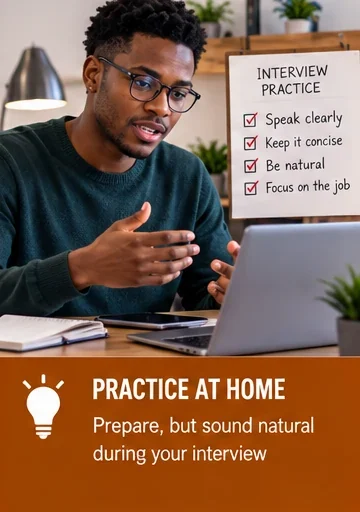
Reading your answer silently is not enough.
Say it aloud.
Record yourself on your phone if necessary.
Listen for:
- speed;
- clarity;
- filler words;
- unnecessary repetition;
- volume;
- awkward phrases; and
- whether the answer sounds memorised.
Then shorten it.
The Department of Employment and Labour recommends practising possible interview questions with a friend or family member and using their feedback to improve factors such as tone, eye contact, facial expression and body language.
Mock interviews can also help. South African university career services such as UCT run mock-interview programmes where students can practise interviews and receive feedback.
Body Language During Your Introduction
Your words matter, but so does how you communicate them.
Try to:
- sit comfortably upright;
- look at the interviewer while speaking;
- include other panel members naturally if there is a panel;
- speak clearly enough to be heard;
- avoid rushing;
- listen before answering; and
- show interest without forcing exaggerated enthusiasm.
If you are nervous, that is not automatically a disaster.
Interviewers regularly speak to nervous candidates.
Your goal is not to perform like a television presenter.
Your goal is to communicate clearly enough for the interviewer to understand what you can offer.
How to Introduce Yourself in a Panel Interview
South African government and corporate interviews can sometimes involve several interviewers.
Do not stare at only one person for the entire answer.
When one panel member asks the question, begin by responding naturally to that person. As you continue, you can make comfortable eye contact with the other panel members too.
Do not rapidly move your head from person to person after every sentence.
Keep it natural.
Your answer itself does not need to change simply because there is a panel.
How to Introduce Yourself in a Virtual Interview
The content of your introduction remains largely the same.
The preparation changes.
Before a Microsoft Teams, Zoom or similar virtual interview:
- test your internet connection;
- test your microphone;
- check your camera;
- choose a quiet location;
- charge your device;
- have the meeting link ready;
- position the camera sensibly;
- remove distracting background noise where possible; and
- join early enough to deal with technical problems.
Do not read your introduction from another window.
Interviewers can often tell when a candidate is reading instead of speaking naturally.
You can keep a few short reminder points nearby, but your attention should remain on the conversation.
Common Mistakes When Introducing Yourself
1. Giving your entire life story
The interviewer does not need a chronological biography from primary school onwards.
Focus on the parts of your story relevant to the vacancy.
2. Repeating your CV word for word
The interviewer probably already has your CV.
Your introduction should interpret your experience, not recite it.
3. Saying only adjectives
“I’m hardworking, passionate, dedicated, motivated and honest.”
These words are easy to claim.
Connect strengths to evidence.
4. Talking for too long
A long introduction can make it difficult for the interviewer to identify your strongest selling points.
Prioritise.
5. Giving the same introduction for every job
Tailor your answer to the vacancy.
6. Speaking negatively about a former employer
Your opening introduction is not the place to explain workplace conflicts.
7. Lying about experience
If the vacancy asks for Excel and you only have basic Excel knowledge, do not describe yourself as an advanced user.
Interviewers may test you.
8. Saying “everything is already on my CV”
Your CV got you into the interview.
The interview now gives the employer an opportunity to evaluate how you communicate and whether your background fits the position.
9. Starting with desperation
Avoid:
“Please give me this job because I’ve been unemployed for two years.”
Your circumstances may be difficult, but your introduction should focus on what you can contribute.
10. Sounding like a motivational poster
Avoid generic statements that could belong to any candidate.
Specific information is more memorable.
Build Your Own Interview Introduction
Use this template:
“I’m [professional description/current situation]. I have [relevant experience/education]. Through that experience, I’ve developed [two or three relevant skills]. One area I’m particularly strong in is [relevant strength with brief evidence]. I’m interested in this position because [genuine connection between you and the role].”
Example with experience
“I’m an experienced retail employee with four years of experience in customer service and stock-related work. Through my previous positions, I’ve developed strong customer communication, merchandising and stock-control skills. I’m particularly comfortable working in busy environments where I need to prioritise several responsibilities. I’m interested in this position because it matches my retail background while giving me an opportunity to take on more responsibility.”
Example without experience
“I recently completed matric and I’m looking for my first formal work opportunity. Through school and community activities, I’ve developed teamwork, communication and basic computer skills. I’m reliable, willing to learn and comfortable working with other people. I applied for this position because it offers an opportunity to gain practical experience while contributing to a working team.”
Do not copy either example blindly.
Replace the content with your real experience.
A Five-Minute Preparation Exercise
Take the vacancy you are interviewing for and create four headings on a piece of paper:
1. What they need
Write the five most important requirements from the advertisement.
2. What I have
Next to each requirement, write experience, education or skills you genuinely have.
3. My strongest evidence
Choose the best two or three matches.
4. My introduction
Turn those matches into a short spoken answer.
For example:
| Employer needs | Candidate evidence | Mention in introduction? |
|---|---|---|
| Customer service | Two years assisting retail customers | Yes |
| Stock control | Regular stock counts and merchandising | Yes |
| Microsoft Excel | Basic knowledge only | Mention only if relevant |
| Driver’s licence | Does not have one | No — never invent it |
| Teamwork | Worked in a department team | Yes |
This exercise prevents you from giving a generic introduction.
What Happens After You Introduce Yourself?
Your introduction often creates material for follow-up questions.
If you say:
“I have strong stock-control experience.”
the interviewer may ask:
“Can you give us an example?”
If you say:
“I’m good at solving customer problems.”
they may ask:
“Tell us about a difficult customer you dealt with.”
Therefore, never put something in your introduction that you cannot explain.
Prepare examples.
A useful approach for behavioural questions is to explain:
- the situation;
- what you needed to do;
- what action you took; and
- what happened.
Keep examples factual and focused on your own contribution.
Questions You Should Prepare After “Tell Me About Yourself”
Your introduction is only the beginning.
The Department of Employment and Labour’s interview-preparation guidance identifies other common questions, including why the employer should hire you, your strengths and weaknesses, why you want to work for the organisation, your understanding of the position, career objectives and examples of challenges you have faced.
Prepare for questions such as:
- Why should we hire you?
- Why do you want this job?
- What do you know about our company?
- What are your strengths?
- What is one weakness you are working on?
- Why did you leave your previous job?
- Tell us about a difficult situation you handled.
- Where do you see yourself in the next few years?
- What do you understand about this position?
- Do you have any questions for us?
Research the employer as well.
Do not prepare only information about yourself.
Understanding the company, its work and the advertised role makes it easier to explain why your background is relevant.
Frequently Asked Questions
How do I introduce myself during an interview?
Briefly explain who you are professionally, your relevant experience or education, two or three strengths related to the vacancy and why you are interested in the position. Keep the answer focused on information that helps the interviewer assess your suitability.
What should I say when an interviewer says “Tell me about yourself”?
Start with your current professional situation, move to relevant experience or education, highlight useful skills and finish by connecting your background to the vacancy.
How do I introduce myself if I have no experience?
Focus on education, practical projects, volunteering, learnerships, school responsibilities, transferable skills and your willingness to develop. Do not invent work experience.
Should I mention my name when introducing myself?
You can, although it is not compulsory if the interviewer has already greeted you by name. Starting with “My name is…” is perfectly acceptable if it helps you begin confidently.
How long should my interview introduction be?
There is no compulsory duration. Roughly 45–90 seconds can be a useful practice range for many interviews, but relevance and clarity matter more than hitting an exact time.
Should I talk about my family?
Usually not in your opening introduction unless there is a genuine reason it is relevant or the interviewer specifically asks. Focus primarily on your professional background and suitability for the role.
Can I say that I am hardworking?
Yes, but it is stronger when supported by evidence. Instead of simply claiming you are hardworking, briefly explain a responsibility or situation that demonstrates reliability, effort or persistence.
Should I memorise my answer?
Prepare and practise it, but try not to memorise every sentence. Learn the main points so that you can speak naturally.
What if English is not my first language?
You do not need complicated vocabulary to make a good impression. Clear, relevant answers are more useful than trying to sound overly sophisticated. Practise your introduction aloud until you are comfortable expressing the main points.
What if I become nervous and forget what I prepared?
Return to four points: who you are, your relevant background, your strongest relevant skills and why you want the position. A short genuine answer is better than panicking because you cannot remember a memorised script.
Final Interview Introduction Checklist
Before your interview, make sure you can answer these questions:
- Who am I professionally?
- What relevant experience or education do I have?
- Which two or three skills best match this vacancy?
- What evidence supports those skills?
- Why did I apply for this particular job?
- Can I explain everything I mention?
- Does my introduction sound natural when spoken aloud?
- Have I researched the employer?
- Have I reread the job advertisement?
- Have I practised likely follow-up questions?
Your introduction does not need to be perfect.
It needs to be relevant, truthful, concise and connected to the job.
When an interviewer asks you to introduce yourself, do not try to tell them everything about you. Give them the information that makes it easiest to understand why you could be a suitable candidate—and then allow the rest of the interview to provide the evidence.