
Which Province in SA Has the Highest Unemployment Rate?
Which province in SA has the highest unemployment rate? The Eastern Cape has the highest official unemployment rate in South Africa, at 47.5% in the second quarter of 2026, according to the latest provincial data published by Statistics South Africa (Stats SA). That means almost half of the Eastern Cape labour force was officially unemployed during Q2 2026. The Western Cape had the lowest official unemployment rate, at 19.5%.
However, there is an important distinction. When Stats SA uses the broader measure that includes the potential labour force, North West has the highest rate at 56.0%, compared with 54.1% in the Eastern Cape. So the answer depends on whether you are looking at the official unemployment rate or a broader measure of labour underutilisation.
For most comparisons, news reports and discussions of South Africa’s unemployment rate, the official unemployment rate is the figure used. On that measure, the Eastern Cape currently ranks highest.
Table of Contents
South African unemployment rate by province
Stats SA’s Quarterly Labour Force Survey (QLFS) for Q2 2026 provides a clear picture of how unemployment differs across the country’s nine provinces.
Here is the ranking based on the official unemployment rate:
| Rank | Province | Official unemployment rate Q2 2026 |
|---|---|---|
| 1 | Eastern Cape | 47.5% |
| 2 | North West | 38.1% |
| 3 | Free State | 37.3% |
| 4 | Mpumalanga | 36.6% |
| 5 | Gauteng | 34.6% |
| — | South Africa overall | 33.6% |
| 6 | KwaZulu-Natal | 32.5% |
| 7 | Limpopo | 32.0% |
| 8 | Northern Cape | 28.7% |
| 9 | Western Cape | 19.5% |
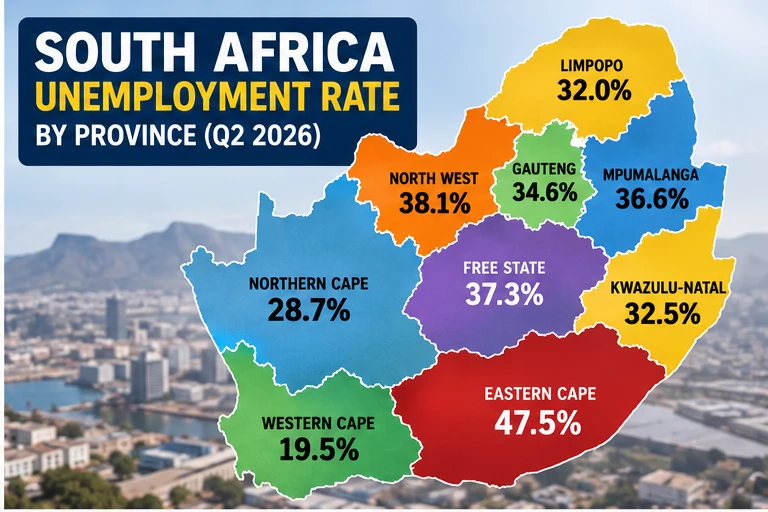
Source: Statistics South Africa, Quarterly Labour Force Survey, Q2 2026.
The table shows just how large the provincial differences are.
The Eastern Cape’s 47.5% unemployment rate was 28 percentage points higher than the Western Cape’s 19.5%.
It was also 13.9 percentage points above South Africa’s national official unemployment rate of 33.6%.
Readers can check the latest releases through the Statistics South Africa Quarterly Labour Force Survey page.
Why does the Eastern Cape have the highest unemployment rate in South Africa?

There is no single explanation for the Eastern Cape’s high unemployment rate.
Employment outcomes are influenced by a combination of economic activity, demographics, investment, education and skills, the availability and location of employers, migration, infrastructure and the structure of provincial economies.
It is also important not to interpret a high unemployment rate as meaning that people in the province are unwilling to work.
The unemployment rate measures conditions in the labour market. It tells us about the relationship between people who are employed and unemployed within the labour force.
In Q2 2026, the Eastern Cape’s official unemployment rate reached 47.5%. Its absorption rate was only 28.9%, according to Stats SA. The absorption rate measures the proportion of the working-age population that is employed.
That provides another perspective on the scale of the challenge.
Fewer major employment centres
South Africa’s economic activity is not distributed evenly across all nine provinces.
Gauteng contains major economic centres such as Johannesburg, Pretoria, Sandton, Midrand, Centurion and large parts of Ekurhuleni. The Western Cape has Cape Town and surrounding commercial and industrial areas.
The Eastern Cape has important economic centres of its own, particularly Gqeberha and East London, including significant automotive and manufacturing activity.
However, a large proportion of the province also consists of smaller towns and rural communities where access to large concentrations of formal employment can be more limited.
Someone living near a major industrial or commercial centre can potentially access a larger pool of employers than a job seeker living far from one.
That does not automatically mean finding employment is easy in Johannesburg or Cape Town. Gauteng itself had an unemployment rate of 34.6% in Q2 2026, slightly above the national rate.
Location therefore matters, but it is only one part of the explanation.
A labour market can change quickly
The Eastern Cape’s position also demonstrates why unemployment rankings should always include a date.
In Q4 2025, the province’s official unemployment rate was 42.5%. It increased to 44.6% in Q1 2026 before reaching 47.5% in Q2 2026.
That means an article simply saying “the Eastern Cape unemployment rate is X%” without specifying the quarter can become outdated quickly.
JobMarketSA readers should therefore check the publication date whenever they encounter provincial unemployment statistics.
Eastern Cape unemployment increased significantly
The Eastern Cape’s unemployment situation did not remain static between late 2025 and 2026.
Stats SA reported the following official unemployment rates:
| Period | Eastern Cape unemployment rate |
|---|---|
| Q4 2025 | 42.5% |
| Q1 2026 | 44.6% |
| Q2 2026 | 47.5% |
The province therefore experienced a substantial increase over these three quarterly observations.
But unemployment-rate movements need to be interpreted carefully.
A rising unemployment rate does not necessarily mean that exactly the same proportion of existing jobs disappeared. The number of people participating in the labour market can change as people start or stop looking for work.
In fact, Stats SA reported that the Eastern Cape recorded an increase of approximately 13,000 employed people between Q1 and Q2 2026, even though its unemployment rate was very high.
That may initially sound contradictory.
It isn’t.
Employment and unemployment can increase simultaneously if more people enter the labour force and begin actively looking for work.
This is why simply reading the unemployment percentage without understanding the underlying labour-market movements can lead to misleading conclusions.
Which province has the second-highest unemployment rate?
North West had the second-highest official unemployment rate in Q2 2026, at 38.1%.
That put it 9.4 percentage points below the Eastern Cape’s 47.5%.
The Free State followed closely at 37.3%, with Mpumalanga at 36.6%.
Interestingly, North West becomes number one when a broader measure of unemployment and potential labour force is used.
That difference deserves explanation.
Official vs broader unemployment: why North West can also appear highest
A person searching for the province with the highest unemployment rate may encounter two apparently conflicting answers:
Eastern Cape: 47.5%
and
North West: 56.0%
Both figures can be correct because they measure different things.
Stats SA publishes several measures of labour underutilisation.
The official unemployment rate, also called LU1, focuses on unemployed people according to the official definition.
A broader measure, LU3, combines unemployment with the potential labour force.
In Q2 2026:
| Province | Official rate (LU1) | Unemployment + potential labour force (LU3) |
|---|---|---|
| Eastern Cape | 47.5% | 54.1% |
| Northern Cape | 28.7% | 47.1% |
| Free State | 37.3% | 44.0% |
| KwaZulu-Natal | 32.5% | 47.8% |
| North West | 38.1% | 56.0% |
| Gauteng | 34.6% | 40.5% |
| Mpumalanga | 36.6% | 48.3% |
| Limpopo | 32.0% | 46.7% |
| Western Cape | 19.5% | 26.1% |
| South Africa | 33.6% | 43.8% |
Source: Stats SA QLFS Q2 2026.
Therefore:
Highest official unemployment rate: Eastern Cape — 47.5%.
Highest combined unemployment and potential labour-force rate: North West — 56.0%.
This distinction is important when comparing articles, reports and statistics.
What is South Africa’s overall unemployment rate?
South Africa’s official unemployment rate was 33.6% in Q2 2026, up from 32.7% in Q1 2026.
Stats SA recorded approximately 8.5 million unemployed people and about 16.7 million employed people in the second quarter.
Compared with Q1 2026, the number of unemployed people increased by approximately 345,000 while the number of employed people decreased by approximately 16,000.
The potential labour force stood at approximately 4.6 million people.
Stats SA’s broader LU3 measure—which combines unemployment and the potential labour force—was 43.8% nationally.
This distinction helps explain why readers sometimes encounter different figures for “South Africa’s unemployment rate”.
They may be looking at different measures.
Which province has the lowest unemployment rate in South Africa?
The Western Cape has the lowest official unemployment rate in South Africa, at 19.5% in Q2 2026.
That was considerably lower than the national rate of 33.6%.
The Northern Cape had the second-lowest official rate at 28.7%.
The Western Cape also had the highest absorption rate among the provinces, at 54.6%, according to Stats SA’s Q2 2026 summary. Its labour-force participation rate was 67.8%.
Those figures indicate a substantially different labour-market picture from the Eastern Cape.
However, saying that the Western Cape has South Africa’s lowest provincial unemployment rate does not mean finding work there is easy or guaranteed.
Thousands of people can still compete for vacancies, and employment opportunities vary substantially by occupation, education, experience, location and industry.
Does Gauteng have the lowest unemployment because it has Johannesburg?
No.
This is an easy assumption to make because Gauteng is South Africa’s major economic hub and contains Johannesburg, Pretoria and many of the country’s largest business districts.
Nevertheless, Gauteng’s official unemployment rate was 34.6% in Q2 2026, which was slightly higher than the national rate of 33.6%.
Gauteng also had a relatively high labour-force participation rate of 67.2%.
This matters because unemployment rates are influenced not only by how many jobs exist, but also by how many people are participating in the labour market and actively looking for employment.
A province can have a large economy, millions of jobs and still have high unemployment.
People also move towards major economic centres in search of opportunities.
A fictional example makes this easier to understand.
Imagine Sipho lives in a smaller Eastern Cape town and moves to Johannesburg after hearing that Gauteng has more employers. He does not immediately find work, but he actively applies for vacancies.
Gauteng has gained another active job seeker.
The province may offer more vacancies than his hometown, but his presence also increases the number of people participating in Gauteng’s labour market.
This example illustrates why “more jobs” does not automatically mean “low unemployment”.
How did unemployment change across the provinces?
Provincial unemployment rankings can change from quarter to quarter.
Stats SA reported that the national unemployment rate increased from 32.7% in Q1 2026 to 33.6% in Q2.
The Q2 data also showed that employment changes were not evenly distributed.
Stats SA reported employment increases in:
- Mpumalanga: approximately 41,000;
- Eastern Cape: approximately 13,000; and
- Free State: approximately 9,000.
Meanwhile, some of the largest employment decreases occurred in:
- Western Cape: approximately 48,000;
- Gauteng: approximately 22,000; and
- North West: approximately 15,000.
Again, these quarterly employment changes should not be confused with provincial unemployment rates.
A province’s unemployment rate depends on movements among employment, unemployment and labour-force participation.
Why provincial unemployment rates matter to job seekers
If you are looking for work, provincial unemployment statistics provide useful context—but they should not determine your entire job-search strategy.
A provincial average cannot tell you exactly how difficult it will be for you to find a particular job.
Consider two fictional job seekers.
Ayanda is a qualified automotive technician living in Gqeberha.
Lerato is looking for an entry-level administrative job in Johannesburg.
The Eastern Cape has a much higher overall unemployment rate than Gauteng, but Ayanda may have access to a specialised local industry where her skills are needed. Lerato may live in South Africa’s largest economic province while competing against hundreds of applicants for individual entry-level vacancies.
Your occupation, skills and experience can therefore matter just as much as the provincial unemployment rate.
Look at the local industry
Do not ask only:
“Which province has the lowest unemployment?”
Also ask:
“Where are employers in my occupation located?”
Someone interested in mining may examine opportunities differently from someone looking for financial-services work.
A hospitality worker may focus on areas with substantial tourism activity.
A logistics applicant may pay attention to major transport, warehousing and distribution centres.
A qualified artisan may look at industrial areas and infrastructure projects.
The national unemployment rate cannot answer these occupation-specific questions.
Should you move provinces to find a job?
Moving from a high-unemployment province to a lower-unemployment province does not guarantee employment.
Relocation can sometimes expand the number of vacancies a person can reasonably access, but it also creates costs and risks.
Before moving, consider:
| Question | Why it matters |
|---|---|
| Are there vacancies for your actual occupation? | Provincial averages don’t measure demand for your specific skills |
| What is the salary? | Higher earnings may be offset by higher living expenses |
| What will accommodation cost? | Rent can consume a large part of an entry-level salary |
| What will transport cost? | Daily commuting expenses affect take-home income |
| Do you already have interviews or an offer? | Moving without prospects creates greater financial risk |
| Can you apply remotely first? | Many applications can be submitted before relocation |
| Do you have a support network? | Relocating can involve additional financial and practical challenges |
For example, seeing the Western Cape’s 19.5% unemployment rate and immediately moving to Cape Town without a job offer would be risky.
The provincial figure tells you something important about the overall labour market. It does not tell you whether employers need your specific qualifications or whether the salary you can obtain will cover your expenses.
A more practical approach is to search vacancies in the destination province first, compare requirements and salaries, submit applications and investigate living and transport costs before making a relocation decision.
What does the unemployment rate actually mean?
Understanding the definition helps prevent common mistakes.
Stats SA’s QLFS is a household-based sample survey. It gathers information about labour-market activities of people aged 15 and older, while the published labour-market analysis covers the working-age population aged 15–64.
The unemployment rate is not simply the percentage of everyone living in a province who does not have a job.
This matters because children, many full-time students, retirees and other people outside the labour force are not simply counted as unemployed.
The labour-force framework distinguishes between people who are employed, unemployed and outside the labour force.
That is also why a province’s unemployment rate can move even when employment does not change dramatically.
What is the absorption rate?
The absorption rate measures the percentage of the working-age population that is employed.
This provides another useful way of comparing provinces.
In Q2 2026:
- Western Cape had an absorption rate of 54.6%;
- Gauteng: 43.9%;
- Free State: 39.6%;
- Mpumalanga: 39.1%;
- Limpopo: 36.6%;
- Northern Cape: 36.3%;
- KwaZulu-Natal: 34.8%;
- North West: 30.6%; and
- Eastern Cape: 28.9%.
The Eastern Cape therefore had both the country’s highest official unemployment rate and its lowest provincial absorption rate in Q2 2026.
These two indicators together provide a clearer picture than either one alone.
Youth unemployment makes the challenge even more serious
South Africa’s unemployment problem is particularly severe among young people.
Stats SA reported that the number of unemployed young people aged 15–34 increased by approximately 264,000 between Q1 and Q2 2026, reaching around 5.0 million.
Youth employment decreased by approximately 40,000 to 5.6 million over the same period.
The youth unemployment rate consequently increased by 1.5 percentage points to 47.4% in Q2 2026.
That is the national youth figure rather than the Eastern Cape’s provincial unemployment rate, so the two should not be directly substituted for one another.
It nevertheless shows why young South African job seekers can experience a considerably tougher labour market than the headline national unemployment figure alone suggests.
What can job seekers in high-unemployment provinces do?

A high provincial unemployment rate is discouraging, but it does not mean there are no vacancies.
Job seekers can improve their search by becoming more targeted.
Search beyond one job title
A common mistake is repeatedly searching for exactly the same position.
Instead, identify transferable skills.
A person who has worked as a retail shelf packer, for example, may have relevant experience in stock rotation, merchandising, receiving stock, inventory control and customer service.
Those skills could potentially match vacancies in retail, wholesale, warehousing and distribution.
Search nearby towns and employment centres
If transport makes it realistic, broaden your search radius.
Someone in the Eastern Cape might investigate opportunities in nearby commercial or industrial areas rather than searching only within a very small town.
But calculate transport costs before accepting a distant job.
A vacancy is not financially sustainable if most of the salary disappears into commuting expenses.
Check requirements before applying
Submitting hundreds of completely unsuitable applications is not necessarily better than submitting fewer targeted applications.
Read the minimum requirements.
If a vacancy asks for a driver’s licence and you do not have one, determine whether it is genuinely mandatory.
If an employer requires a particular qualification, don’t claim to have it when you do not.
Focus your effort where your experience and qualifications have a realistic match.
Develop skills connected to real vacancies
Do not take random courses simply because they are free.
First search actual vacancies that interest you.
Write down the skills and qualifications that repeatedly appear.
That gives you evidence about what employers are asking for.
You can then investigate legitimate universities, TVET colleges, SETAs and recognised training providers where appropriate.
Don’t confuse unemployment statistics with vacancies
The unemployment rate does not tell you how many vacancies currently exist.
It also cannot tell you whether a particular company is hiring.
For vacancies, use current employer career pages and legitimate recruitment sources.
If a company advertises a vacancy, verify it through the company’s official website where possible.
Be particularly careful when someone contacts you through WhatsApp and promises employment in exchange for money.
A legitimate job search should never require you to hand over banking passwords or PINs.
High unemployment can unfortunately create conditions in which desperate job seekers become attractive targets for recruitment scams.
How often does Stats SA publish unemployment data?
Stats SA publishes the Quarterly Labour Force Survey on a quarterly basis.
That means provincial unemployment rates change as new QLFS results are released.
The Q2 2026 publication was released on 11 August 2026.
For this reason, an article about “the province with the highest unemployment rate” should always show both the percentage and the quarter.
A statistic from 2023, 2024 or 2025 should not be presented as though it describes today’s labour market.
JobMarketSA readers can use the official Stats SA QLFS publication page to check whether a newer quarter has been published.
Frequently Asked Questions
Which province in SA has the highest unemployment rate?
The Eastern Cape has the highest official unemployment rate in South Africa according to the latest available Q2 2026 Stats SA figures. Its official unemployment rate was 47.5%.
What is the unemployment rate in the Eastern Cape?
The Eastern Cape’s official unemployment rate was 47.5% in Q2 2026, up from 44.6% in Q1 2026.
Which province has the second-highest unemployment rate?
North West had the second-highest official unemployment rate at 38.1% in Q2 2026, followed by Free State at 37.3%.
Which province has the lowest unemployment rate in South Africa?
The Western Cape had the lowest official provincial unemployment rate at 19.5% in Q2 2026. Northern Cape was second-lowest at 28.7%.
What is Gauteng’s unemployment rate?
Gauteng’s official unemployment rate was 34.6% in Q2 2026. This was slightly higher than South Africa’s national rate of 33.6%.
What is KwaZulu-Natal’s unemployment rate?
KwaZulu-Natal recorded an official unemployment rate of 32.5% in Q2 2026, slightly below the national rate of 33.6%.
What is South Africa’s unemployment rate?
South Africa’s official unemployment rate was 33.6% in Q2 2026. Approximately 8.5 million people were unemployed according to the QLFS.
Why does North West sometimes appear to have the highest unemployment?
North West had the highest combined rate of unemployment and potential labour force (LU3) at 56.0%. The Eastern Cape, however, had the highest official unemployment rate (LU1) at 47.5%. These measures have different definitions.
Is unemployment worse among young South Africans?
Yes. Nationally, the unemployment rate among people aged 15–34 was 47.4% in Q2 2026, substantially higher than the overall official rate of 33.6%.
Should I move to the Western Cape because unemployment is lower?
A lower provincial unemployment rate does not guarantee that you will find work. Check demand for your specific occupation, salaries, accommodation, transport costs and actual vacancies before relocating.
Conclusion
The Eastern Cape currently has the highest official unemployment rate in South Africa, at 47.5% in Q2 2026, according to Stats SA. North West was second at 38.1%, while the Western Cape had the lowest rate at 19.5%.
There is an important qualification: North West recorded the highest broader combined unemployment and potential labour-force rate, at 56.0%. That is why readers may encounter different answers depending on the unemployment measure being discussed.
For job seekers, provincial unemployment figures provide valuable context, but they should not be the only factor determining where to look for work. Your occupation, qualifications, experience, local employers, transport costs and demand for your skills can matter more to your individual chances of finding employment.
Because the QLFS is published quarterly, always check the latest Stats SA release before relying on a provincial unemployment ranking.