
How Many Jobs Are Expected to Be Lost in South Africa in 2027?
How many jobs are expected to be lost in South Africa in 2027? There is currently no credible official forecast stating that a specific number of South African jobs will be lost in 2027. As of October 2026, Statistics South Africa (Stats SA), National Treasury and the International Monetary Fund (IMF) have published labour-market or economic data relevant to 2027, but none of these sources predicts an exact nationwide number of jobs that South Africa will lose during 2027.
That distinction matters. Headlines about artificial intelligence, automation, company retrenchments and South Africa’s high unemployment rate can create the impression that hundreds of thousands or even millions of jobs have already been forecast to disappear in 2027. The available evidence does not support such a precise claim.
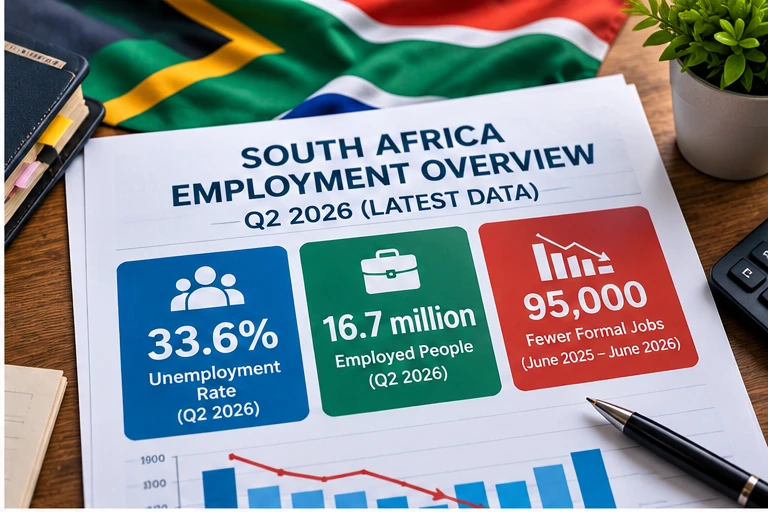
South Africa is nevertheless entering 2027 with a difficult labour market. Stats SA reported that the official unemployment rate was 33.6% in the second quarter of 2026, with approximately 8.5 million people unemployed. Employment stood at about 16.7 million people.
Formal-sector employment has also shown weakness. Stats SA’s latest Quarterly Employment Statistics available at the time of writing recorded 95,000 fewer formal non-agricultural jobs in June 2026 than in June 2025.
However, those figures describe what has already happened. They should not be presented as proof that the same number of jobs will disappear in 2027.
This article explains what we actually know about South Africa’s 2027 employment outlook, which industries may face pressure, where new opportunities may emerge and what workers and job seekers can realistically do to prepare.
Table of Contents
Is there an official estimate for how many jobs South Africa will lose in 2027?
No. There is no verified official figure for the total number of jobs expected to be lost in South Africa in 2027.
Stats SA measures employment and unemployment using surveys such as the Quarterly Labour Force Survey (QLFS) and Quarterly Employment Statistics (QES). These publications tell us what has happened in the labour market; they do not provide a definitive count of how many jobs will be lost during the following calendar year.
The Statistics South Africa Quarterly Labour Force Survey is particularly important when assessing the country’s employment situation.
The QLFS is a household-based survey covering labour-market activities, while the QES measures employment in the formal non-agricultural business sector. These two datasets should not be treated as though they measure exactly the same population.
The absence of an exact 2027 job-loss forecast does not mean there is no useful information about what could happen. Economic forecasts, current employment data, employer expectations and technological trends can help us understand the direction of the labour market.
The responsible answer is therefore:
South Africa may experience job losses in particular companies, occupations and industries during 2027, but there is currently no authoritative nationwide forecast giving an exact number of jobs that will be lost in 2027.
Any article or social-media post claiming, for example, that “500,000 South African jobs will disappear in 2027” should therefore identify the study, methodology and period behind that figure before the claim is accepted.
What does the latest South African employment data show?
Understanding the 2027 outlook starts with knowing where the labour market stood before 2027.
Stats SA’s Q2 2026 QLFS recorded approximately 16.7 million employed people and 8.5 million unemployed people. The official unemployment rate increased from 32.7% in Q1 2026 to 33.6% in Q2 2026.
The quarterly movements also demonstrate why it is dangerous to take one employment number and extrapolate it directly into the future.
| Labour-market measure | Latest relevant figure | What it means |
|---|---|---|
| Official unemployment rate, Q2 2026 | 33.6% | About one-third of the labour force was officially unemployed |
| Employed people, Q2 2026 | About 16.7 million | Total employment measured by the QLFS |
| Unemployed people, Q2 2026 | About 8.5 million | People meeting the official unemployment definition |
| Change in QLFS employment from Q1 to Q2 2026 | -16,000 | Total employment declined slightly during the quarter |
| Formal non-agricultural employment, June 2026 | About 10.425 million | Employment measured by the separate QES |
| QES year-on-year change, June 2025–June 2026 | -95,000 | Formal non-agricultural employment was lower than a year earlier |
Sources: Stats SA QLFS Q2 2026 and QES Q2 2026.
The Q1 2026 QLFS had been considerably weaker. Employment declined by approximately 345,000 people between Q4 2025 and Q1 2026, while unemployment increased by about 301,000.
That was a quarterly movement, not a forecast of permanent job destruction.
Similarly, the formal-sector QES showed an 80,000 quarter-on-quarter decline in employment during Q1 2026.
These movements demonstrate that South Africa can gain and lose substantial numbers of jobs between quarters. Employment can be affected by seasonal work, economic growth, company restructuring, investment, government employment, consumer demand, exports and many other factors.
What is forecast for South Africa’s unemployment rate in 2027?
Although we do not have an exact job-loss forecast, there are economic forecasts for unemployment.
The IMF’s 2025 Article IV consultation, released in February 2026, projected South Africa’s annual-average unemployment rate at approximately 32.4% in 2026 and 32.3% in 2027. It projected real GDP growth of approximately 1.5% in 2027.
The detailed IMF staff report provides a very similar medium-term picture, with unemployment remaining above 32% rather than suddenly disappearing.
Readers can review the IMF’s South Africa economic assessment for the underlying economic projections.
Importantly, a projected unemployment rate of around 32% does not mean that 32% of existing jobs are expected to disappear.
Unemployment and job losses are different concepts.
People enter and leave the labour force. Businesses create new positions while other businesses retrench employees. Graduates and school leavers begin looking for work. Workers retire. Some unemployed people find jobs while other employed people lose theirs.
South Africa can therefore experience thousands of job losses and thousands of job gains during the same year.
Does the IMF expect a massive employment collapse in 2027?
The IMF’s baseline forecast does not currently point to a sudden nationwide employment collapse in 2027.
Its February 2026 projections expected real GDP growth to rise modestly from around 1.4% in 2026 to 1.5% in 2027, while the unemployment rate was projected to edge down slightly.
This does not mean South Africa’s employment problem is solved.
An unemployment rate above 30% remains exceptionally serious. The IMF has specifically warned that South Africa’s economic growth remains too weak to reduce unemployment significantly. It has highlighted reforms involving areas such as electricity, logistics, investment and the business environment as important for stronger employment creation.
National Treasury’s 2026 Budget Review also forecasts positive economic growth rather than a nationwide recession as its central scenario.
Economic forecasts can change, however. Unexpected electricity problems, global trade disruptions, commodity-price changes, geopolitical events, weak investment or domestic economic shocks could produce different outcomes.
A forecast should therefore be treated as an informed projection, not a guarantee.
Which sectors have recently been losing jobs?
Recent Stats SA data can help identify where employment pressure has appeared, although it cannot tell us exactly which industries will lose the most jobs in 2027.
In Q2 2026, formal non-agricultural employment decreased by approximately 14,000 jobs compared with the previous quarter.
The changes differed substantially by industry.
| Industry | Q2 2026 quarterly employment change | Direction |
|---|---|---|
| Manufacturing | -20,000 | Decline |
| Business services | -13,000 | Decline |
| Trade | -8,000 | Decline |
| Transport | -5,000 | Decline |
| Community services | +29,000 | Increase |
| Electricity | +1,000 | Increase |
| Mining | +1,000 | Increase |
| Construction | +1,000 | Increase |
Source: Stats SA QES, June 2026.
These numbers are useful because they show that there is no single South African “jobs trend”.
One industry can be shedding jobs while another is hiring.
Even within manufacturing, for example, conditions can differ between automotive production, food manufacturing, metals, chemicals and other operations.
The same applies geographically. Employment conditions in Johannesburg or Ekurhuleni may differ from those in Cape Town, Durban, Rustenburg, Gqeberha or a smaller rural municipality.
Will artificial intelligence cause South African job losses in 2027?

Artificial intelligence is likely to continue changing the way some South Africans work, but there is no authoritative evidence showing exactly how many South African jobs AI will eliminate specifically during 2027.
This is another area where readers should be careful with dramatic numbers.
The World Economic Forum’s Future of Jobs Report 2025 estimates that globally, labour-market transformation could displace approximately 92 million existing jobs by 2030, while approximately 170 million new jobs could be created, producing a projected net increase of 78 million jobs globally.
Those are global projections through 2030.
They are not predictions that 92 million people will become permanently unemployed, and they certainly do not mean that 92 million South African jobs will disappear.
The report identifies technological change, AI, demographic shifts, the green transition and economic changes among the forces reshaping work.
Its South Africa profile also indicates that employers expect a changing balance between tasks performed predominantly by people, technology and combinations of the two.
Readers interested in the international evidence can consult the World Economic Forum Future of Jobs Report 2025.
AI may change tasks before eliminating entire occupations
One of the biggest mistakes in discussions about AI is treating a “task” and a “job” as the same thing.
Imagine a fictional administrative employee working for a logistics company in Midrand.
Five years ago, that worker may have manually entered information from invoices, prepared basic reports, responded to routine emails and scheduled meetings.
AI-enabled software could automate some of those tasks.
That does not automatically mean the employer eliminates the position. The employee could spend more time resolving customer problems, checking AI-generated information, coordinating suppliers or handling unusual cases.
In another business, however, automation may allow five employees’ previous workload to be completed by three employees.
Both situations are possible.
That is why responsible forecasts discuss job transformation, displacement and creation, rather than assuming every automated task equals one unemployed person.
Which jobs could face greater pressure from automation?
The jobs most exposed to technological change are generally those containing a large proportion of repetitive, predictable or easily digitised tasks.
The World Economic Forum’s global employer survey identifies roles such as cashiers and ticket clerks, administrative assistants, executive secretaries and some clerical positions among occupations expected to decline fastest globally through 2030.
This does not mean every South African cashier or administrative assistant will lose their job.
South Africa’s labour market, wage structures, technology adoption, infrastructure and business conditions differ from those of other countries.
It does suggest that workers in highly repetitive roles should pay attention to changing skill requirements.
For example, a cashier in a Johannesburg shopping centre who sees more self-service technology appearing should not assume immediate retrenchment. A sensible response would be to develop transferable abilities in customer service, stock control, online-order processing, merchandising, receiving, inventory systems or supervision.
The objective is not to panic about technology. It is to become useful across a wider range of tasks.
Why South Africa could still lose jobs even if the economy grows
Economic growth does not automatically guarantee that every industry will increase employment.
A business can produce more while employing fewer people if productivity improves.
A mine can invest in machinery while reducing certain manual positions. A retailer can open an e-commerce distribution operation while reducing some traditional functions. A bank can expand digital services while closing selected branches.
At the same time, technological investment can create different jobs.
A company installing automated systems may need technicians, engineers, software specialists, data professionals, maintenance workers and cybersecurity personnel.
This creates what is sometimes called labour-market churn: jobs disappear in certain areas while new ones emerge elsewhere.
South Africa’s challenge is particularly difficult because the country already has very high structural unemployment. Even if the economy creates jobs in 2027, employment growth would need to be strong enough to accommodate existing unemployed people as well as new entrants to the labour market.
What could cause more jobs to be lost in South Africa in 2027?
Several risks could make employment conditions worse than current baseline forecasts.
1. Weak economic growth
Businesses usually find it harder to expand their workforce when demand and economic activity are weak.
The IMF has argued that South Africa’s current growth rate is insufficient to reduce unemployment substantially.
A significant slowdown would therefore make employment creation even more difficult.
2. Company restructuring and retrenchments
Individual companies can reduce staff even while the wider economy grows.
Retrenchments can result from falling sales, restructuring, mergers, financial distress, automation or changes in business strategy.
One large retrenchment announcement should not, however, be used as evidence that the entire South African economy is losing jobs at the same rate.
3. Manufacturing weakness
Manufacturing lost approximately 20,000 formal jobs between March and June 2026 according to the QES.
Manufacturers can be sensitive to electricity costs, logistics, global demand, imports, exports, input prices and investment conditions.
Whether this decline continues through 2027 will depend on broader economic conditions.
4. Automation and digitalisation
AI, robotics, self-service technology and improved business software can reduce demand for certain repetitive activities.
However, technology can simultaneously create demand for new skills.
The question for a worker is therefore increasingly not simply, “Will AI take my job?” but, “Which parts of my job can technology perform, and which valuable skills can I develop that complement technology?”
5. Global economic and trade conditions
South Africa is closely connected to international markets through mining, manufacturing, agriculture, tourism, financial services and trade.
Weakness in major export markets or severe international trade disruptions can therefore affect domestic businesses and employment.
Where could jobs be created?
A discussion about expected job losses in South Africa in 2027 is incomplete without discussing job creation.
The government has said it is working towards creating two million work opportunities by 2030, alongside youth employment initiatives and implementation of the National Employment Policy. Parliament’s employment and labour committee has stressed that these commitments require measurable implementation.
Government targets should not be confused with guaranteed permanent jobs. A “work opportunity” can differ from permanent formal employment.
Nevertheless, South Africa has areas where employment could grow if investment and demand strengthen.
These include infrastructure-related work, energy, logistics, digital services, selected business services, construction, tourism and occupations connected to technological change.
The exact opportunities will depend on province, qualification level and industry.
A software graduate looking for work in Sandton faces a very different labour market from a qualified artisan in Mpumalanga or a retail job seeker in Durban.
How should South African job seekers prepare for 2027?

The lack of a precise job-loss forecast does not mean workers should ignore changes in the labour market.
A practical approach is to concentrate on what you can control.
1. Identify transferable skills
Do not describe your experience only by your job title.
For example, a retail worker may have experience with:
- inventory control;
- stock counts;
- receiving deliveries;
- customer service;
- merchandising;
- point-of-sale systems;
- expiry-date management;
- workplace safety; and
- supervising or coordinating other workers.
Those abilities may transfer to warehousing, logistics, wholesale, distribution and other retail positions.
2. Watch real employment data rather than viral predictions
Use official information from Statistics South Africa when assessing national unemployment and employment trends.
If someone claims that millions of South African jobs will disappear on a particular date, check where the number comes from.
Ask whether it refers to South Africa or the world, job losses or jobs affected, one year or several years, and gross losses or net employment change.
Those distinctions can completely change the meaning of a statistic.
3. Learn skills that complement technology
Workers do not necessarily need to become programmers.
A bookkeeper could learn modern accounting software and AI-assisted reporting. An administrative employee could improve spreadsheet, project-management and digital communication skills. A warehouse worker could learn inventory-management systems. A retail employee could develop e-commerce fulfilment and stock-control skills.
The appropriate skill depends on the occupation.
4. Do not wait for retrenchment before updating your CV
If your industry is experiencing repeated layoffs or restructuring, keep your CV and supporting documents current.
Record new responsibilities while you still remember them.
Keep copies of legitimate qualifications and training certificates and periodically check which skills employers are requesting for the positions you want.
5. Follow industries, not only job titles
A job title can exist across many industries.
An administrator may work in healthcare, logistics, education, manufacturing or financial services. A salesperson can work in retail, technology, telecommunications or business services.
If one industry contracts, the worker’s underlying skills may still be valuable elsewhere.
How to check whether a 2027 job-loss claim is trustworthy
Before sharing a prediction, perform a simple verification.
| Question to ask | Why it matters |
|---|---|
| Who published the number? | Official and reputable research sources are generally more reliable |
| Does it specifically refer to South Africa? | Global forecasts are often incorrectly presented as SA forecasts |
| Does it specifically refer to 2027? | A forecast to 2030 cannot automatically be converted into a 2027 figure |
| Does it measure jobs lost or jobs affected? | These are different measures |
| Does it include jobs expected to be created? | Gross displacement and net employment change are different |
| When was the research published? | Economic forecasts can become outdated |
| Is the methodology available? | A number without a methodology is difficult to assess |
This verification process is particularly important when reading claims about AI.
For example, taking the World Economic Forum’s global projection of 92 million displaced jobs through 2030 and dividing it by the number of years would not produce a reliable estimate for South Africa in 2027.
The countries, industries and occupations represented in the global calculation are not distributed evenly.
What 2027 may realistically look like
Based on the evidence available in October 2026, the most defensible outlook is not that South Africa will suddenly lose a predetermined number of jobs.
Instead, the country is likely to continue experiencing a mixture of job creation, job destruction and changes to existing occupations.
Some companies and industries may retrench workers.
Other employers may expand.
Technology may reduce the need for certain tasks while increasing demand for different skills.
Most importantly, South Africa is expected to enter 2027 with unemployment still extremely high. Even the IMF’s baseline projection of around 32% unemployment indicates that the labour market is likely to remain difficult.
The problem is therefore larger than simply counting jobs that might disappear.
South Africa needs enough sustained employment creation to absorb people who are already unemployed and people entering the labour force.
Frequently Asked Questions
How many jobs are expected to be lost in South Africa in 2027?
There is currently no authoritative official forecast giving an exact number of jobs expected to be lost in South Africa during 2027. Available forecasts provide information about economic growth and unemployment, while Stats SA publishes actual employment changes.
Will unemployment increase in South Africa in 2027?
Not necessarily. The IMF’s February 2026 baseline projection placed South Africa’s annual-average unemployment rate at about 32.3% for 2027, slightly below its 2026 projection. Forecasts can change as economic conditions change.
What is South Africa’s latest unemployment rate?
Stats SA reported an official unemployment rate of 33.6% in Q2 2026, up from 32.7% in Q1 2026.
How many formal jobs has South Africa recently lost?
Stats SA’s QES reported that formal non-agricultural employment was approximately 95,000 jobs lower in June 2026 than in June 2025. The QES does not cover every job in the South African economy.
Will AI take jobs in South Africa?
AI is likely to automate or change some workplace tasks and could contribute to displacement in certain occupations. However, there is no credible official figure showing exactly how many South African jobs AI will eliminate in 2027. Technology can also create new occupations and increase demand for different skills.
Which jobs are most vulnerable to AI and automation?
International employer surveys indicate that some repetitive clerical and administrative occupations face greater pressure. Cashiers, ticket clerks and administrative support roles are among occupations the World Economic Forum expects to decline globally through 2030. This is a global forecast, not a guarantee that individual South African workers in these occupations will lose their jobs.
Is 92 million jobs expected to be lost in South Africa?
No. The World Economic Forum estimates that about 92 million jobs could be displaced globally by labour-market transformation through 2030. It simultaneously estimates approximately 170 million jobs could be created globally. The 92 million figure should not be presented as a South African job-loss forecast.
What should I do if I am worried my job could disappear?
Update your CV, identify transferable skills, monitor vacancies in related industries and develop skills that employers are increasingly requesting. If technology is changing your occupation, concentrate on learning how to work effectively with new systems rather than assuming your entire occupation will disappear.
Where can I find reliable South African employment statistics?
Use Stats SA’s Quarterly Labour Force Survey for broad labour-market information and its Quarterly Employment Statistics for formal non-agricultural business-sector employment. Understanding which survey a statistic comes from helps prevent misleading comparisons.
Conclusion
There is no verified number of jobs expected to be lost in South Africa in 2027. Current evidence points instead to a difficult but changing labour market in which some jobs will disappear, others will be created and many occupations will change.
South Africa entered the second half of 2026 with an official unemployment rate of 33.6%, while formal non-agricultural employment was 95,000 lower in June 2026 than a year earlier. Those are serious warning signs, but they are historical measurements—not a prediction of 2027 job losses.
For workers and job seekers, the useful response is not to panic over unsupported predictions. Follow official labour-market data, build transferable skills, pay attention to changes in your industry and prepare for occupations to evolve as technology and South Africa’s economy change.