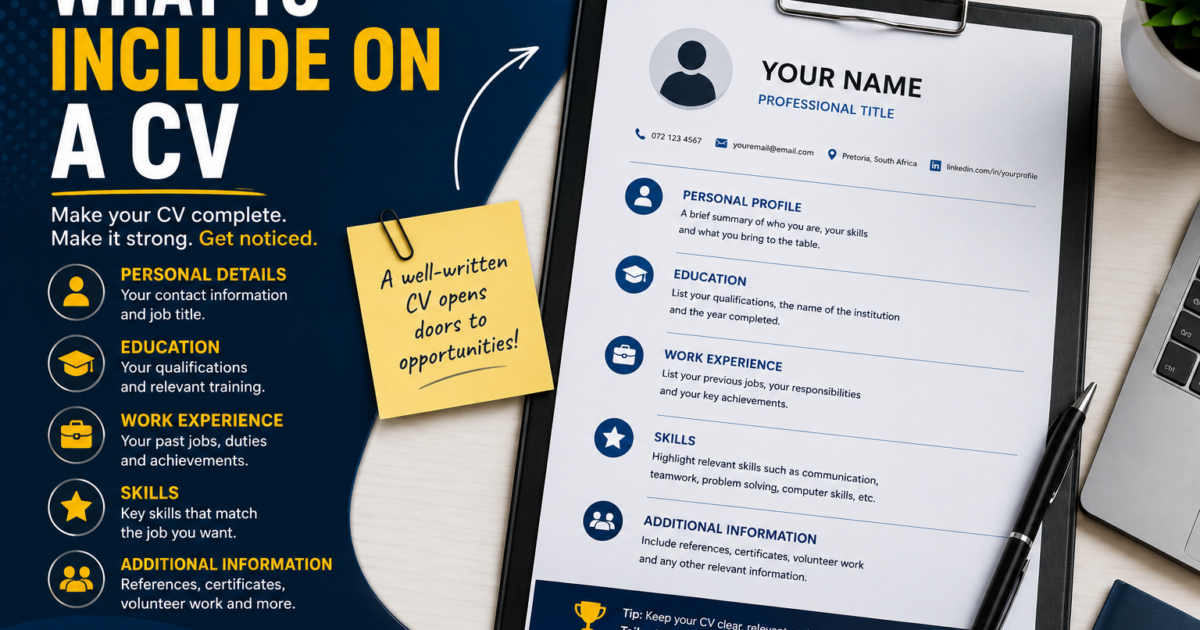
A good CV includes everything an employer needs to consider you — and nothing that creates risk or invites bias. In South Africa, that second part matters more than many people realise, because of privacy law and the way some personal details can lead to unfair treatment. Here is a clear list of what to include and what to leave off.
What to include
- Full name and a phone number you answer.
- A professional email address.
- Your city, town or general area (a full street address is not necessary).
- A personal profile summarising who you are.
- Skills relevant to the job.
- Work experience (or informal experience if you are starting out).
- Education and qualifications.
- A note that references are available on request.
- Your driver’s licence if the job needs it, and a note that you are legally allowed to work in South Africa.
What to leave off — and why
Your ID number
The old habit — and some outdated official checklists — told South Africans to put their ID number on their CV. That advice no longer holds up. Under the Protection of Personal Information Act (POPIA), which has been fully in force since July 2021, your ID number is legally classed as personal information. A CV can be forwarded, printed and emailed many times, so putting your ID number on it creates a needless identity-theft risk. Employers can request it later, on a proper application form, once you are further along. Leave it off unless a specific application explicitly asks for it.
Details that can invite bias
South Africa’s Employment Equity Act prohibits unfair discrimination against job applicants on grounds such as race, gender, marital status, pregnancy, religion, age, disability and several others. You are not required to hand employers information that relates to these grounds, and leaving it off protects you from bias, whether conscious or not. So you can safely leave out:
- Marital status and number of children.
- Religion.
- Age or date of birth.
- Health conditions or disability status (unless you choose to disclose).
A photo is optional and sits in the same grey area — it can introduce bias, and for CVs screened by software it can cause technical problems too. Many South Africans now leave the photo off. It is your call, but you lose nothing by omitting it.
Your referees’ personal details (in a public document)
Listing your references’ names and numbers openly on a widely-shared CV exposes their personal information without much control. A privacy-friendly approach is to write “References available on request” and hand over the details privately when asked.
Clutter that adds nothing
- Irrelevant hobbies that do not support the application.
- Reasons for leaving previous jobs (save that for the interview).
- Salary expectations (unless the advert asks).
- Every short course you have ever done — keep it relevant.
A note on POPIA consent lines
Some South African job seekers add a short line giving the employer permission to process the personal information on the CV. This is optional and can be a courteous touch, but it does not replace the sensible step of simply not putting sensitive details like your ID number on the document in the first place.
Common mistakes with CV content
- Publishing your ID number and full address on a document that circulates freely.
- Including personal details that can only invite bias.
- Listing referees’ contact numbers without their consent.
- Padding the CV with irrelevant information.
- Leaving off the basics an employer actually needs, like a reliable phone number.
Optional sections worth adding (when relevant)
- Languages: valuable in South Africa, especially for customer-facing roles. List the languages you speak.
- Driver’s licence: include the code if the job needs driving, and mention if you have your own transport.
- Availability: note if you can start immediately or work shifts and weekends, when the advert calls for it.
- Certificates: first aid, firefighting, forklift, computer courses — anything relevant to the role.
- Portfolio or work samples: for hands-on or creative roles, a link or note that samples are available.
What about a cover letter?
Many South African applications, especially for entry-level roles, do not require one — but a short, tailored cover letter or even a well-written email can help you stand out. Keep it to a few lines: who you are, the role you want, and why you are a good fit. Do not simply repeat your CV; use it to add a little personality and enthusiasm.
When in doubt, ask: does this help or expose me?
For every item, run two quick tests. First: does this help an employer judge my suitability? If not, cut it. Second: does sharing this create privacy risk or invite bias? If yes — like your ID number or personal details unrelated to the job — leave it off. Those two questions settle almost every “should I include this?” decision.
Do this now
Open your current CV and remove three things: your ID number, your full street address, and any personal detail (age, marital status, religion) that the job does not require. Replace your listed referees with “References available on request”.
Frequently asked questions
Is it illegal to put my ID number on my CV?
No, it is not illegal to share your own information. But because a CV spreads easily, leaving your ID number off is the safer, recommended practice under POPIA. Provide it later, on a formal application.
Should I include a photo on my CV?
It is optional. Leaving it off avoids potential bias and works better with screening software. If you include one, keep it a plain, professional headshot.
Do I need to state that I can work in South Africa?
A short line confirming you are a citizen or hold the right to work is helpful and does not require sharing your ID number.
What about my matric certificate number or bank details?
Leave sensitive numbers and all banking details off the CV entirely. They belong in later, secure steps of the hiring process.
The bottom line
Include what an employer needs to judge your suitability, and leave off sensitive personal details that create risk or invite bias — especially your ID number. It protects your privacy and keeps the focus on your ability. Next, tighten up your common CV mistakes.