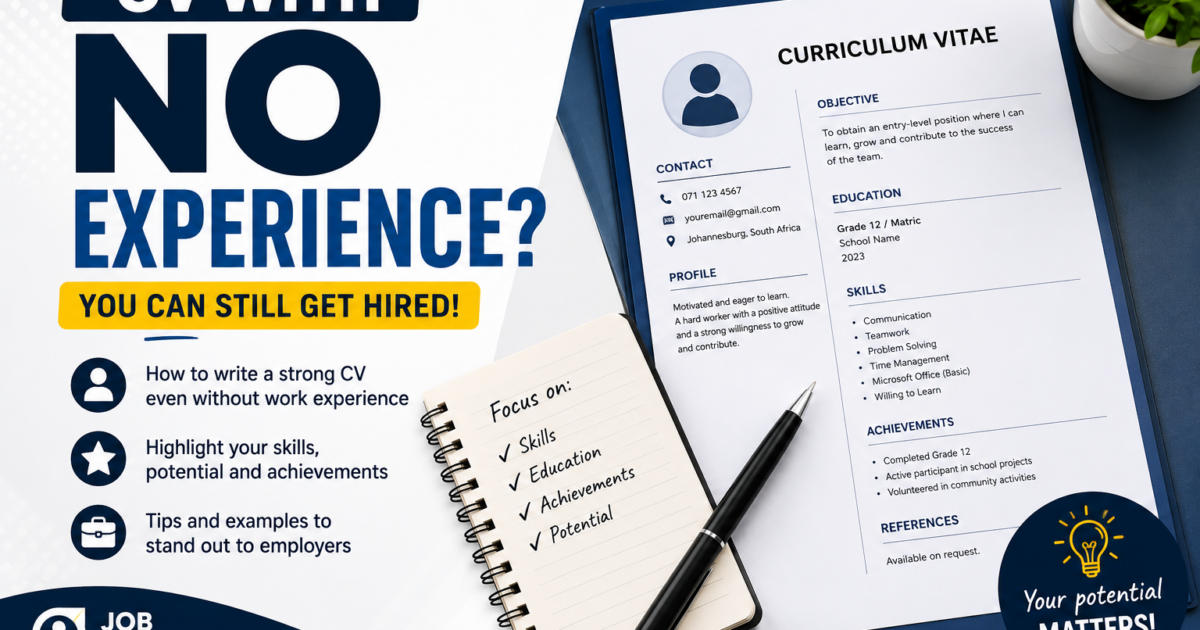
Writing your first CV with no formal work experience feels like a chicken-and-egg problem: you need a job to get experience, but you need experience to get a job. The good news is that entry-level employers do not expect a long work history. They want to see potential, reliability and the right attitude — and you can show all of that. Here is how.
Change the order of your CV
When you have no work experience, do not lead with an empty “Work Experience” section. Reorder your CV so your strengths come first:
- Contact details
- Personal profile (highlighting your attitude and what you offer)
- Education (your strongest section right now)
- Skills
- Any informal experience, volunteering or projects
- References
Make your education work harder
Your education is your main asset, so give it detail. Include your matric year and school, and if you did well, list a few strong subjects. Add any short courses, online certificates or learnerships. Even in-progress studies count — mention them.
Write a confident personal profile
Because you have no experience to lean on, your profile sells your attitude. Example: “Reliable and hardworking matriculant with strong communication skills and a keen willingness to learn. Comfortable with customer service and eager to take on my first role in a busy, team-based environment.” Keep it honest and specific.
Include informal and unpaid experience
You have done more than you think. All of these belong on a CV:
- Helping in a family business, spaza shop or stall.
- Volunteering at church, an NGO or a community project.
- School responsibilities — prefect, team captain, committee member.
- Piece jobs, holiday work or informal gigs like hairdressing or phone repairs.
- Personal projects that show initiative.
Describe them just like a real job: what you did and what it taught you. For how to phrase these, see how to describe work experience.
Highlight your skills
List skills relevant to the job — both practical ones (cash handling, computer basics, a driver’s licence) and people skills (communication, teamwork, reliability). Match them to what the advert asks for. Our guide to listing skills on a CV explains how to prove them rather than just list them.
Handle references
No former boss? Use a teacher, a coach, a community leader, or someone you volunteered under — anyone credible who can speak to your character. Always ask their permission first, or simply write “References available on request”.
Common mistakes on a first CV
- Leaving it almost blank because you “have no experience”.
- Leading with an empty work section instead of your education.
- Dismissing volunteering, family help and school roles as unimportant.
- A vague, generic profile that could belong to anyone.
- Making things up — honesty matters more than an impressive-looking gap-filler.
A simple CV skeleton you can copy
Use this outline and fill in your own details:
- Name | phone | professional email | city/area
- Personal profile: 3–4 lines on who you are, what you offer, what you want
- Education: Matric (year, school) + strong subjects; any courses/certificates
- Skills: 6–10 relevant skills (mix of practical and people skills)
- Experience: informal work, volunteering, school roles — described properly
- References: “Available on request”
Build real experience while you job-hunt
You can strengthen a thin CV over time. Consider:
- Learnerships and youth programmes that combine training with work.
- Volunteering at a church, NGO, clinic or community project — it gives you references and real tasks to describe.
- Short courses (computer literacy, first aid, customer service), many of them free or low cost.
- Helping in a family or community business, which counts as genuine experience.
Each of these adds a line to your CV and, just as importantly, a talking point for your interview when you have no experience.
Confidence is part of the CV
Do not undersell yourself with phrases like “only helped out sometimes”. Describe what you did plainly and with pride. An employer reading a confident, well-organised first CV sees potential; one reading an apologetic, half-empty page sees hesitation.
Do this now
Write down every non-job activity you have done — school, family, community, courses, piece jobs. Turn each into a short CV line describing what you did and the skill it shows. That becomes the heart of your first CV.
Frequently asked questions
Is it okay to have a one-page CV with no experience?
Yes. A focused one-page CV is perfectly acceptable and often better than padding it out. See how long a CV should be.
Can I put school activities on my CV?
Definitely. Prefect duties, sports teams, clubs and committees all show responsibility and teamwork.
Should I include my matric results?
If they are good, yes — a few strong subjects or symbols help. If they are weaker, simply state that you have matriculated.
How do I explain having no experience?
Let your profile and skills speak for you, and prepare to address it confidently in the interview — see our guide to an interview when you have no work experience.
The bottom line
A blank work history is not a dead end. Reorder your CV to lead with education and skills, include every bit of informal experience, and write a confident profile. You have more to offer than you think. Then get ready for your interview when you have no work experience.