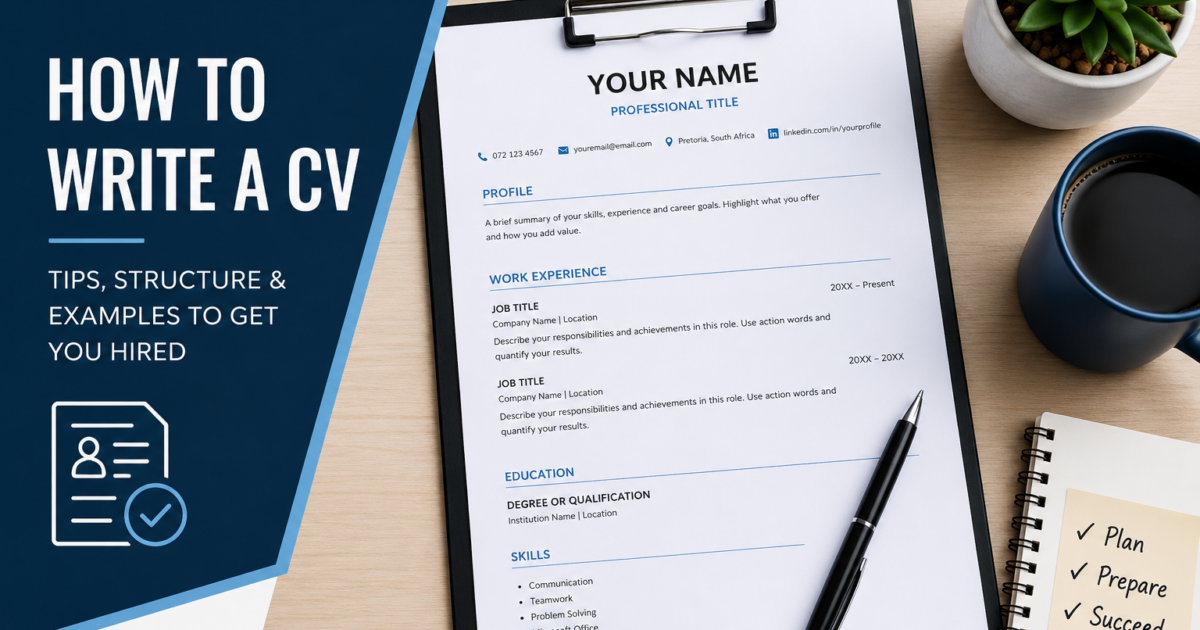
Your CV has one job: to get you an interview. It is a short, clear summary of who you are, what you can do, and why an employer should meet you. This guide walks through exactly how to build a strong CV for the South African job market, section by section.
Start with the right structure
A clear, well-ordered CV beats a fancy design. Use this order, which South African employers expect:
- Personal and contact details — name, phone number, professional email, and city or area.
- Personal profile — a short three-to-four line summary of who you are.
- Skills — the abilities relevant to the job.
- Work experience — jobs listed newest first.
- Education — your matric and any qualifications.
- References — or a note that they are available on request.
Contact details: keep them professional
List your full name, a phone number you actually answer, a professional email address (firstname.surname@ rather than a nickname), and your general area. You do not need to put your full home address or your ID number on a CV — we explain why in what to include (and leave off) your CV.
Write a short personal profile
Under your details, add a few lines summarising who you are and what you offer. This is the first thing a recruiter reads, so make it count. Full guidance and examples are in how to write a strong CV personal profile.
List your skills clearly
Include the skills that match the job — a mix of practical (hard) skills and people (soft) skills. Do not just dump a list of buzzwords; choose skills you can actually back up. See how to list skills on a CV for how to do this well.
Describe your work experience with impact
For each job, give your job title, the employer, and the dates. Then, instead of a flat list of duties, describe what you actually did and achieved. There is a big difference between “Responsible for stock” and a proper description of the work. We show you exactly how in how to describe work experience on your CV.
If you have no formal work experience yet, do not worry — how to write a CV with no work experience shows you how to build a strong CV anyway.
Add your education
List your highest qualification first. Include your matric (with the year and school), plus any diplomas, degrees, certificates or short courses. If you are a recent school leaver, you can include a few strong subjects or results.
Handle references properly
You can list two or three references with their name, your relationship to them, and a contact number — but only with their permission. Because of privacy considerations, many South Africans now simply write “References available on request” and share the details later. Either approach is fine.
Keep the length and format right
For most people, a CV of one to two pages is ideal — more on that in how long a CV should be. Use a clean, simple layout with clear headings and readable font. Fancy graphics, columns and photos can actually cause problems, especially with the screening software many employers use, which we cover in making your CV easy for recruiters and ATS to read.
Tailor it to each job
Do not send the exact same CV everywhere. Adjust your profile, skills and experience to match each advert. It takes a few minutes and makes a real difference — how to tailor your CV for a specific job shows you how.
Common mistakes when writing a CV
- Spelling and grammar errors, and wrong contact numbers.
- A flat list of duties with no sense of what you achieved.
- Cramming everything onto a cluttered, hard-to-read page.
- Using one generic CV for every application.
- Including unnecessary personal information.
Chronological or skills-based layout?
There are two common ways to organise a CV:
- Chronological (most common): your work experience listed newest first. Best if you have a steady work history.
- Skills-based (functional): leads with your skills and abilities, with work history lower down. Useful if you have little experience, gaps, or are changing direction — see writing a CV with no experience.
Most South African employers are used to the chronological format, so use it unless you have a clear reason not to.
Keep the design clean and simple
Fancy is not the goal — clear is. Use one simple, readable font, consistent spacing, and bold only for headings and job titles. Leave enough white space so the page is easy to scan. Avoid heavy colours, columns, tables and graphics, which can look cluttered and can confuse the screening software many employers use (see making your CV ATS-friendly).
Save and send it properly
Save your CV with a clear file name like Name-Surname-CV, not “cv final final2”. Send it as a clean Word document or a simple PDF. When emailing it, write a short, polite message in the body — a greeting, the role you are applying for, and a line saying your CV is attached — rather than sending a blank email with just an attachment.
A quick final review before you send
- Contact details correct and professional.
- No spelling or grammar errors (get someone to check).
- Tailored to the specific job (see tailoring your CV to the job).
- Clean, consistent formatting.
- Saved with a sensible file name and format.
Do this now
Open a blank document and set up the six sections above as headings. Fill in your contact details and education first — the easy parts — then work through the rest using the linked guides.
Frequently asked questions
Should my CV be one page or two?
One to two pages suits most people. Let your experience decide, and never pad it out. See how long a CV should be for detail.
Do I need a photo on my CV in South Africa?
It is optional, and there are good reasons to leave it off, especially for applications screened by software. what to include (and leave off) your CV explains the trade-offs.
What if I have no work experience?
Lead with your education, skills and any informal or volunteer work. Our full guide is how to write a CV with no work experience.
What file format should I use?
A clean Word document (.docx) is the safest all-round choice, with a simple PDF as an alternative. Avoid image-based or heavily designed files — see making your CV easy for recruiters and ATS to read.
The bottom line
A strong CV is clear, well-ordered, honest and tailored to the job. Get the structure right, describe your experience with impact, and keep it clean. Once it starts winning you interviews, prepare with common interview questions.