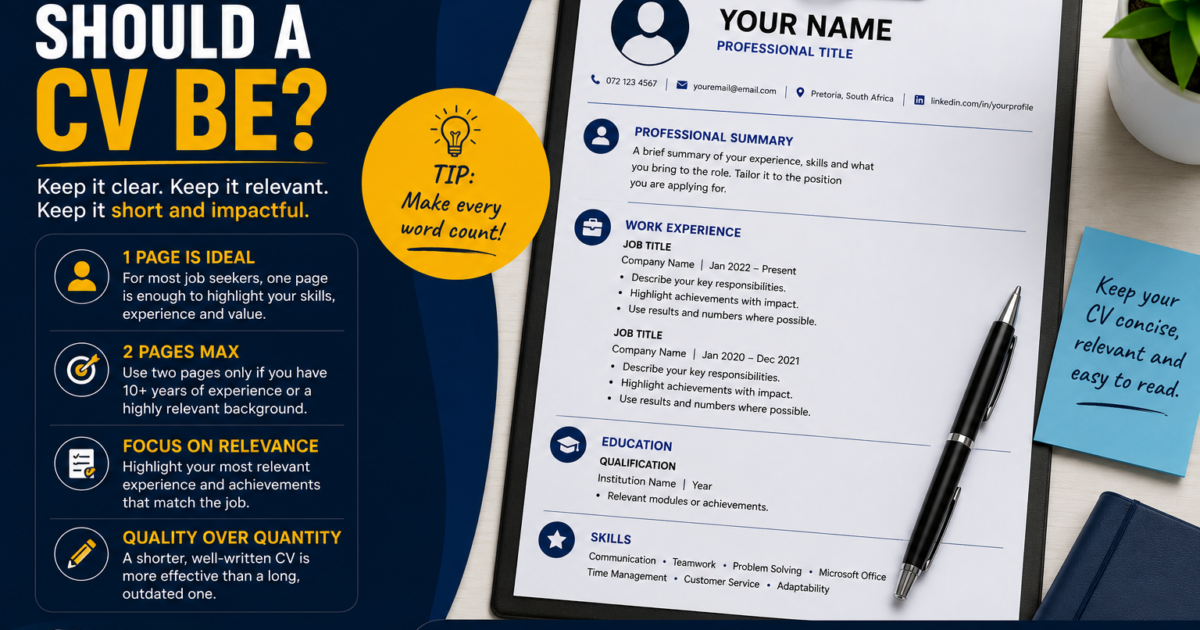
The short answer: for most South African job seekers, one to two pages is right. But the honest answer is that it depends on how much relevant experience you have. Ignore anyone who insists a CV must always be exactly one page — that rule does not fit everyone. Here is how to judge the right length for you.
The general guideline by experience
- School leavers and first-time job seekers: one page is usually enough. You do not have years of work to describe, and a tight one-pager looks focused, not thin.
- A few years of experience: one to two pages. Use the space to describe your roles properly, but do not pad.
- Extensive experience (many roles, senior positions): two pages, occasionally three, is acceptable — as long as every line earns its place.
Why “one page only” is a myth
The one-page rule comes largely from overseas advice and does not suit everyone. If forcing your CV onto a single page means shrinking the font to an unreadable size or cutting genuinely relevant experience, you have made it worse, not better. Clarity beats page count. A well-organised two-page CV is far stronger than a cramped, unreadable one-pager.
Every line must earn its place
Length is really a question of relevance. The test for each line is simple: does it help an employer see why to interview me? If yes, keep it. If not, cut it. That single question solves most length problems.
How to trim a CV that’s too long
- Cut old, irrelevant jobs down to a single line, or remove them entirely.
- Remove personal details you do not need, like your ID number and full address (see what to include on a CV).
- Trim duties that repeat across roles — keep the strongest examples.
- Delete filler phrases and generic buzzwords.
- Reduce a long list of short courses to the most relevant ones.
How to bulk up a CV that’s too short
- Add informal experience — family business, volunteering, piece jobs.
- Give more detail on your education, including strong subjects or projects.
- Expand your skills section with abilities relevant to the job.
- Describe your existing experience more fully, focusing on what you achieved (see describe your experience more fully).
Do not, however, invent experience or waffle just to fill space. A genuine one-pager beats a padded two-pager every time.
Common mistakes with CV length
- Shrinking the font to a tiny size to force one page.
- Cutting relevant, recent experience just to hit a page target.
- Padding a thin CV with irrelevant filler.
- Letting a CV sprawl to four or five pages with old, irrelevant detail.
- Sacrificing readability for a page-count rule.
What a one-page CV usually contains
For a school leaver or first-time job seeker, one page comfortably holds your contact details, a short profile, your education, a skills section, and any informal or volunteer experience. That is enough to make a strong case without stretching.
What a two-page CV usually contains
With a few years of experience, page one carries your details, profile, skills and most recent roles; page two continues older experience and your education. The key is that page two must still be worth reading — not filler to reach a second page.
Formatting tricks to control length
- Use consistent, sensible margins — not huge white borders, not cramped edges.
- Keep the body font readable (around 10–12pt) rather than shrinking it.
- Use short bullet points instead of long paragraphs.
- Cut repeated duties that appear across several jobs.
A note on cover letter length
If you include a cover letter, keep it to well under one page — a short greeting, a paragraph or two on why you fit the role, and a polite close. A long cover letter rarely gets read in full.
Let the role guide you
A senior or specialised position may justify more detail than an entry-level one. Read the advert: if they ask for extensive experience, they expect to see it; if it is a general worker role, they want a quick, clear read. Match the depth of your CV to what the job actually calls for.
Do this now
Read your CV line by line and ask of each: “Does this help me get an interview?” Cut every line that fails the test. Whatever length remains after that is the right length for you.
Frequently asked questions
Is a two-page CV too long for an entry-level job?
Often, yes — most first-time applicants fit comfortably on one page. But if you have relevant courses, volunteering and skills to show, a tidy second page is fine.
Should I use a smaller font to fit one page?
No. Keep the font readable (around 10–12pt for body text). Cut content instead of shrinking text.
Does length affect screening software?
Length matters less to software than clean formatting does. See easy for recruiters and screening software to read for what actually helps.
Can a CV ever be three pages?
For very experienced candidates with a lot of relevant history, occasionally. For most job seekers, it is too long.
The bottom line
Aim for one to two pages, guided by how much relevant experience you have, not by a rigid rule. Keep only what earns its place, and never sacrifice readability for page count. Next, make sure your CV is easy for recruiters and screening software to read.