Your personal profile is the short paragraph at the top of your CV, just under your contact details. It is the first thing a recruiter reads, and it often decides whether they keep reading. In three or four lines, it needs to say who you are, what you offer, and what you are looking for. Here is how to write one that works.
What a personal profile is (and isn’t)
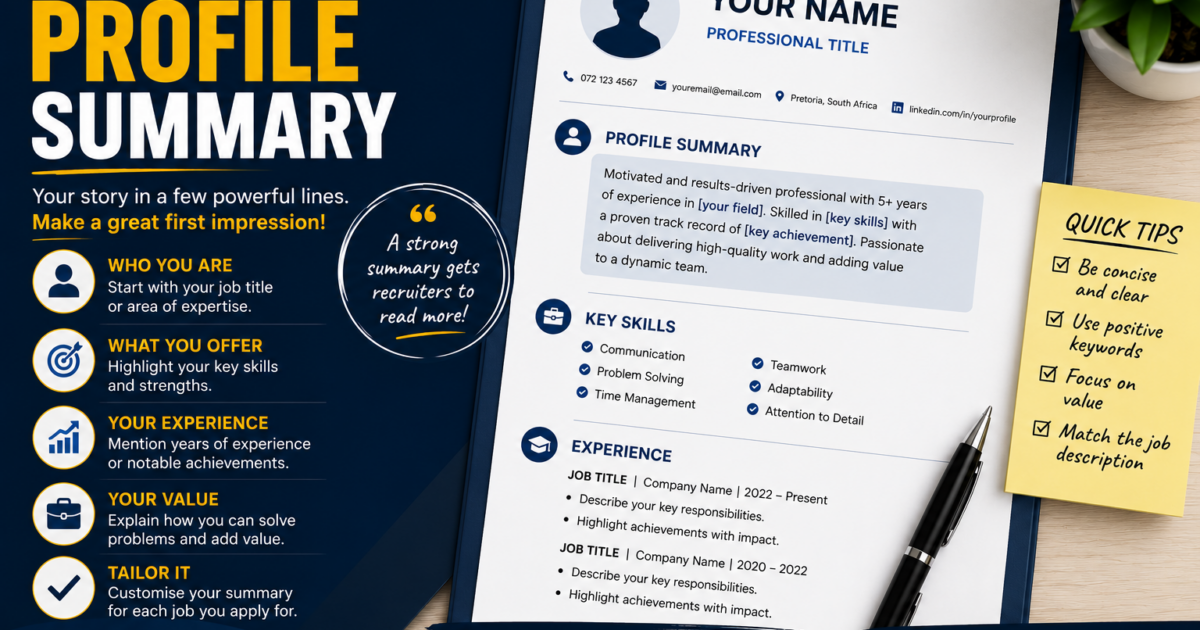
A personal profile is a brief professional summary — not a life story and not a cover letter. Think of it as your elevator pitch: a punchy snapshot that makes the reader want to see the rest of your CV. Keep it to about three or four lines.
The simple formula
A strong profile usually contains three things:
- Who you are — your role, field or status (e.g. “reliable retail assistant”, “recent HR graduate”, “hardworking matriculant”).
- What you offer — one or two key strengths or skills relevant to the job.
- What you want — the kind of role you are seeking.
Weak vs strong examples
Weak
“I am a hardworking person looking for a job. I am a fast learner and a team player who is willing to work hard and learn new things.”
This says nothing specific and could belong to anyone.
Strong (experienced retail worker)
“Reliable retail assistant with two years’ experience on the shop floor and in stock control. Known for accuracy, good customer service and never missing a shift. Looking to take on a role with more responsibility in a busy store.”
Strong (matriculant, first job)
“Motivated matriculant with strong communication skills and experience helping in a family business. Comfortable handling cash and serving customers, and eager to take on my first formal role in a team environment.”
Strong (graduate)
“Recent Human Resource Management graduate with practical experience gained during a work placement in recruitment admin. Organised, detail-focused and keen to begin a career in HR within a supportive company.”
Tailor it to the job
Your profile should shift slightly for each application to echo what the advert asks for. If the job stresses customer service, make sure customer service appears in your profile. This small effort is part of tailoring your CV to a specific job, and it makes your CV feel written for that role rather than mass-produced.
Common mistakes in a personal profile
- Filling it with generic phrases (“hardworking team player”) and no specifics.
- Writing a full paragraph of five or six lines — keep it short.
- Using the exact same profile for every different job.
- Writing in the third person awkwardly, or mixing “I” and “he/she”.
- Making claims you cannot back up in the rest of the CV.
More profile examples for different situations
General worker
“Hardworking and reliable general worker, physically fit and comfortable with manual tasks and shift work. Known for punctuality and following instructions carefully. Seeking a warehouse or general worker role in a busy team.”
Career changer
“Experienced retail assistant moving into office administration, bringing strong organisation, customer service and computer skills. Recently completed a computer literacy course. Looking for an entry-level admin role where I can apply these strengths.”
Returning to work
“Dependable worker returning to full-time employment after time caring for family, with previous experience in customer service and cash handling. Eager, quick to refresh skills, and ready to commit to a stable role.”
Words that weaken a profile
Empty phrases fill space without saying anything: “hardworking team player”, “go-getter”, “results-driven”, “think outside the box”. If you use a word, make sure the rest of your CV proves it — otherwise cut it and replace it with something specific.
Adapt the profile to each application
Your profile is the easiest part of your CV to tailor, and the most valuable to get right, because it is read first. For each job, echo one or two words from the advert so the reader immediately sees a match. This small edit is a core part of tailoring your CV to the job.
Do this now
Write a three-line profile using the formula: who you are, what you offer, what you want. Then compare it to the weak example above — if yours could belong to anyone, add specifics until it clearly describes you.
Frequently asked questions
Should I write my profile in the first or third person?
Either works, as long as you are consistent. Many CVs drop the “I” entirely: “Reliable retail assistant with…” reads cleanly.
How long should the profile be?
Three to four lines. Long enough to say something real, short enough to read in seconds.
Is a personal profile the same as an objective?
They overlap. A profile focuses more on what you offer; an objective focuses on what you want. A good profile blends both.
Do I need one if I have no experience?
Yes — it is even more useful, because it lets you lead with attitude and potential. See writing a CV with no experience.
The bottom line
A strong personal profile is short, specific and tailored: who you are, what you offer, what you want. Get those three or four lines right and you earn the reader’s attention for the rest of your CV. Next, learn to describe your work experience effectively.