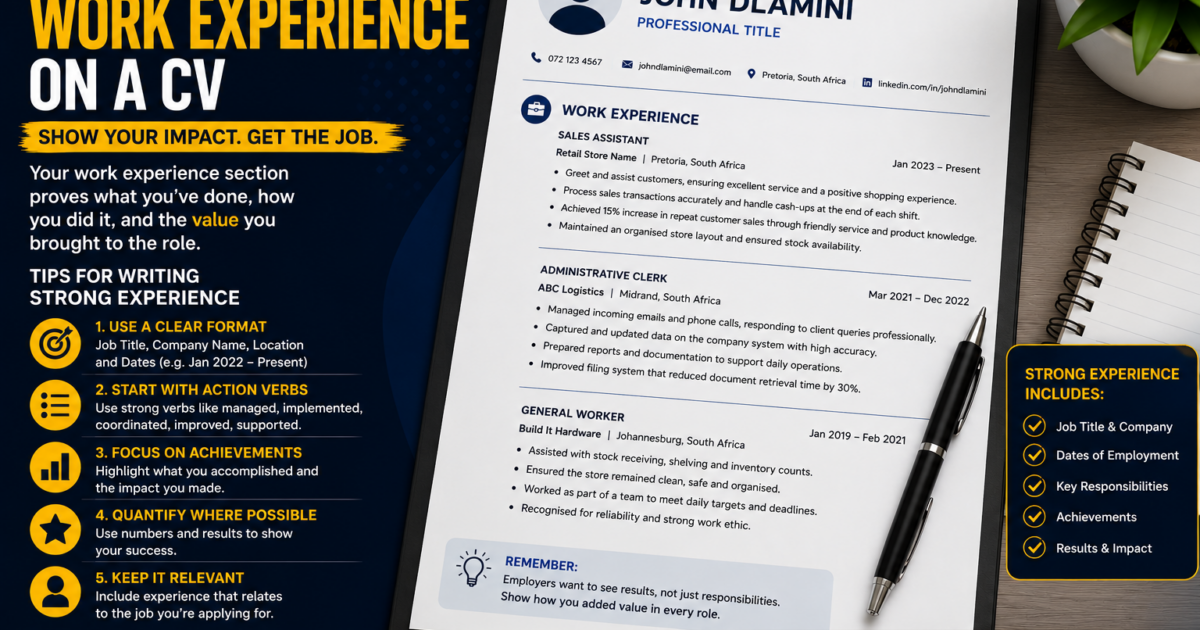
The work experience section is where most CVs fall flat. People list job duties in the dullest possible way and wonder why they do not get called. The fix is simple: describe what you actually did and the difference it made, in specific terms. Here is how to turn a weak duty list into descriptions that get you interviews.
Get the basics right first
For each role, include your job title, the employer’s name, and the dates you worked there (month and year). List your most recent job first and work backwards. Under each, describe your responsibilities and contributions in a few short bullet points.
The big shift: from vague duties to specific descriptions
Compare these two ways of describing the same retail job:
Weak: “Responsible for stock.”
Strong: “Monitored stock levels, rotated products using FIFO principles, checked expiry dates, and helped maintain shelf availability during busy periods.”
The second version is not made up or exaggerated — it simply describes the real work in specific terms. It tells the employer exactly what you can do. That is the whole trick: take the vague duty and spell out what it actually involved.
More before-and-after examples
- Weak: “Worked on the till.” → Strong: “Operated the till accurately during busy trading hours, handled cash and card payments, and balanced the till at the end of each shift.”
- Weak: “Helped customers.” → Strong: “Assisted customers on the shop floor, answered product questions, and resolved complaints calmly to keep customers satisfied.”
- Weak: “Did cleaning.” → Strong: “Maintained a clean, safe work area in line with hygiene standards, ensuring the space was ready for inspection at all times.”
Start each point with an action word
Begin your descriptions with strong verbs — monitored, operated, assisted, organised, prepared, maintained, resolved, supervised. Action words make you sound capable and active rather than passive.
Show results where you honestly can
If you genuinely improved something, say so — but never invent numbers or achievements. Honest, concrete results are powerful: “helped reduce stock waste by rotating products properly” or “trained two new team members” are believable and specific. If you do not have a measurable result, a clear description of the work is still strong on its own.
Describing informal or piece work
Informal work counts, and you describe it the same way. “Helped in family spaza shop” becomes “Served customers, managed stock and handled daily cash takings in a family-run spaza shop.” Treat it with the same respect as formal work — see writing a CV with no experience for building a whole CV around this kind of experience.
Common mistakes in the experience section
- Listing bare duties (“responsible for stock”) with no detail.
- Copying the exact wording from the original job advert.
- Writing long paragraphs instead of scannable bullet points.
- Inventing achievements or fake percentages.
- Leaving out dates or listing jobs in a random order.
A bank of action words to start your points
Strong descriptions begin with a verb. Reach for words like: operated, managed, monitored, assisted, served, prepared, organised, maintained, resolved, handled, supervised, trained, packed, recorded, checked, delivered, arranged. They make you sound active and capable.
Handling promotions and multiple roles at one employer
If you were promoted or changed roles within the same company, show it — it signals that you were trusted and grew. List the employer once, then show each position with its own dates and description. Rising from “shelf packer” to “controller”, for example, tells a story of reliability and progress that a flat listing would hide.
How to handle gaps in your work history
Gaps are common and not automatically a problem. Do not try to hide them with false dates. If you were studying, caring for family, doing piece jobs, or job-hunting, you can note it briefly and honestly. What matters most is what you can do now; a short, calm explanation is far better than a suspicious gap or a lie that unravels later.
Match your descriptions to the job
Emphasise the parts of each role that relate to the job you are applying for. The same retail job can be described to highlight customer service for one advert and stock control for another — all truthfully. This is part of tailoring your CV to the job, and it makes your experience feel purpose-written for the role.
Do this now
Take one job on your CV and rewrite each duty using the before-and-after method: start with an action word, then describe what the task actually involved. Do this for every role.
Frequently asked questions
How many bullet points per job?
Around three to five for recent, relevant roles; fewer for older or less relevant ones.
Should I include short-term or temporary jobs?
Yes, if they are relevant or help fill your history. Describe them the same way as any other role.
What if my duties were very basic?
Basic work still involves real skills — accuracy, reliability, customer service, following procedures. Describe those honestly and they carry weight.
Can I use the same descriptions for every application?
Start from the same base, but adjust the emphasis to match each advert. See tailoring your CV to each advert.
The bottom line
Replace vague duties with specific descriptions of what you actually did, lead with action words, and include honest results where you have them. This one change often makes the difference between being overlooked and being called in. Next, learn to list skills on your CV.