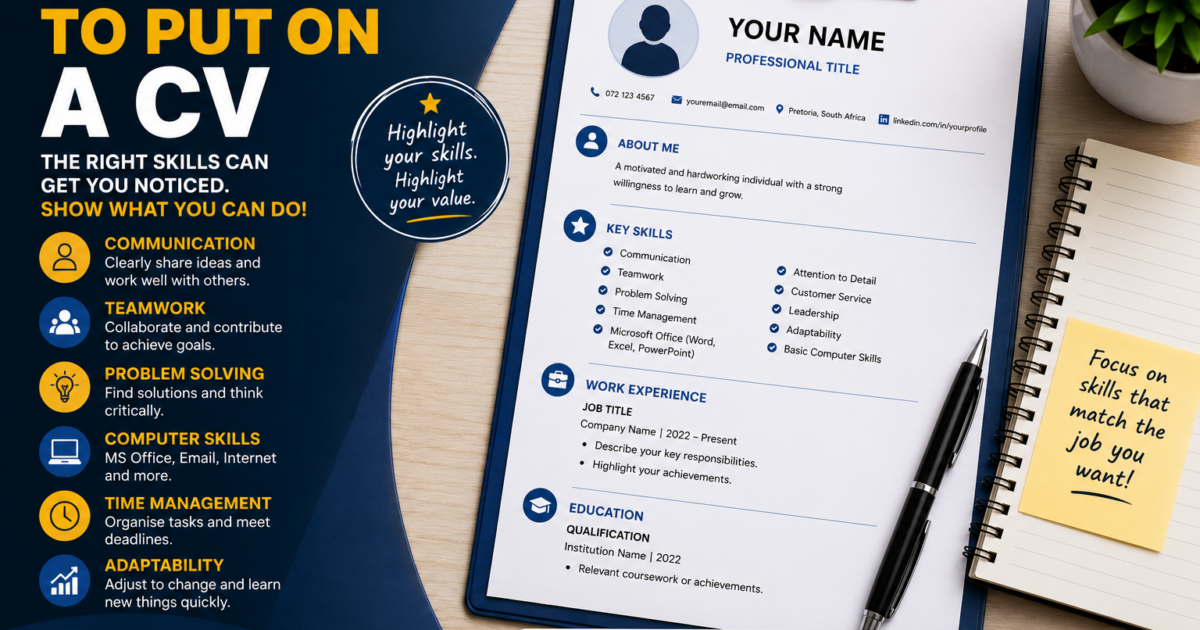
A skills section can strengthen your CV or waste space, depending on how you do it. A random list of buzzwords helps nobody. The right approach is to choose skills that match the job and show evidence that you actually have them. Here is how to list skills on your CV so they count.
Understand hard skills vs soft skills
- Hard skills are specific, teachable abilities: operating a till, driving (with a licence code), computer skills, cash handling, stock control, a specific language.
- Soft skills are personal qualities and ways of working: communication, teamwork, reliability, problem-solving, time management.
A strong CV shows a balance of both. Hard skills prove you can do the tasks; soft skills prove you are good to work with.
Choose skills that match the advert
Do not list every skill you can think of. Read the job advert and pick out the skills it actually asks for, then make sure those appear on your CV (as long as you truly have them). If the advert wants “good customer service and cash handling”, those two should be easy to spot on your CV. This overlaps with tailoring your CV to a specific job and screening software, where matching the advert’s language really matters.
Prove your skills, don’t just claim them
Anyone can type “excellent communication skills”. What sets you apart is evidence. There are two good ways to do this:
- Back the skill with a brief example elsewhere in your CV (in your experience section).
- Attach a quick proof point to the skill itself: “Cash handling — balanced the till daily for two years.”
A skill an employer can believe is worth far more than a longer list they cannot.
Useful skills for common South African entry-level roles
- Retail / customer service: customer service, cash handling, till operation, stock control, communication.
- Call centre: clear communication, listening, patience, computer literacy, working to targets.
- Warehouse / general worker: reliability, physical stamina, following safety procedures, teamwork.
- Admin: computer literacy (email, spreadsheets), organisation, attention to detail, filing.
Skip the meaningless buzzwords
Words like “synergy”, “go-getter” or “results-driven” say nothing on their own. If you cannot show what a word means through an example, either back it up or leave it out.
How to lay out the skills section
Keep it clean and scannable — a short list or two columns of clearly named skills. Do not use rating bars or “9/10” style graphics; they are subjective and can confuse screening software (see screening software). Simple text is best.
Common mistakes with the skills section
- Listing generic buzzwords with no proof.
- Claiming skills you do not have — this unravels in the interview or on the job.
- Including skills that have nothing to do with the role.
- Using fancy skill-rating graphics that software cannot read.
- Only listing soft skills, or only hard skills, instead of a balance.
A categorised list of useful skills
Practical (hard) skills
Cash handling, till operation, stock control, computer literacy (email, internet, Word, spreadsheets), data capturing, driving (with licence code), forklift operation, first aid, cooking or food prep, cleaning to hygiene standards, basic bookkeeping.
People (soft) skills
Communication, customer service, teamwork, reliability, punctuality, problem-solving, time management, patience, attention to detail, adaptability, staying calm under pressure.
Where to place skills on your CV
Put a clear skills section near the top, especially if you are light on experience, so the reader sees your strengths immediately. Then reinforce those skills lower down by showing them in action in your experience section — a skill that appears both as a heading and in a real example is much more convincing.
How to show language ability
In South Africa, the languages you speak are a genuine asset. List them and, if useful, note your level simply — for example “English (fluent), isiZulu (home language), Afrikaans (conversational)”. For customer-facing roles, being able to serve people in their own language is a real selling point.
Grow the skills employers keep asking for
If the same skill keeps appearing in adverts you cannot yet claim — often basic computer literacy — consider a short course to gain it. Adding one in-demand skill can open up a whole category of jobs, and it gives you something fresh to talk about in your personal profile and your interview.
Do this now
Take the advert for the job you want, list the skills it mentions, and tick the ones you genuinely have. Put those at the top of your skills section, and add a short proof point to each where you can.
Frequently asked questions
How many skills should I list?
Around six to ten relevant skills is plenty. A huge list dilutes the strong ones.
Should I list languages as skills?
Yes — language ability is valuable in South Africa, especially for customer-facing roles. List the languages you speak.
Are computer skills worth including?
Yes, even basic ones (email, internet, Word). For many roles, basic computer literacy is a real advantage.
What if I don’t have many hard skills yet?
Lean on soft skills and any you have gained informally, and consider a short course to build one or two. See writing a CV with no experience.
The bottom line
Choose skills that match the job, balance hard and soft skills, and prove them with brief evidence. A believable, targeted skills section beats a long list of buzzwords every time. Next, put it all together by learning to tailoring your CV to a specific job.