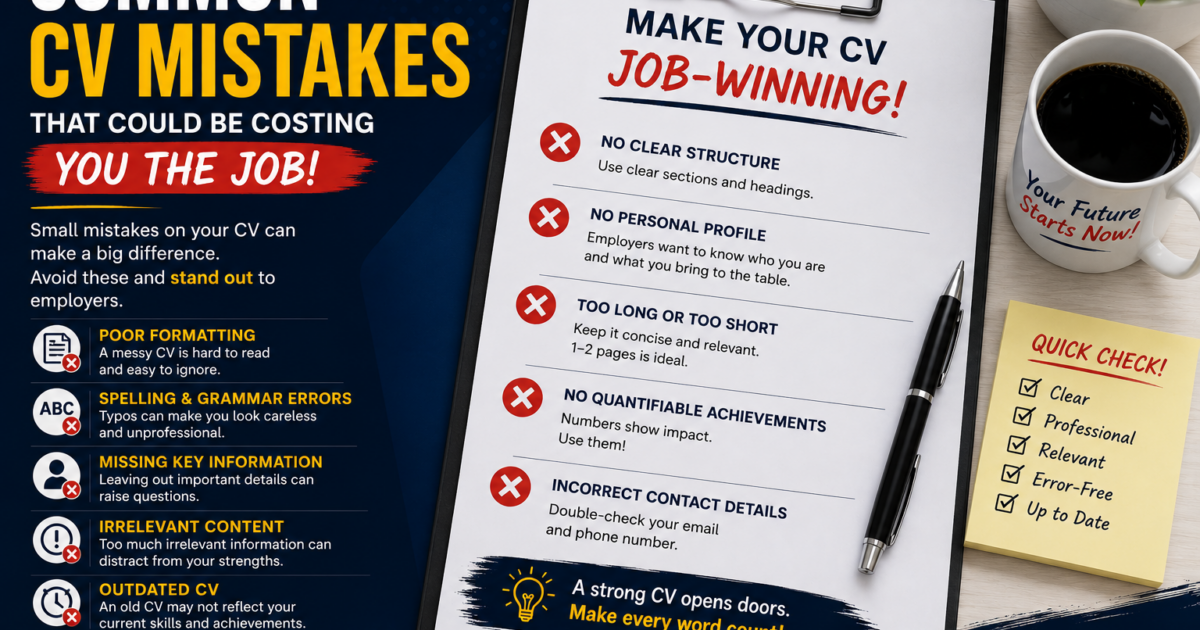
Sometimes it is not your experience holding you back — it is small, fixable mistakes on your CV. Recruiters go through many applications quickly, and an avoidable error can get yours set aside before your strengths are even seen. Here are the most common CV mistakes and how to fix each one. (This is about execution — for decisions about what information belongs on your CV at all, see what to include (and leave off) your CV.)
Spelling and grammar errors
Typos suggest carelessness, especially on a document meant to represent your best effort. Read your CV slowly, use spellcheck, and — most importantly — ask someone else to read it. A second pair of eyes catches what you miss.
Wrong or missing contact details
This is the most painful mistake of all: a CV that impresses, with a phone number that is one digit wrong. Double-check your number and email. Make sure the number is one you actually answer, and that your voicemail is set up.
An unprofessional email address
An address like “party_girl2000@” or “bigboss4life@” undermines you instantly. Create a simple, professional one using your name, such as firstname.surname@. It is free and takes minutes.
Using one generic CV for everything
Blasting the identical CV to every job is a mistake. Employers can tell when a CV was not written with their role in mind. Tailoring it to each advert takes a few minutes and lifts your chances significantly — see tailoring your CV for a specific job.
Poor formatting and cluttered layout
A wall of text, inconsistent fonts, or a cramped page makes recruiters work too hard. Use clear headings, consistent formatting, enough white space, and a readable font. Heavy design with columns, tables and graphics can also break the screening software many employers use (see making your CV easy to read for software).
Dishonesty and exaggeration
Fake qualifications, invented job titles or exaggerated dates tend to surface — in the interview, during reference checks, or once you are on the job. The damage to your reputation is not worth it. Keep your CV honest.
Vague, duty-only descriptions
“Responsible for stock” tells an employer nothing. Flat duty lists with no detail are a wasted opportunity — learn to describe your work experience effectively instead.
Outdated or irrelevant information
Old jobs from many years ago described in full, a school project from a decade back, or hobbies with no relevance all clutter your CV. Keep it current and relevant to the role.
Sending the CV in the wrong format
A photographed or scanned CV, or one exported as an image, can be unreadable to both recruiters and software. Send a clean Word document or a simple text-based PDF (more on this in making your CV easy to read for software).
Common mistakes at a glance
- Typos and grammar errors.
- Wrong phone number or email.
- An unprofessional email address.
- One generic CV sent everywhere.
- Cluttered, hard-to-read formatting.
- Dishonesty and exaggeration.
- Vague, duty-only experience descriptions.
- Outdated or irrelevant content.
File and format mistakes
- Sending a photographed or scanned CV that software and recruiters struggle to read.
- Using a heavily designed template with columns, tables and graphics.
- Naming the file something like “cv2.docx” instead of your name.
- Sending the CV as an image or an unusual file type.
A clean Word document or simple PDF, named with your name, avoids all of these — see making your CV ATS-friendly.
Inconsistency mistakes
- Mixing date formats (2022, then Jan 2023, then 03/2024).
- Switching between past and present tense within the same job.
- Different fonts, bullet styles or heading sizes across the page.
- Job titles or dates that do not line up with what you say in the interview.
Consistency looks professional and signals attention to detail — a quality many employers screen for.
A final proofreading checklist
- Read the whole CV out loud, slowly.
- Check every date and job title for accuracy.
- Confirm your phone number and email digit by digit.
- Make sure formatting is consistent from top to bottom.
- Ask a friend or family member to read it fresh.
Do this now
Proofread your CV out loud, then send it to a friend or family member to check. Confirm your phone number digit by digit, and make sure your email address looks professional.
Frequently asked questions
How do I catch mistakes I keep missing?
Read it aloud, and get someone else to check it. Reading slowly, or even printing it, helps you spot errors that blur on screen.
Is it really worth tailoring my CV every time?
Yes. It is one of the highest-impact things you can do to get more interviews. See tailoring your CV for a specific job.
Will one small typo really cost me the job?
Not always, but why take the risk when it is so easy to fix? For some roles that value attention to detail, it can matter a lot.
Should I use a template?
A clean, simple template is fine and can help with layout. Avoid heavily designed ones with graphics that clutter the page or confuse screening software.
The bottom line
Most CV mistakes are small and completely fixable: proofread carefully, check your contact details, keep it professional and honest, and tailor it to each job. Fix these and your real strengths finally get the attention they deserve. Next, master tailoring your CV for a specific job.