What Online Jobs Can I Do From Home in South Africa? 12 Legitimate Options
If you’re wondering what online jobs can I do from home in South Africa, some of the most realistic options include virtual assistant work, remote customer service, online tutoring, freelance writing, social media assistance, remote administration, transcription, bookkeeping, graphic design, video editing, appointment setting and other freelance digital services. You don’t necessarily need a university degree for every remote job, but you will usually need reliable internet, a computer or suitable device, basic digital skills and the ability to prove that you can do the work.

Table of Contents
Working from home sounds simple until you actually start looking.
Search for “online jobs” on social media and you’ll quickly come across posts promising things like:
“Earn R2,000 per day using your phone.”
“No experience. Start immediately.”
“Pay a registration fee to secure your position.”
That’s where you need to be careful.
Real online work exists in South Africa, but a remote job is still a job. Legitimate employers normally care about your skills, reliability and ability to perform the role. You should be suspicious of anyone promising unusually easy money simply for having a phone.
This guide explains the online jobs worth investigating, what you may need to get started, where to search and how to protect yourself from fake work-from-home opportunities.
What Is an Online Job?
An online job is work you can perform mainly through a computer, internet connection and digital communication tools.
You could be an employee working remotely for one company, a contractor working for an overseas business or a freelancer serving several clients.
Those arrangements aren’t necessarily the same.
For example, someone employed as a remote customer-support agent may have fixed shifts, a supervisor and regular responsibilities.
A freelance video editor, on the other hand, may work with several clients and charge per project.
Someone running an online business is different again.
That distinction matters because people often use phrases such as online job, remote job, freelancing and work from home as though they all mean exactly the same thing.
For this article, we’re focusing mainly on work you can perform remotely from South Africa.
1. Virtual Assistant

Virtual assistance is one of the first options I’d investigate if you’re comfortable with basic computer and administrative work.
A virtual assistant, often called a VA, helps a person or business with tasks that can be completed remotely.
Depending on the employer or client, those tasks could include:
- managing emails;
- organising calendars;
- booking meetings;
- updating spreadsheets;
- online research;
- preparing documents;
- entering information into systems;
- responding to customers;
- basic social-media administration;
- organising digital files.
You don’t have to know how to do every task on that list.
One employer may want an assistant mainly for email and scheduling. Another might need someone who can work with spreadsheets and customer enquiries.
What skills can help?
Being organised is important.
You should also be comfortable using email, browsers, video calls and common office software.
Microsoft Word and Excel skills can be useful, while familiarity with tools such as Google Docs, Google Sheets and online calendars can widen the jobs you’re able to apply for.
Is virtual assistant work suitable for beginners?
Some VA positions are beginner-friendly, while others ask for previous administrative or executive-assistant experience.
Don’t assume “virtual” means “no experience required.”
Read each vacancy properly.
If you have previous office, customer-service, retail or administrative experience, think about which parts of that experience transfer to remote work.
2. Remote Customer Service

Customer service doesn’t always happen across a shop counter.
Companies can employ people to assist customers remotely through:
- telephone calls;
- email;
- live chat;
- support tickets;
- social media;
- online help desks.
Your responsibilities depend on the company.
You could help customers understand a service, resolve account problems, answer product questions, process requests or escalate complicated cases.
What do employers look for?
Communication matters.
Being able to remain professional when a customer is frustrated can be just as important online as it is in a physical workplace.
Employers may also look for:
- clear written English;
- typing ability;
- computer literacy;
- problem-solving;
- patience;
- attention to detail;
- previous customer-service experience.
If you’ve worked with customers in retail, hospitality or another face-to-face environment, don’t automatically assume that experience is useless for remote customer support.
Customer-service skills can transfer.
3. Online Tutoring
If you’re strong in a particular subject, online tutoring is another possibility.
You might tutor:
- English;
- Mathematics;
- Physical Sciences;
- accounting;
- another school subject;
- a language;
- university-level subjects where appropriately qualified;
- practical skills you genuinely understand.
Some tutoring companies have specific education or certification requirements, while others have different entry standards.
Check before applying.
Teaching English online
You’ll frequently see “teach English online” suggested as an easy way to make money.
Treat the word easy carefully.
Different platforms can have different requirements around qualifications, English proficiency, teaching certifications, equipment and experience.
There may also be competition for available teaching hours.
Don’t pay for an expensive course simply because someone on social media guarantees that completing it will automatically get you an online teaching job.
Research the actual employers you intend to apply to first.
4. Freelance Writing
If you can write clearly and research responsibly, freelance writing can be done entirely from home.
The work can include:
- blog articles;
- website content;
- product descriptions;
- newsletters;
- guides;
- email copy;
- business content;
- editing and proofreading.
The challenge is that simply saying “I’m a writer” doesn’t show a client what you can do.
You need evidence.
That could be a small portfolio containing a few strong samples.
If you want to write about careers, for example, create a useful sample careers article.
If you want to write about technology, produce a well-researched technology sample.
Choose a niche you can write about accurately.
What about AI?
AI tools have changed online writing considerably, but they don’t remove the need for judgement, research, fact-checking and editing.
Submitting inaccurate, generic or poorly researched content because an AI tool produced it quickly isn’t a strong long-term strategy.
The useful skill is producing content that solves the client’s problem.
5. Social Media Assistant
Businesses, organisations and creators often need help maintaining social-media accounts.
A social media assistant might:
- schedule posts;
- write captions;
- prepare basic graphics;
- reply to comments;
- organise content calendars;
- upload videos;
- research content ideas;
- prepare performance reports;
- moderate messages.
This can be suitable for someone who already understands platforms such as Facebook, Instagram, TikTok or LinkedIn.
But there’s a difference between casually using social media and managing it professionally.
A business cares about accuracy, consistency, brand reputation and results.
How can a beginner build experience?
You can create sample work without pretending you’ve worked for a company that never hired you.
Choose an imaginary brand and create a sample seven-day content calendar.
Design several example posts.
Write the captions.
Explain what each post is intended to achieve.
Now you have something to show when a client asks:
“Can I see examples of your work?”
6. Remote Administrative Assistant
Remote admin work is similar to virtual assistance, although an administrative assistant may work more closely within one company’s normal operations.
Tasks can include:
- data capturing;
- updating records;
- preparing documents;
- organising meetings;
- managing emails;
- maintaining spreadsheets;
- filing digital documents;
- processing routine administrative requests.
If you already have office-administration experience, this can be a natural direction to explore.
Even without formal admin experience, skills such as Microsoft Word, Excel, professional email writing and attention to detail can help.
Just be careful with the phrase “data entry.”
Fake job advertisements frequently use easy-sounding administrative work to attract job seekers.
I’ll explain how to recognise warning signs later in this article.
7. Data Entry and Data Capturing
Yes, legitimate data-entry work exists.
But this category deserves caution because scammers know people search for phrases such as:
data entry jobs from home
typing jobs South Africa
online jobs no experience
work from home using laptop
Real data-entry work may involve updating databases, spreadsheets, CRM systems, customer information or other business records.
An employer may care about:
- typing accuracy;
- Excel or Google Sheets;
- attention to detail;
- confidentiality;
- following instructions;
- checking information for errors.
Be suspicious of advertisements claiming you’ll earn huge amounts for simply copying and pasting text for a few minutes per day.
The easier the advertisement makes the work sound while promising unusually high earnings, the more carefully you should investigate it.
8. Appointment Setter
Appointment setting can be done remotely.
Your job is generally to help a business arrange meetings between potential customers and its sales team.
Depending on the position, you might communicate through:
- telephone calls;
- email;
- social media;
- messaging;
- customer relationship management software.
Some positions may involve cold calling, while others involve contacting people who have already shown interest.
Make sure you understand which one you’re applying for.
Who might suit this work?
Someone who communicates confidently and doesn’t become discouraged easily may be more comfortable in appointment setting.
Targets can form part of the job.
Some positions also operate according to overseas business hours.
For a South African working for an American company, for example, that could mean working later than a normal South African office schedule.
Check working hours before accepting anything.
9. Bookkeeping and Remote Finance Administration
If you already have genuine bookkeeping or accounting skills, there are tasks that can be performed remotely.
These might include:
- capturing transactions;
- invoicing;
- reconciling records;
- organising financial documents;
- accounts administration;
- preparing information for accountants.
This isn’t something to pretend you understand just because you want an online job.
Businesses depend on accurate financial records.
If you don’t have bookkeeping knowledge, get appropriate training before selling yourself as a bookkeeper.
For people who already have accounting or finance experience, however, remote work can widen the geographical area in which they can look for opportunities.
10. Graphic Design
Graphic design can be offered remotely to clients in South Africa or elsewhere.
Possible projects include:
- social-media graphics;
- posters;
- presentations;
- website graphics;
- advertisements;
- thumbnails;
- simple marketing materials.
Your portfolio matters.
A client doesn’t necessarily want to read five paragraphs saying you’re creative.
They want to see your work.
Create a small portfolio showing different examples and make sure they are genuinely your work or clearly identified as portfolio concepts.
You can use design software you’re comfortable with, but learning the software isn’t the same as learning good design.
Layout, readability, visual hierarchy and understanding what the client is trying to communicate still matter.
11. Video Editing
Video editing has become another service that can be delivered remotely.
Clients may need editors for:
- TikTok;
- Instagram Reels;
- YouTube Shorts;
- YouTube videos;
- advertisements;
- podcasts;
- business videos.
You don’t necessarily need expensive equipment to begin learning basic editing, although more demanding projects may require a capable computer and suitable software.
Start by developing actual editing ability.
Create sample short-form videos.
Practise:
- cutting unnecessary sections;
- pacing;
- subtitles;
- audio levels;
- transitions;
- storytelling.
Don’t fill your portfolio with stolen videos and claim they’re client projects.
Create your own examples or use material you have permission to edit.
12. Transcription and Captioning
Transcription involves listening to audio and converting it into written text.
Captioning adds written captions to video or audio content.
It sounds simple, but accurate transcription can be demanding.
Audio might contain:
- multiple speakers;
- background noise;
- unfamiliar accents;
- technical terminology;
- poor recording quality.
You need good listening ability, spelling, grammar and attention to detail.
Also look carefully at how you’re paid.
A rate per audio minute is different from being paid for every minute you spend working.
A difficult 30-minute recording can take considerably longer than 30 minutes to transcribe accurately.
Which Online Jobs Are Best for Beginners in South Africa?
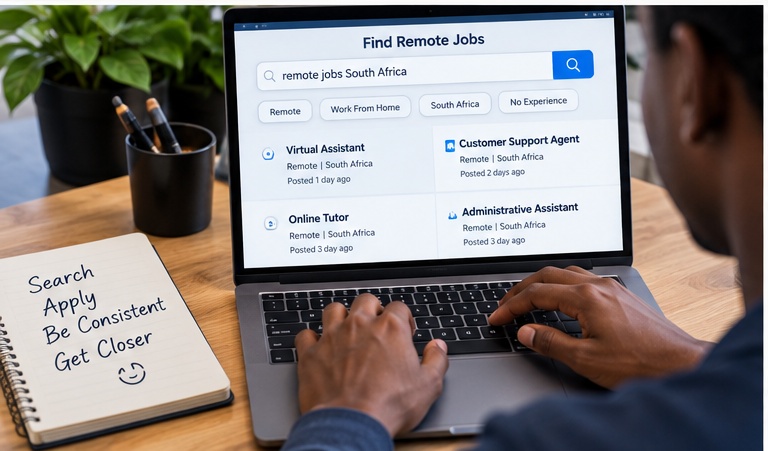
If you’re starting without specialised qualifications, I would first investigate roles where transferable skills matter.
Three particularly practical categories are:
Virtual Assistant
Useful if you’re organised and comfortable with basic computer tasks.
Customer Support
Worth considering if you already have customer-service experience and communicate well.
Remote Administration
Potentially suitable if you’re comfortable with Word, spreadsheets, email and record keeping.
That doesn’t mean you’re guaranteed to get one of these jobs.
It means the skills required can overlap with experience many people already have from traditional workplaces.
If you have a specialist skill such as graphic design, bookkeeping, writing or video editing, your best route could be completely different.
Can I Work for an Overseas Company From South Africa?
Potentially, yes.
Remote work can allow South Africans to apply for certain international opportunities, but “remote” doesn’t always mean “work from anywhere.”
An employer might restrict applicants to a particular country because of payroll, tax, legal, security or operational requirements.
Another employer may accept international contractors.
Always check the location requirements before spending time on an application.
Pay attention to time zones
An international remote job may require you to work according to the employer’s local hours.
That could mean working evenings or nights in South Africa.
Don’t accept a job because the salary sounds attractive and only afterwards realise the shift runs through the night.
Ask or check:
What time does my shift start in South African Standard Time?
What Do I Need to Work From Home?
The exact requirements depend on the job.
For many online positions, you may need:
- reliable internet;
- a laptop or desktop computer;
- a working email address;
- a quiet workspace;
- a headset for voice-based roles;
- basic computer literacy;
- video-meeting software;
- reliable electricity arrangements where the job requires continuous availability.
A smartphone can be useful, but I wouldn’t assume every legitimate online job can be done entirely from a phone.
Some employers require computer-based software that isn’t practical on mobile.
Check your internet before interviews
If the position involves video calls or customer support, test your connection beforehand.
Check your microphone.
Check your camera if required.
Learn how the video-meeting software works.
Doing this before the interview is much less stressful than troubleshooting while a recruiter waits.
How Do I Get an Online Job With No Experience?
Start by choosing one or two types of work, not twenty.
Suppose you choose virtual assistance.
Look at genuine VA vacancies and identify the skills employers repeatedly request.
Perhaps you notice:
- email management;
- spreadsheets;
- scheduling;
- online research;
- Google Workspace.
Now you know what to practise.
Next, build evidence.
Create a sample spreadsheet.
Prepare a professional email example.
Create a simple calendar-management example.
Write a short document explaining how you’d organise an inbox.
You’re not pretending those were paid client projects.
You’re demonstrating that you understand the work.
Then build your CV around relevant transferable experience.
If you previously worked in retail and handled customers, don’t write:
“Retail has nothing to do with remote work.”
Customer service is still customer service.
If you previously dealt with complaints, worked with stock systems, captured information or communicated with suppliers, some of those skills may transfer.
Your job is to explain that connection accurately.
You can also read our JobMarketSA guide on how to get a job with no experience in South Africa for a broader job-search strategy.
How to Create a CV for Online Jobs

Don’t send the same CV to every remote position.
If you’re applying for virtual assistant work, your CV should make your administrative and computer skills visible.
If you’re applying for customer support, highlight genuine customer-service experience.
If you’re applying for social-media work, show relevant social-media abilities.
A short profile might look something like:
Reliable and organised job seeker with experience in customer service and administration, comfortable using Microsoft Word, Excel, email and online communication tools. Seeking a remote customer-support or administrative position where strong communication and attention to detail can be applied.
Don’t copy that if it doesn’t describe you.
Your CV should reflect your actual experience.
Include relevant digital skills
Depending on the position and your real abilities, this might include:
Microsoft Word
Microsoft Excel
Google Docs
Google Sheets
Email management
Zoom or Microsoft Teams
Canva
CRM software
Don’t list software you’ve never used just because it appears in the vacancy.
Instead, learn the basics where practical.
Where Can I Find Legitimate Online Jobs in South Africa?
Use several sources rather than depending on a random WhatsApp group.
You can investigate:
- established job boards;
- LinkedIn;
- company career pages;
- legitimate recruitment agencies;
- specialist remote-job websites;
- freelance platforms;
- Employment Services of South Africa.
South Africa’s Department of Employment and Labour operates Employment Services of South Africa (ESSA). Registered individuals can search its database for available work or learning opportunities, capture their CV information and potentially be matched with employers. (Employment Services South Africa)
Employment Services of South Africa (ESSA)
ESSA won’t necessarily have the specific remote position you want at a particular moment, but it’s a legitimate additional job-search channel.
For private job boards, search terms such as:
remote jobs South Africa
work from home jobs South Africa
virtual assistant South Africa
remote customer service South Africa
remote administrator South Africa
online jobs South Africa
can help narrow your search.
Also use JobMarketSA’s guide to the fastest way to find a job to organise your wider search.
Be Careful of Online Job Scams
This section matters more for online work than many people realise.
Working from home makes it easier for legitimate companies to hire remotely.
Unfortunately, it also makes it easier for someone pretending to be a recruiter to contact you from behind a screen.
The South African Department of Employment and Labour has repeatedly warned work seekers about fake job offers. It specifically warns against employment schemes asking applicants to pay recruitment, placement or supposed background-check fees. (Department of Labour)
Red flag 1: You must pay to get the job
Someone tells you:
“Congratulations, you’ve been selected. Pay R300 for registration.”
Stop.
The Department says no person may charge a work seeker a fee for providing employment services to that work seeker, and its public employment services are provided free of charge. (Department of Labour)
Red flag 2: The salary makes no sense
Be careful if an advertisement promises unusually high earnings for extremely simple work.
For example:
Work 1 hour per day. No experience. Earn R40,000 monthly.
That doesn’t automatically prove fraud, but it should make you investigate carefully rather than rush to apply.
Red flag 3: You’re hired without a proper process
A message saying:
“You have the job. No interview needed. Send your banking details.”
should make you cautious.
Red flag 4: They want sensitive information immediately
Some legitimate employers eventually need personal information for employment administration.
That’s different from sending sensitive information to an unverified stranger on WhatsApp.
The Department has warned that fake employment schemes may request ID numbers, banking details and other confidential information. (Department of Labour)
Red flag 5: The company can’t be verified
Search for the employer independently.
Don’t rely only on the link the supposed recruiter sent you.
Check the company’s official website.
Look for the vacancy on its careers page where possible.
Check whether the recruiter’s email domain makes sense.
If someone claims to represent a government department, verify the opportunity through an official government website.
Online Job vs Freelancing: Which Is Better?
Neither is automatically better.
They solve different problems.
A remote job
A remote employee may have:
- scheduled working hours;
- regular responsibilities;
- one employer;
- supervision;
- a more predictable pay structure.
Freelancing
A freelancer may:
- find their own clients;
- work on several projects;
- set or negotiate rates;
- experience inconsistent income;
- handle their own business administration.
If what you want is stable employment, search primarily for remote jobs.
If you want to sell a skill independently, explore freelancing.
You can eventually do both in some circumstances, but check your employment contract and avoid conflicts with your employer.
Can I Make Money Online Using Only My Phone?
There are tasks that can be completed from a smartphone, but having access to a computer greatly expands your options.
Consider writing a long spreadsheet on your phone.
Technically possible?
Yes.
Pleasant for an eight-hour working day?
Probably not.
Remote admin, video editing, customer support, writing and virtual assistance can all involve software that works much better on a computer.
If you currently have only a phone, focus on opportunities genuinely designed for mobile use rather than pretending you have equipment an employer requires.
How Much Can I Earn Working Online in South Africa?
There isn’t one useful answer.
“Online work” is far too broad.
A beginner virtual assistant, experienced software developer, freelance designer and remote finance professional aren’t doing comparable jobs simply because they all work through the internet.
Your income can depend on:
- occupation;
- experience;
- employer;
- client;
- hours;
- employment status;
- skills;
- country of the employer;
- payment structure;
- exchange rates for foreign income;
- demand for your services.
Be especially careful with articles that promise every beginner a specific monthly income.
A more useful question is:
What does this particular job pay, and what skills do I need to qualify for it?
Evaluate vacancies individually.
A Simple 7-Day Plan to Start Looking for Online Work
If you’ve been endlessly searching “make money online” without getting anywhere, change the approach.
Day 1: Pick your target
Choose one primary role.
For example:
Virtual Assistant
Not:
Virtual assistant + writer + designer + trader + YouTuber + tutor + data entry + programmer.
Focus makes your job search easier.
Day 2: Study real vacancies
Read 15–20 genuine advertisements for your chosen position.
Don’t apply yet.
Write down the skills that appear repeatedly.
Now you have a practical skills list.
Day 3: Fix your CV
Make your relevant skills and experience obvious.
Remove unnecessary information.
Check spelling, phone number and email address.
Day 4: Create proof of ability
If the role benefits from a portfolio, create two or three samples.
Don’t invent clients.
Label them as sample projects if necessary.
Day 5: Set up job alerts
Create alerts using several versions of your job title.
For example:
Virtual Assistant
Remote Administrative Assistant
Remote Admin
Work From Home Administrator
Day 6: Apply properly
Start with positions you actually qualify for.
Tailor each application rather than sending the same generic CV everywhere.
Day 7: Review
Look at what happened.
Did you apply for suitable jobs?
Were your applications complete?
Are you missing a skill that keeps appearing?
Then improve the weakest part and continue.
Seven days probably won’t magically produce a job.
But after seven focused days, you should have something much more useful than another week spent scrolling through “easy money online” videos.
Frequently Asked Questions
What online jobs can I do from home in South Africa?
You can investigate virtual assistance, remote customer service, online tutoring, remote administration, freelance writing, social-media assistance, data entry, appointment setting, bookkeeping, graphic design, video editing and transcription. Your best option depends on your existing skills, equipment and experience.
Can I get an online job in South Africa with no experience?
Yes, some entry-level opportunities exist, but “no experience” doesn’t mean “no skills.” Employers can still expect computer literacy, communication ability, reliability and the ability to perform the job. Build relevant skills and create samples where appropriate.
What is the easiest online job for beginners?
There isn’t one universally easiest online job. Virtual assistance, customer support and remote administration can be practical starting points for people with transferable communication, customer-service or basic computer skills.
Can I work online for an overseas company while living in South Africa?
Some overseas employers and clients accept South African applicants, while others restrict remote work to specific countries. Check the vacancy’s location, employment arrangement and working hours before applying.
Do I need a degree to work from home?
Not for every job. Requirements depend on the occupation and employer. Some professional or specialist roles require qualifications, while other remote positions place greater emphasis on skills and experience.
Can I work online using my phone?
Some online tasks are mobile-friendly, but many serious remote positions require a laptop or desktop computer. Check the employer’s equipment requirements before applying.
Are online data-entry jobs legitimate?
Some are, but the category also attracts scams. Verify the employer independently and be especially cautious about unusually high pay, requests for upfront fees or requests for sensitive information before you’ve confirmed who you’re dealing with.
Should I pay a registration fee for an online job?
Be very cautious. South Africa’s Department of Employment and Labour says work seekers should not be charged fees for employment services and has warned repeatedly about fake vacancies requesting payments. (Department of Labour)
Where can I register as a work seeker in South Africa?
You can register on the Department of Employment and Labour’s Employment Services of South Africa platform. ESSA allows individuals to capture their CV details and search available work and learning opportunities. (Employment Services South Africa)
Final Thoughts
So, what online jobs can I do from home in South Africa?
There are more options than just “data entry.”
You could work in customer service, administration, virtual assistance, tutoring, writing, social media, bookkeeping, design, video editing, appointment setting or another role that can genuinely be performed remotely.
But don’t start by asking:
“Which online job makes the most money?”
Start with:
“Which useful skill can I already offer, or realistically learn well enough to get hired?”
Then build around that.
Choose one type of work.
Study real vacancies.
Improve the skills employers are actually requesting.
Prepare a CV for that role.
Create proof of your ability where appropriate.
Apply consistently.
And protect yourself.
If somebody promises an effortless work-from-home income but first needs your money, banking information or sensitive personal details, don’t let the excitement of finding a job stop you from verifying who you’re dealing with.
A legitimate online job isn’t magic money.
It’s simply work that happens to be done remotely.