How Long Should a CV Be in South Africa? 7 Rules to Follow
How long should a CV be in South Africa? For most job seekers, a one- to two-page CV is a strong target, with two pages usually providing enough space to present relevant skills, qualifications and work experience without overwhelming the employer. PNet’s South African job-seeker guidance recommends keeping a CV to no more than two A4 pages, while the Department of Employment and Labour warns that employers are unlikely to read CVs that are unnecessarily long. (PNet)
However, two pages is not a law.
A first-time job seeker may have enough relevant information for one page. Someone with substantial technical, professional or management experience may genuinely need more space. Some government vacancies may also specifically request a comprehensive CV with detailed previous experience, in which case the vacancy instructions should take priority over a general two-page guideline. (Department of Labour)
The goal is therefore not simply to make your CV shorter.
It is to make every page useful.
This guide explains how long your CV should be, what deserves space, what you can remove and how to shorten an overcrowded CV without deleting information that could help you get an interview.

Table of Contents
Quick Answer: How Many Pages Should a CV Be?
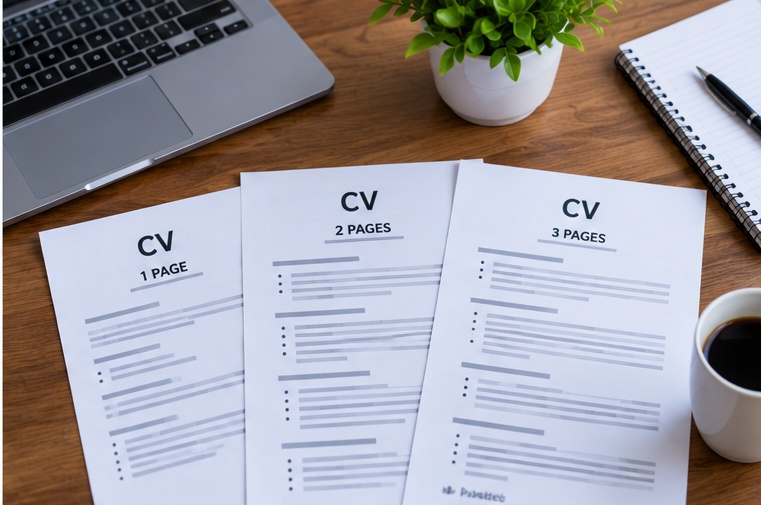
A practical starting point is:
| Your situation | Suggested CV length |
|---|---|
| Matriculant/first job | 1–2 pages |
| Entry-level candidate | 1–2 pages |
| Graduate | 1–2 pages |
| Candidate with a few years’ experience | About 2 pages |
| Experienced professional | 2 pages where practical |
| Extensive technical/specialist career | 2+ pages if genuinely necessary |
| Government application | Follow the vacancy instructions |
PNet’s guidance has consistently recommended concise CVs, with its more recent CV guide using two A4 pages as a rule of thumb. (PNet)
But don’t squeeze ten years of relevant experience into unreadable eight-point text just to obey a page number.
Relevance and readability matter more than hitting exactly two pages.
1. Aim for One to Two Pages for Most Applications
If you’re wondering how long should a CV be in South Africa, start with a simple rule:
Try to communicate the information that matters within one or two pages.
PNet advises that a CV should generally be no more than two A4 pages and emphasises including the information that makes you suitable for the advertised position rather than your entire life story. (PNet)
The Department of Employment and Labour makes a similar point without prescribing a universal page count: employers may not read CVs that are too long, while a well-organised CV makes it easier to see whether the applicant possesses the necessary skills. (Department of Labour)
That gives us the real principle:
Your CV needs to be concise enough to scan but detailed enough to prove that you’re suitable.
Don’t confuse concise with incomplete
A two-page CV isn’t automatically better than a three-page CV.
A one-page CV isn’t automatically better than two pages.
Consider these examples.
Candidate A
One page.
Contains:
- name;
- phone number;
- education;
- three vague skills.
The applicant has five years of relevant experience but omitted most of it to keep the CV on one page.
Candidate B
Two pages.
Contains:
- professional profile;
- relevant skills;
- five years of work history;
- achievements;
- education;
- certifications.
Candidate B’s longer CV is probably more useful.
The goal isn’t winning a competition for the shortest CV.
2. A One-Page CV Can Work for First-Time Job Seekers
If you’ve never worked before, don’t panic because your CV doesn’t fill two pages.
You don’t need to manufacture information.
A first-time job seeker’s one-page CV could contain:
Contact details
Personal profile
Key skills
Education
School/university projects
Volunteering
Certificates
References or “available on request” where appropriate
That’s enough if it accurately represents what you currently have.
Don’t add filler
Avoid making the CV longer by adding:
- an oversized photograph;
- huge headings;
- a long personal biography;
- irrelevant hobbies;
- every subject from primary school;
- generic personality statements;
- unnecessary personal details.
Instead, make the information you do have stronger.
For example, don’t simply write:
School Project
Explain it:
Business Studies Project — 2025
- Worked with four classmates to prepare a business plan.
- Researched potential customers and competitors.
- Used Microsoft Excel to organise projected costs.
- Helped present the final project.
Now the employer can see evidence of:
- teamwork;
- research;
- Excel;
- communication.
If you’re building your first CV, read our JobMarketSA guide on how to write a CV with no work experience in South Africa.
3. Two Pages Is a Good Target for Many Experienced Applicants
Once you have work experience, two pages can give you enough room to explain your background without turning the CV into an autobiography.
A two-page CV could look like this:
Page 1
- Name and contact information
- Professional profile
- Key skills
- Most recent employment
- Major achievements
Page 2
- Earlier relevant employment
- Education
- Qualifications
- Certifications
- Additional relevant information
- References where requested
The exact layout can change.
The principle is to put the most valuable information early.
Your most recent relevant experience deserves more space
Suppose you’ve worked for:
Company C — 2023–2026
Company B — 2019–2023
Company A — 2013–2014
Your current/recent work will often deserve more detail than a short job you held more than a decade ago, assuming the older position isn’t especially relevant to the vacancy.
Don’t give every job exactly the same amount of space just because that feels consistent.
Your CV is a marketing document for your employment history, not an archive.
4. More Than Two Pages Can Sometimes Be Justified
The two-page recommendation is useful, but it shouldn’t become an inflexible rule.
There are situations where additional length may be reasonable.
For example:
- senior professionals;
- technical specialists;
- academics;
- researchers;
- candidates with extensive relevant project histories;
- candidates required to provide a comprehensive CV;
- specialised applications requiring publications or professional credentials.
The key word is relevant.
Having worked for 20 years doesn’t automatically mean you need a six-page CV.
Ask:
Does this additional information help demonstrate my suitability for this particular job?
If yes, keep it.
If not, consider removing or condensing it.
5. Government CV Requirements Can Be Different
This is particularly important in South Africa.
Don’t automatically apply the “maximum two pages” rule to every government vacancy.
Read the advertisement.
Some current Department of Employment and Labour vacancies require applicants to submit a recently updated comprehensive CV with detailed previous experience alongside the required Z83 application information. (Department of Labour)
Other Department vacancies specify that online applications should combine the Z83 and CV into one PDF attachment, and warn that failure to follow the stated application process can result in disqualification. (Department of Labour)
That gives you an important rule:
The vacancy’s instructions override generic CV advice.
If an advert asks for:
- a comprehensive CV;
- specific supporting information;
- a particular file format;
- one combined PDF;
- a reference number;
- a Z83;
follow those instructions.
Don’t remove requested information because someone on social media told you every CV must be exactly two pages.
If you’re applying for public-sector vacancies, also read our guide on how to find government jobs in South Africa.
6. Remove Information That Doesn’t Earn Its Space

If your CV is four or five pages and you’re struggling to shorten it, don’t immediately shrink the font.
First, audit the content.
Ask this question about every section:
Does this help the employer decide whether I’m suitable for this job?
Let’s look at common areas you can review.
Long personal profiles
Your professional profile shouldn’t consume half a page.
Instead of:
I am a highly motivated, dedicated, passionate, enthusiastic, energetic, hardworking, honest and trustworthy individual who can work independently and as part of a team…
write something specific.
For example:
Retail supervisor with four years of FMCG experience in stock control, merchandising, customer service and team coordination. Experienced in maintaining stock availability, monitoring expiry dates and supporting daily store operations.
The second version tells the employer far more.
Remove generic adjectives
Words such as:
- hardworking;
- passionate;
- motivated;
- dedicated;
- trustworthy
aren’t necessarily bad.
But listing ten adjectives doesn’t prove anything.
Use evidence.
Excessive duties
You don’t need 20 bullet points for every job.
Prioritise responsibilities relevant to your target position.
Suppose you’re applying for a warehouse role.
Your previous retail job included:
- receiving stock;
- stock counts;
- inventory control;
- customer assistance;
- cleaning;
- merchandising;
- price checks;
- promotional displays.
For the warehouse application, stock and inventory responsibilities probably deserve more attention.
Condense repetitive duties
If three previous jobs involved similar customer-service duties, you don’t need to describe the same responsibility in identical detail three times.
Old or irrelevant information
Ask whether you still need:
- very old short courses;
- unrelated temporary work;
- outdated technical skills;
- every school achievement;
- primary-school information;
- irrelevant hobbies.
This doesn’t mean older experience is automatically worthless.
It means older information needs to justify the space it occupies.
7. Tailor the CV Instead of Making One Huge Master CV Your Application
One reason CVs become excessively long is that job seekers try to include everything they’ve ever done because the document must supposedly work for every vacancy.
A better approach is to maintain:
Master CV
This can contain your complete employment information.
It can be long.
You don’t necessarily send this version.
Targeted CV
Create the application version from your master CV.
Include the information most relevant to the vacancy.
For example, suppose you have experience in:
- retail;
- administration;
- customer service;
- stock control.
You’re applying for:
Stock Controller
Your targeted CV should emphasise:
- inventory;
- stock counts;
- receiving;
- shrinkage/waste;
- stock rotation;
- ordering;
- merchandising.
Then you apply for:
Administration Assistant
The CV might instead emphasise:
- Microsoft Office;
- record keeping;
- data capturing;
- communication;
- reporting;
- organisation.
Your employment history remains truthful.
You’re simply deciding which parts deserve the most space.
The Department of Employment and Labour specifically advises applicants not to use the exact same CV for every application and recommends bringing relevant work goals and skills forward for the particular job. (Department of Labour)
How Long Should a CV Be for a Matriculant in South Africa?
If you’ve recently completed Matric and have little or no employment history, one page may be completely reasonable.
Don’t stretch it artificially.
A useful structure is:
1. Contact details
Name, phone number, professional email and general location.
2. Personal profile
Three or four concise lines.
3. Skills
Relevant abilities you genuinely possess.
4. Education
Your National Senior Certificate and relevant subjects.
5. Projects/volunteering
Anything that provides evidence of useful skills.
6. Certificates
Only relevant ones.
7. References
Where appropriate.
If that naturally fills one strong page, stop.
You don’t get extra points because you found a way to make it two.
How Long Should a Graduate CV Be?
For most graduates, one to two pages is a sensible target.
You may need space for:
- degree/diploma;
- relevant modules;
- internship;
- projects;
- practical training;
- volunteer work;
- leadership;
- certifications;
- skills.
The mistake graduates sometimes make is describing every university module in detail.
You don’t need to reproduce your academic transcript inside your CV.
Choose what’s relevant.
Example
For a software-development graduate, useful project information could include:
Final-Year Web Application — 2026
- Developed a responsive web application using relevant technologies.
- Designed and connected a database.
- Implemented user authentication.
- Tested functionality across multiple devices.
That is more useful than listing 25 unrelated modules.
How Long Should a CV Be With No Experience?
Usually one or two pages, depending on what you have to include.
Your CV can still contain:
- education;
- skills;
- academic projects;
- personal projects;
- volunteering;
- leadership;
- certificates;
- informal experience.
The Department of Employment and Labour includes volunteer work among the areas that can form part of a CV, particularly where it demonstrates responsibility and experience. (Department of Labour)
Again, don’t invent content just to reach page two.
How Long Should a CV Be for Someone With 10 Years of Experience?

Two pages may still be achievable.
The secret is not giving all ten years equal weight.
Your recent and relevant roles should normally receive the most detail.
Older jobs can often be condensed.
For example:
Current role — 2023–Present
5–7 relevant bullet points.
Previous role — 2019–2023
4–6 relevant bullet points.
Earlier role — 2016–2019
2–4 relevant bullet points.
That’s only an example, not a fixed formula.
If an older role is extremely relevant to the vacancy, give it more space.
What Information Should Always Have Priority?
When space is limited, prioritise information that helps an employer evaluate you.
That normally includes:
Contact details
The employer must be able to reach you.
Professional profile
A short summary of what you offer.
Relevant skills
Particularly those matching the vacancy.
Work experience
With useful responsibilities and achievements.
Education and qualifications
Especially qualifications required for the position.
Relevant certifications
Where applicable.
The Department of Employment and Labour’s CV guidance similarly identifies areas including career goals, personal information, education, qualifications, skills, languages, career history and references as possible components of a CV. (Department of Labour)
Not every section needs the same amount of space.
What Can You Remove From a CV to Make It Shorter?
If you’re trying to reduce your CV from four pages to two, consider removing or condensing:
- long personal statements;
- repeated responsibilities;
- irrelevant hobbies;
- outdated short courses;
- excessive personal information;
- primary-school details;
- references with unnecessary descriptions;
- old irrelevant positions;
- paragraphs that could become bullet points.
But don’t blindly delete:
- relevant experience;
- required qualifications;
- licences required by the job;
- essential technical skills;
- major achievements.
Shortening should improve the CV, not weaken it.
Don’t Shrink the Font Just to Reach Two Pages
Suppose your CV is three pages.
You change the font from a readable size to tiny text.
Now it’s two pages.
Technically, you achieved the page target.
Practically, you’ve made the document worse.
Your CV should be comfortable to read on:
- laptop;
- desktop;
- printed A4 paper;
- potentially a phone or recruitment system.
The Department of Employment and Labour emphasises a neat, organised CV and warns against spelling and typing errors. (Department of Labour)
Readability matters.
Don’t Use Huge Fonts to Make a CV Look Longer Either
The opposite problem also happens.
Someone with little experience creates a two-page CV by using:
NAME — 30 pt
HEADINGS — 22 pt
massive spacing and half-page margins.
Don’t.
A shorter CV with genuine information is better than an artificially inflated document.
Your CV should look balanced and professional.
Should Your CV Have a Cover Page?
Usually, you don’t need a separate decorative cover page just to display:
CURRICULUM VITAE OF THABO MOKOENA
That page uses valuable space without giving the employer much information.
Start with your name and contact information, then move directly into relevant content.
A cover letter is different.
If the employer requests a job application or cover letter, provide one separately according to the instructions. The Department of Employment and Labour describes an application letter as a one-page document that introduces the applicant and highlights qualifications, experience and interest in the position. (Department of Labour)
Don’t confuse a cover letter with a decorative CV cover page.
Should You Include References on Your CV?
If the vacancy asks for references, include them.
If not, you can decide whether they add value or whether you’d rather preserve space.
If you include references, keep the format simple:
Nomsa Mokoena
Supervisor — Example Company
071 000 0000
nomsa@example.com
Always ask the person for permission.
Make sure the contact information is current.
PNet’s CV guidance also recommends checking that reference contact details are correct and warning references that they may receive a call. (PNet)
Is a Three-Page CV Too Long in South Africa?
Not automatically.
For many ordinary applications, you should first ask whether you can reduce it to two pages without losing important information.
But a three-page CV can be justified when:
- you have substantial relevant experience;
- the role is senior or specialised;
- you have necessary technical projects;
- the application requests a comprehensive CV.
Ask:
What would I remove to make this two pages?
If the answer is:
“Three irrelevant paragraphs about hobbies.”
Remove them.
If the answer is:
“Critical experience directly required by the vacancy.”
Keep it.
Is a Four- or Five-Page CV Too Long?
For many ordinary applications, that’s a sign that the CV needs editing.
Look for:
- repetition;
- excessive duties;
- long paragraphs;
- old irrelevant positions;
- unnecessary personal details;
- redundant qualifications.
Remember that the Department of Employment and Labour specifically warns that employers are unlikely to read CVs that are too long. (Department of Labour)
However, specialised or explicitly comprehensive applications can be exceptions.
Again:
Follow the vacancy.
How to Reduce a 5-Page CV to 2 Pages

Here’s a practical process.
Step 1: Copy the original
Never destroy your master CV.
Save a new version.
Step 2: Read the vacancy
Highlight:
- skills;
- experience;
- qualifications;
- responsibilities.
Step 3: Remove irrelevant content
Delete information that doesn’t support the application.
Step 4: Shorten your profile
Aim for a concise summary rather than a life story.
Step 5: Reduce older roles
Keep the strongest relevant information.
Step 6: Remove repeated duties
Don’t explain the same basic task repeatedly.
Step 7: Convert paragraphs into bullets
This improves scanning.
Step 8: Check formatting
Use consistent spacing and headings.
Step 9: Proofread
Never sacrifice accuracy for speed.
Step 10: Save a clearly named application copy
For example:
Thabo-Mokoena-CV-Admin-Assistant.pdf
Now you still have the long master CV for future applications.
Example of a Bad CV Length Decision
Imagine you’re applying for a cashier position.
Your CV contains six pages.
Page 1 includes:
- photograph;
- objective;
- biography.
Page 2 includes:
- personal details.
Page 3 includes:
- education.
Page 4 includes:
- employment.
Page 5 includes:
- hobbies.
Page 6 includes:
- references.
The employer shouldn’t have to reach page four before discovering you’ve worked as a cashier for three years.
A stronger version might put this on page one:
THABO MOKOENA
Contact details
PROFILE
Three years’ retail cashier experience…
KEY SKILLS
- POS operation
- Cash handling
- Customer service
- Refund procedures
- Merchandising
WORK EXPERIENCE
Cashier — Employer
2023–2026
Now the relevant information is immediately visible.
Example of a Good Two-Page CV Structure
PAGE 1
NAME AND CONTACT DETAILS
PROFESSIONAL PROFILE
Three or four lines.
KEY SKILLS
6–10 relevant skills.
WORK EXPERIENCE
Most recent role.
Key responsibilities and achievements.
Second-most-recent role if space permits.
PAGE 2
EARLIER RELEVANT EXPERIENCE
Condensed where appropriate.
EDUCATION
Relevant qualifications.
CERTIFICATIONS
Relevant certificates.
ADDITIONAL INFORMATION
Licence, languages or other genuinely relevant information.
REFERENCES
If requested or useful.
This isn’t the only correct CV structure.
It’s simply a practical starting point.
Does CV Length Affect ATS Systems?
Applicant Tracking Systems can process CV information differently depending on the platform and employer.
Don’t assume that adding more pages automatically improves your chances because you’ve included more keywords.
Instead:
- use clear headings;
- use relevant terminology naturally;
- avoid keyword stuffing;
- follow upload instructions;
- use the requested file format;
- keep formatting readable.
Your CV still needs to make sense when a human reads it.
Should Your CV Be PDF?
For many applications, PDF is useful because it can preserve formatting.
But the correct answer is:
Use the format requested by the employer.
This is especially important for government applications.
For example, current Department of Employment and Labour vacancy instructions can require a Z83 and CV to be combined into one PDF attachment, while rejecting JPEG or image submissions. (Department of Labour)
Don’t ignore application instructions because your usual CV workflow is different.
7 Rules for Getting Your CV Length Right
Here is the entire article condensed into seven rules.
Rule 1: Aim for one to two pages
This works for many ordinary job applications.
Rule 2: Don’t delete relevant evidence just to reach two pages
Content quality matters.
Rule 3: Don’t add filler to make a one-page CV longer
One strong page can be enough for an entry-level applicant.
Rule 4: Give recent and relevant experience more space
Not every previous job deserves equal detail.
Rule 5: Tailor the CV
Remove irrelevant information for each application.
Rule 6: Keep it readable
Don’t use microscopic fonts or overcrowded layouts.
Rule 7: Follow the vacancy instructions
If an employer requests a comprehensive CV or specific information, provide it.
Frequently Asked Questions
How long should a CV be in South Africa?
For many South African job seekers, one to two pages is a useful target. PNet recommends keeping a CV to no more than two A4 pages as a rule of thumb, while Department of Employment and Labour guidance emphasises avoiding overly long CVs and making relevant skills easy to identify. (PNet)
Is a two-page CV good in South Africa?
Yes. Two pages can provide enough room for relevant experience, skills and qualifications without becoming unnecessarily long.
Is a one-page CV too short?
Not necessarily. A student, graduate or first-time job seeker may have enough relevant information for one strong page. Don’t add filler simply to reach two pages.
Is a three-page CV acceptable?
It can be, particularly for experienced, senior or specialised applicants. Before using three pages, check whether any information is irrelevant or repetitive.
Can a CV be four pages long in South Africa?
It can, but many ordinary applications shouldn’t require four pages. Review whether the extra content genuinely supports your suitability. A comprehensive or specialised application may legitimately require additional length.
How long should a CV be with no experience?
One or two pages is generally enough. Focus on education, skills, projects, volunteering, certifications and other genuine evidence instead of inventing work history.
How long should a graduate CV be?
Usually one or two focused pages. Prioritise your qualification, relevant projects, practical training, internships, skills and achievements.
How long should a government CV be in South Africa?
Follow the specific vacancy instructions. Some government advertisements request a recently updated comprehensive CV with detailed previous experience, so a generic two-page rule should not override the employer’s stated requirements. (Department of Labour)
Should I shorten my CV by reducing the font size?
Not to the point where readability suffers. Remove irrelevant or repetitive content first.
Should every job have the same number of bullet points?
No. Give more detail to positions that are recent and relevant to the job you’re targeting.
Conclusion
So, how long should a CV be in South Africa?
For most ordinary applications, one to two pages is a sensible target, and South African recruitment guidance commonly recommends keeping a CV concise. (PNet)
But don’t obsess over the number.
A strong one-page CV is better than two pages full of filler.
A relevant three-page specialist CV can be better than a two-page version that deletes important evidence.
Focus on four things:
Relevance. Clarity. Readability. Evidence.
Remove information that doesn’t help your application.
Give your strongest and most recent experience priority.
Tailor the CV to the vacancy.
And whenever an employer provides specific CV instructions—particularly for government applications—follow those instructions instead of a generic page-length rule.
If you’re still building your first CV, your next step should be our JobMarketSA guide on how to write a CV with no work experience in South Africa. If you already have a CV but aren’t sure what belongs in it, read our complete guide on how to write a CV for a job in South Africa.