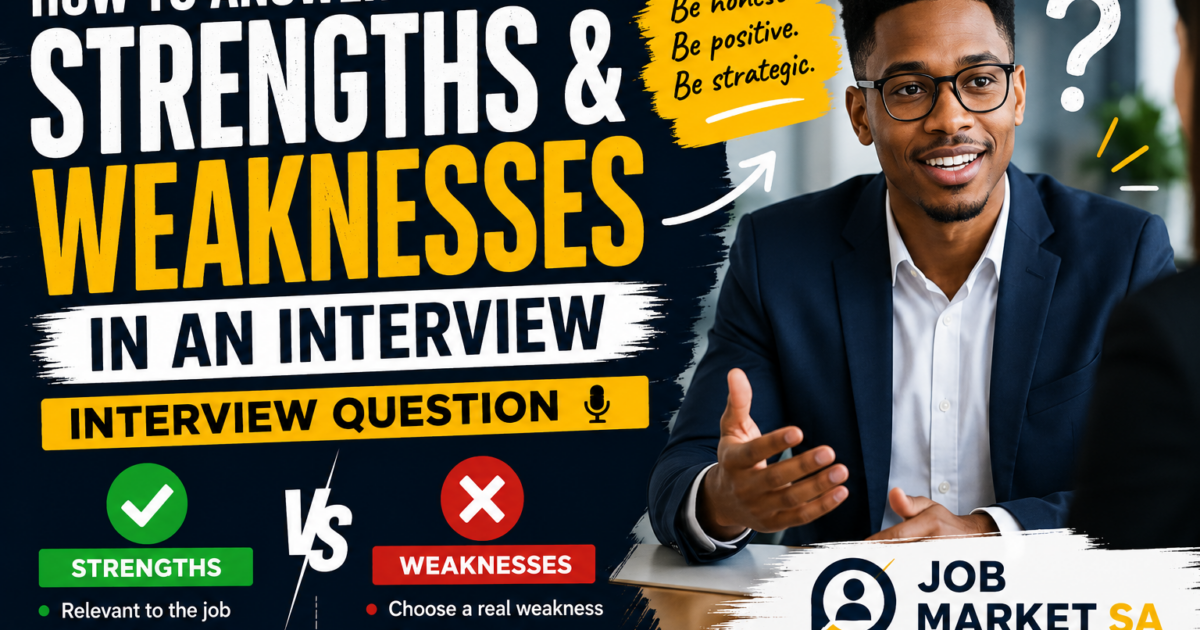
This question trips people up in two ways: they pick strengths that have nothing to do with the job, or they give a fake weakness that everyone has heard a hundred times. Here is how to answer both halves honestly and in a way that actually helps you.
Choosing the right strengths
Do not just say the first positive word that comes to mind. Pick two or three strengths that matter for this role, and back each one with a quick example. The example is what makes it believable.
- For a customer-facing job: patience, communication, staying calm under pressure.
- For a warehouse or general worker job: reliability, physical stamina, following instructions carefully.
- For an admin job: organisation, attention to detail, working accurately.
Example: “One of my strengths is reliability. In my last job I didn’t miss a single shift in over a year, even when transport was difficult.”
Giving a real weakness (without sinking yourself)
The mistake is trying to be clever with a fake weakness like “I’m a perfectionist” or “I work too hard”. Interviewers see straight through it. Instead, name a genuine, non-fatal weakness and — this is the important part — show what you are doing about it.
Two rules: do not pick a weakness that is central to the job (do not say “I struggle with customers” for a customer service role), and always pair it with a plan.
Examples:
- “I used to get nervous speaking in front of groups, so I’ve been volunteering to give small updates in team meetings to build my confidence.”
- “I can be shy about asking for help. I’ve learned that asking early actually saves time, so now I check in sooner rather than struggling alone.”
- “My computer skills were basic, so I took a short course this year to get more comfortable with email and spreadsheets.”
Why honesty works better here
Employers know nobody is perfect. What they are really testing is self-awareness and whether you take responsibility for improving. A candidate who can name a real weakness and show growth looks more mature than one who pretends to have none.
Common mistakes with this question
- Saying “I don’t have any weaknesses” — this reads as either dishonest or lacking self-awareness.
- Using the tired fake weaknesses (“perfectionist”, “I care too much”).
- Choosing a weakness that is core to the job.
- Naming a weakness but giving no plan to improve it.
- Listing strengths with no example to back them up.
A bank of strengths you can use
Pick the ones that are both true for you and relevant to the job, and attach a quick example to each:
- Reliability — “I’m known for showing up on time and doing what I say I’ll do.”
- Communication — “I explain things clearly and listen properly to customers.”
- Teamwork — “I work well with others and pitch in when the team is under pressure.”
- Attention to detail — “I double-check my work so mistakes don’t slip through.”
- Staying calm under pressure — “Busy periods don’t rattle me; I keep working steadily.”
- Fast learner — “I pick up new systems and tasks quickly.”
A bank of safe weaknesses (with fixes)
- “I used to struggle to say no and took on too much — I’ve learned to manage my workload and communicate better.”
- “Public speaking made me nervous, so I’ve been putting myself forward for small presentations to improve.”
- “My spreadsheet skills were basic, so I did a short course to build them up.”
- “I can focus so hard on getting details right that I lose track of time — I now set myself checkpoints.”
If they ask only for your greatest strength
Sometimes the question comes on its own. Choose the single strength most relevant to the job, state it plainly, and back it with your best example. Do not list five — one strong, well-evidenced answer lands harder than a scattered list.
Do this now
Write down three job-relevant strengths, each with a one-line example. Then write one honest weakness paired with a specific action you are taking. Practise saying them so they sound natural.
Frequently asked questions
How many strengths should I give?
Two or three is plenty. More than that and none of them land.
What is a safe weakness to mention?
Something real but not central to the job, such as public speaking nerves, being too self-reliant, or a skill you are actively improving through a course.
What if my weakness genuinely relates to the job?
Pick a different, honest weakness that does not undermine your core suitability, and be ready to show how you compensate.
Should my examples come from work only?
No. School, volunteering, sport or family responsibilities all make good examples, especially if you have limited work experience.
The bottom line
Choose strengths that fit the job and prove them with examples. Give a real weakness and show you are working on it. Honesty and self-awareness beat clever tricks every time. Keep preparing with common interview questions and how to answer them.