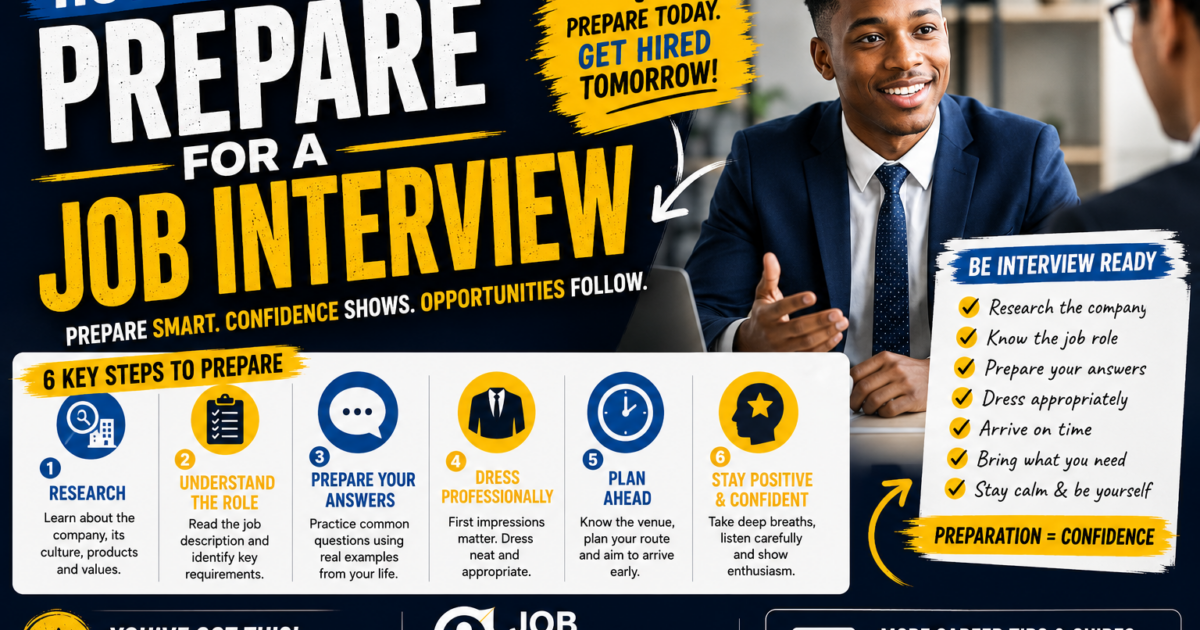
You have the interview. The difference between candidates who freeze and candidates who answer calmly is almost never talent — it is preparation. This guide walks you through exactly what to do from the moment you are invited until you walk into the room.
Start the moment you get the invitation
When the call, email or WhatsApp comes through, reply promptly and politely, and confirm four things:
- The date and time.
- The format — in person, telephone, or a video call.
- The exact address or the platform and link for a video call.
- Who you will be meeting and their role, if they mention it.
Save the recruiter’s number and email straight away so you are not scratching for it later.
Research the company and the role
Read the job advert again, slowly, and highlight the duties and the skills they ask for. These are the exact things you will be asked about. Then spend twenty minutes learning about the company: what they sell or do, where they operate, and who their customers are. A quick look at their website and Facebook page is usually enough.
If you are interviewing for a retail, call-centre, warehouse or general worker role, picture the day-to-day. What does a shift actually involve? Showing that you understand the work is a huge advantage over someone who just wants “a job”.
Get your documents ready
Put a folder together the night before so you are not panicking in the morning:
- Two printed copies of your CV.
- Your ID (for verification — you do not need to hand out copies unless asked).
- Certified copies of your matric certificate or results and any other qualifications.
- Your driver’s licence if the job needs one.
- A short reference list you can hand over if requested.
- A pen and a small notepad.
Plan the practical side — this is where people lose interviews
Strong answers mean nothing if you arrive an hour late and flustered. Sort out the logistics in advance:
- Travel: map your route, check taxi or bus timing, and plan to arrive ten to fifteen minutes early. If you can, do a test run past the building a day or two before.
- Money: set aside transport money the day before so it is not a stress on the morning.
- Load-shedding: for a video interview, check the schedule for that day, charge your phone and laptop fully, and make sure you have enough data. Have a backup plan — a friend’s place with power, or your phone as a hotspot.
- Phone interview: pick a quiet spot with good signal and airtime or data loaded.
Practise your answers out loud
Do not memorise scripts word for word — you will sound like a robot. Instead, practise the shape of your answers so they come out naturally. Focus on the questions that come up in almost every interview, which we cover in common interview questions and how to answer them. Give special attention to how to answer “tell me about yourself”, because it is usually the very first question and it sets the tone.
Say your answers out loud, ideally to a friend or family member, or into your phone’s voice recorder so you can hear how you sound.
Prepare a few questions to ask them
Interviews go both ways. Having two or three thoughtful questions ready shows genuine interest — we cover good options in smart questions to ask the interviewer.
The night before and the morning of
Lay out your outfit (see what to wear to a job interview), get a proper night’s sleep, and eat something before you go. Aim to arrive early enough to sit for a few minutes, breathe, and settle before you are called in.
Common mistakes when preparing
- Not confirming the exact address, then getting lost on the day.
- Going to a phone or video interview with no airtime, data or charge.
- Arriving with no copy of your CV or supporting documents.
- Over-preparing answers until they sound memorised and stiff.
- Researching nothing about the company and having no idea what they do.
Prepare for the specific interview format
Not all interviews look the same, and each format has its own preparation:
- One-on-one: the most common. Focus on rapport, eye contact and clear answers.
- Panel interview: two or more people. Greet each person, and when answering, look mainly at whoever asked the question while occasionally including the others.
- Telephone interview: often a first screening. Keep your CV and notes in front of you, find a quiet spot with good signal, and smile while you talk — it genuinely comes through in your voice.
- Video interview: test your link, camera and microphone beforehand, sit in front of a plain, well-lit background, and look at the camera rather than the screen when speaking.
- Group or assessment day: you may do tasks with other candidates. Contribute without dominating, and be respectful of others — they are watching how you work with people.
A simple preparation timeline
Spreading your prep over a few days beats cramming the night before:
- A few days before: research the company, re-read the advert, and prepare your answers and questions.
- The day before: pack your documents, plan your route and transport money, and iron your outfit.
- The morning of: eat something, leave early, and arrive ten to fifteen minutes ahead so you can settle and breathe.
Do this now
Make a simple one-page prep sheet: the company name and what they do, the top three duties from the advert, your travel plan and arrival time, the documents to pack, and three questions to ask. Fill it in the day before every interview.
Frequently asked questions
How early should I arrive?
Aim to be at the building ten to fifteen minutes early. Much earlier than that and you may be left waiting awkwardly; late, even by a few minutes, creates a poor first impression.
What should I bring to the interview?
Printed copies of your CV, your ID, certified copies of your qualifications, a reference list, and a pen and notepad. Bring the original job advert too, so you can refer to what they asked for.
What if my transport is unreliable and I might be late?
Plan for the worst-case taxi or bus timing and leave earlier than feels necessary. If something genuinely goes wrong on the day, phone the recruiter as soon as you know, apologise briefly, and ask whether it is still convenient to come.
Do I need to prepare differently for a phone interview?
Yes — find a quiet place with good signal, keep your CV and notes in front of you, and speak clearly since they cannot see your body language. Everything else about researching the role stays the same.
The bottom line
Preparation is mostly practical: know the company, pack your documents, sort out travel and power, and practise your answers out loud. Do those things and you will walk in calm, which is exactly the state you need to be in to perform.